
What is the Beer-Lambert Law?
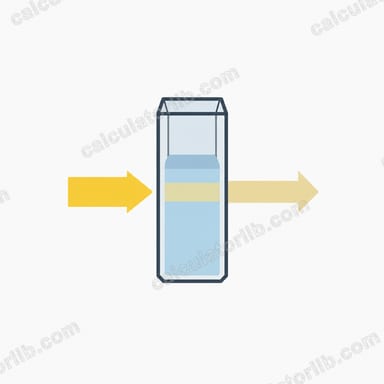
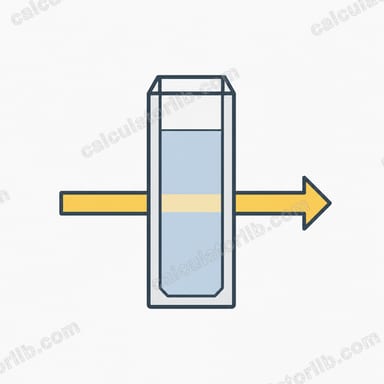
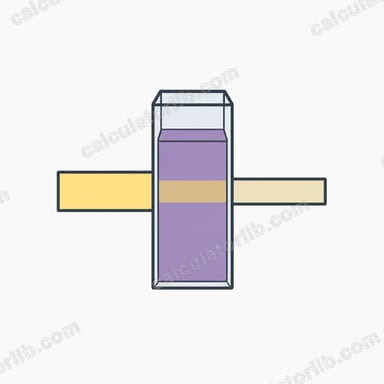
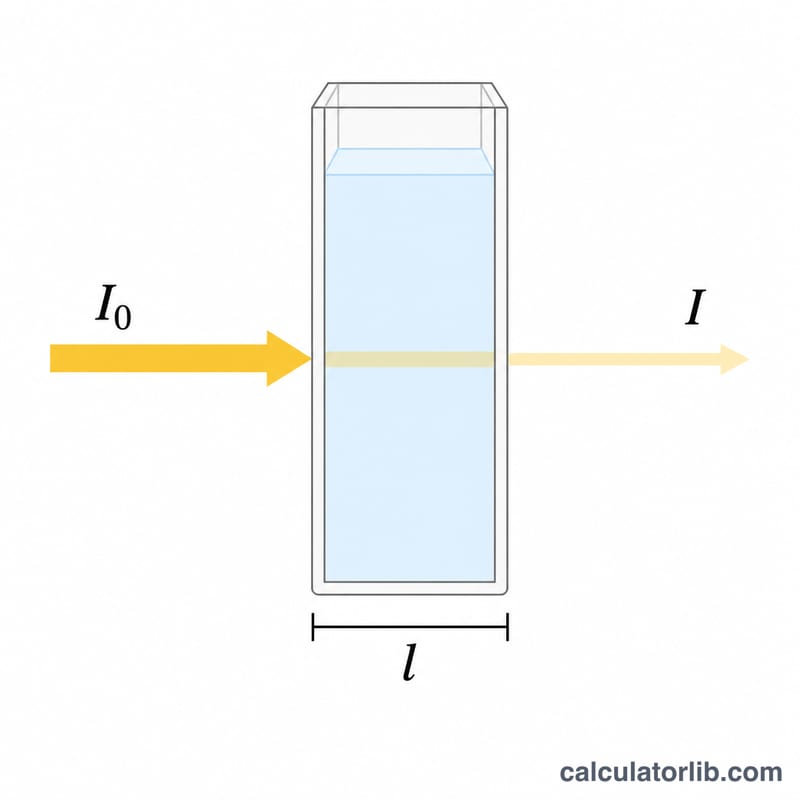
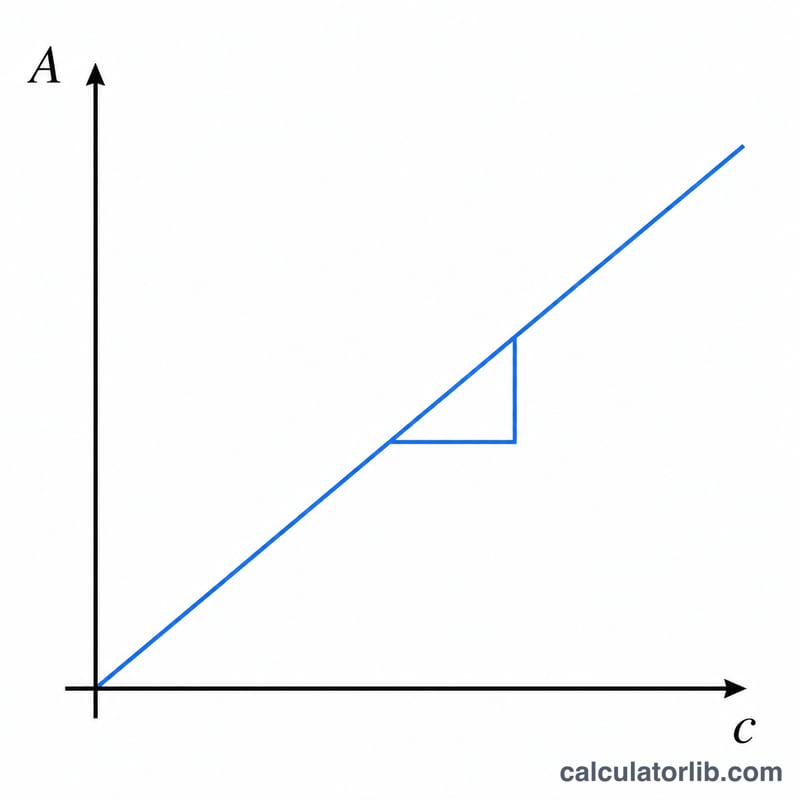
The Beer-Lambert law relates the absorbance of light by a solution to the concentration of the absorbing species. It states that absorbance (A) is directly proportional to the molar absorptivity (ε), the concentration of the solution (c), and the path length of light through the sample (l). This calculator computes A from these three inputs and also reports the corresponding percent transmittance.
How to use this calculator
Enter the molar absorptivity ε in units of M⁻¹·cm⁻¹ (a property of the substance at a given wavelength), the concentration c in mol/L, and the path length l in cm (a standard cuvette is 1 cm). The calculator multiplies the three values to give the dimensionless absorbance and converts it to percent transmittance using \(\%T = 100 \times 10^{-A}\).
The formula explained
$$A = \varepsilon \cdot c \cdot l$$ Absorbance is unitless because the units of \(\varepsilon\) (L·mol⁻¹·cm⁻¹), \(c\) (mol·L⁻¹) and \(l\) (cm) cancel out. Higher concentration, longer path length, or a more strongly absorbing compound all increase absorbance. Absorbance and transmittance are linked logarithmically: \(A = -\log_{10}(T)\).
Worked example
Suppose a compound has \(\varepsilon = 10{,}000\ \text{M}^{-1}\cdot\text{cm}^{-1}\), a concentration of 0.0001 mol/L, in a 1 cm cuvette. Then $$A = 10{,}000 \times 0.0001 \times 1 = 1.0$$ The percent transmittance is \(100 \times 10^{-1} = 10\%\), meaning 10% of the light passes through the sample.
FAQ
Is absorbance always linear with concentration? The law holds at low to moderate concentrations. At high concentrations deviations occur due to solute interactions and changes in refractive index.
What is a typical path length? Most spectrophotometer cuvettes have a 1 cm path length, which is why it is often omitted from quick calculations.
What does absorbance of 2 mean? An absorbance of 2 means only 1% of light is transmitted (\(10^{-2} = 0.01\)), indicating a very strongly absorbing or concentrated sample.