
What This Calculator Does
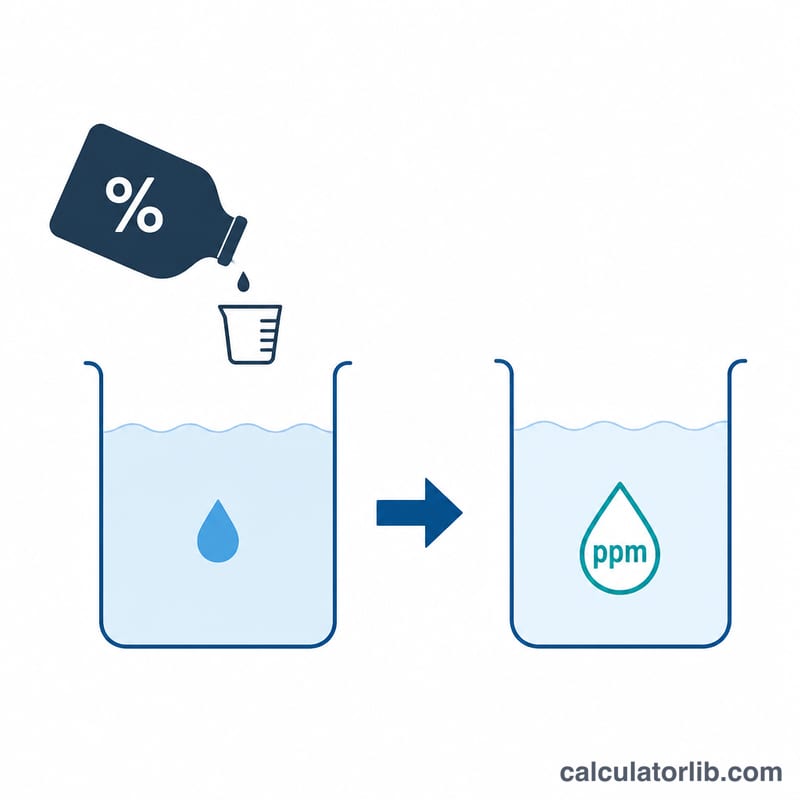
This tool tells you exactly how much concentrated chlorine stock solution (such as liquid bleach or a sodium hypochlorite concentrate) you need to dilute in order to reach a target concentration in parts per million (ppm). It is widely used for sanitizing water, surfaces, food-contact equipment, pools, and tanks where a precise free-chlorine level is required.
How to Use It
Enter three values: the target concentration you want (in ppm, equivalent to mg/L), the final volume of solution you want to make (in liters), and the stock strength as a percentage of available chlorine. The calculator returns the volume of stock to measure out (in milliliters and liters) plus how much water to add to reach your final volume.
The Formula Explained
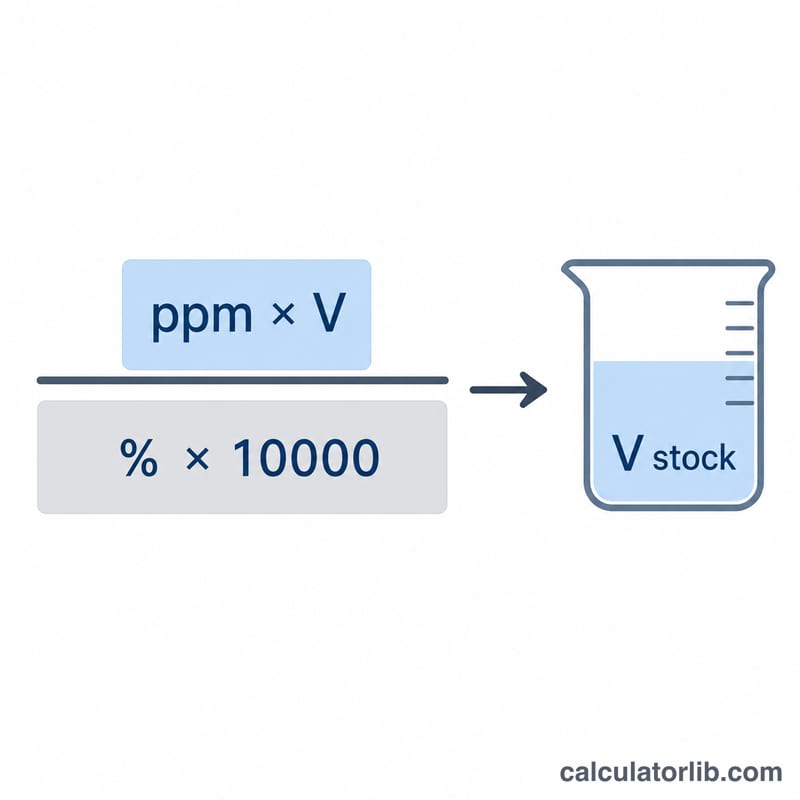
The core equation is:
$$V_{stock}\;(\text{mL}) = \frac{\text{Target (ppm)} \times \text{Final Volume (L)}}{\text{Stock Strength (\%)} \times 10000} \times 1000$$The factor of 10000 converts a percentage into ppm: a 1% solution contains 10,000 ppm of active ingredient. Multiplying stock_% by 10000 gives the stock concentration in ppm, so dividing the required mass-equivalent by it yields the fraction of the final volume that must be stock.
Worked Example
Suppose you want 50 ppm of available chlorine in a 10 L bucket using a 12.5% sodium hypochlorite concentrate. Then $$V_{stock} = \frac{50 \times 10}{12.5 \times 10000} = \frac{500}{125000} = 0.004\ \text{L} = 4\ \text{mL}.$$ Add 4 mL of stock and top up to 10 L with water.
FAQ
Is ppm the same as mg/L? For dilute water-based solutions, yes — 1 ppm is essentially 1 mg per liter.
What stock % should I use? Use the available-chlorine percentage on the product label. Household bleach is often 5–8.25%; commercial concentrates can be 10–12.5%.
Does chlorine strength change over time? Yes — hypochlorite solutions degrade with heat, light, and age, so an old bottle may be weaker than labeled. Verify with a test kit for critical applications.