
What Is a Dilution Ratio Calculator?
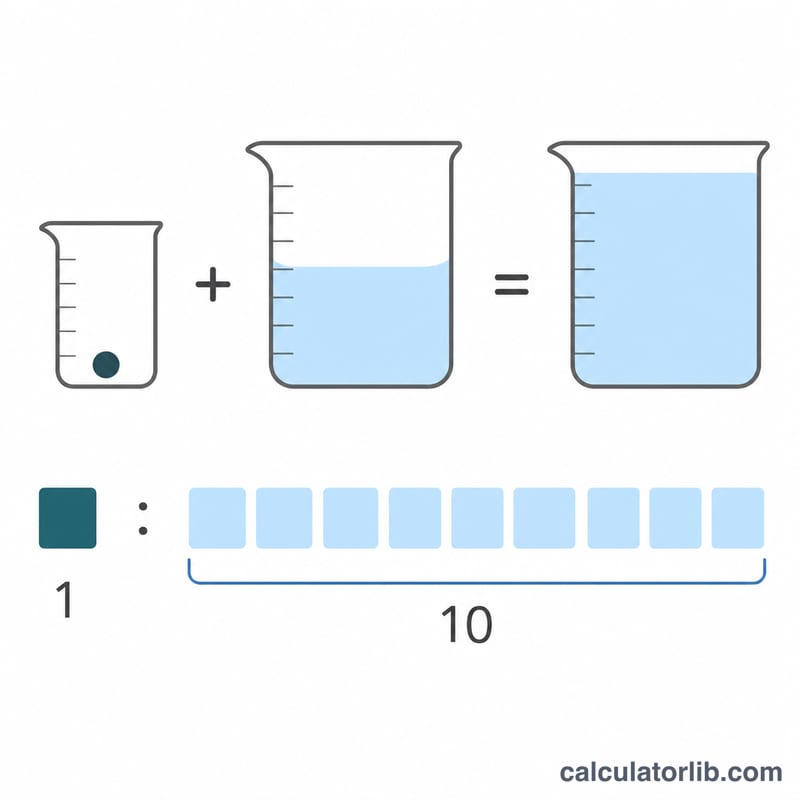
A dilution ratio calculator tells you exactly how much water to add to a measured amount of concentrate to reach a target strength. Ratios are written as 1 : N, meaning one part concentrate to N parts water. This tool works with any consistent unit — milliliters, liters, ounces, gallons — because the math is purely proportional. It's handy for cleaning chemicals, plant fertilizers, pesticides, coffee, paint, coolant, and lab solutions.
How to Use It
Enter the amount of concentrate you have and the dilution ratio (the "N" in 1:N). The calculator returns the volume of water to add and the total volume of the finished mixture. If a product label says "dilute 1:10," type 10 as the ratio.
The Formula Explained
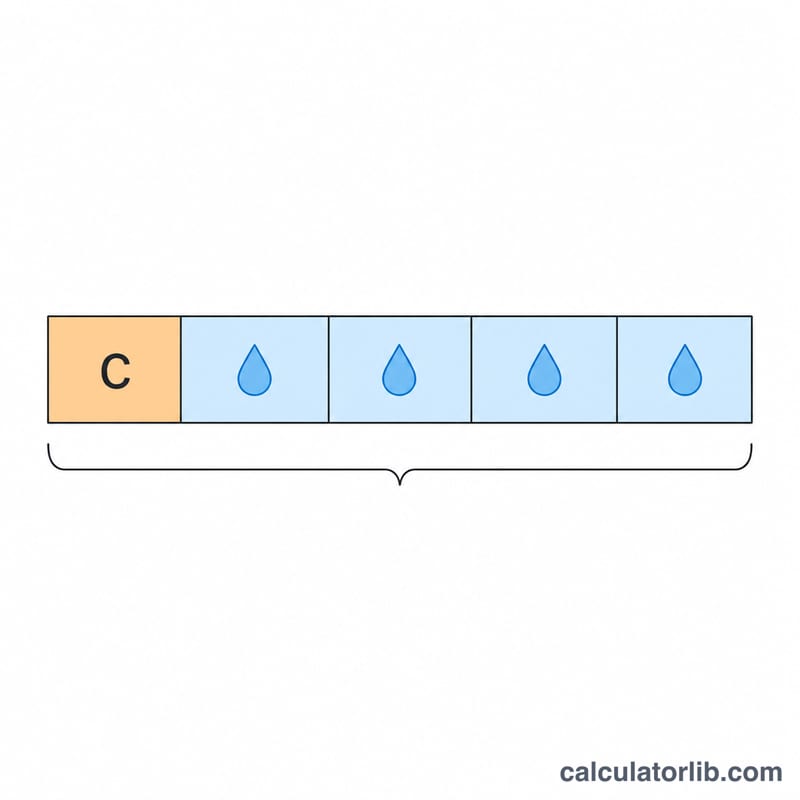
For a ratio of 1:N, each unit of concentrate is paired with N units of water:
$$\text{Water} = \text{Concentrate} \times \text{Ratio}$$
The finished volume includes both the concentrate and the water you added:
$$\text{Total} = \text{Concentrate} \times \left(1 + \text{Ratio}\right)$$
Because everything scales linearly, doubling the concentrate doubles both the water and the total.
Worked Example
You have 100 mL of concentrate and need a 1:10 dilution. Water to add = \(100 \times 10 = 1{,}000\) mL. Total mixed volume = \(100 \times (1 + 10) = 1{,}100\) mL. So you pour 100 mL of concentrate and 1,000 mL of water into a container to make 1,100 mL of solution.
FAQ
Does 1:10 mean 10% concentrate? No. 1:10 means 1 part concentrate to 10 parts water, so the concentrate is \(1/11 \approx 9.1\%\) of the total.
What units should I use? Any unit, as long as you use the same one for input and output. The ratio is unitless.
How do I hit a target total volume instead? Divide your target total by (1 + Ratio) to find the concentrate, then the rest is water. For a 1,100 mL target at 1:10, concentrate = \(1100 \div 11 = 100\) mL.