What Is the Electricity Cost Calculator?
This calculator estimates how much it costs to run any electrical appliance. By entering the device's power rating in watts, how many hours you use it each day, the number of days, and your electricity price per kilowatt-hour (kWh), you instantly see the total cost, the cost per day, and the energy consumed. It works with any currency and any electricity tariff. On the U.S. page the price starts at the latest U.S. average residential price published by the EIA (about 18 cents per kWh in 2026); replace it with the rate on your own bill.
How to Use It
Find the appliance's wattage on its label or in the manual (for example, a 100 W bulb or a 1500 W heater). Enter the typical hours of use per day, the number of days you want to estimate (30 for a month, 365 for a year), and your price per kWh from your electricity bill. The result updates with the full cost breakdown.
The Formula Explained
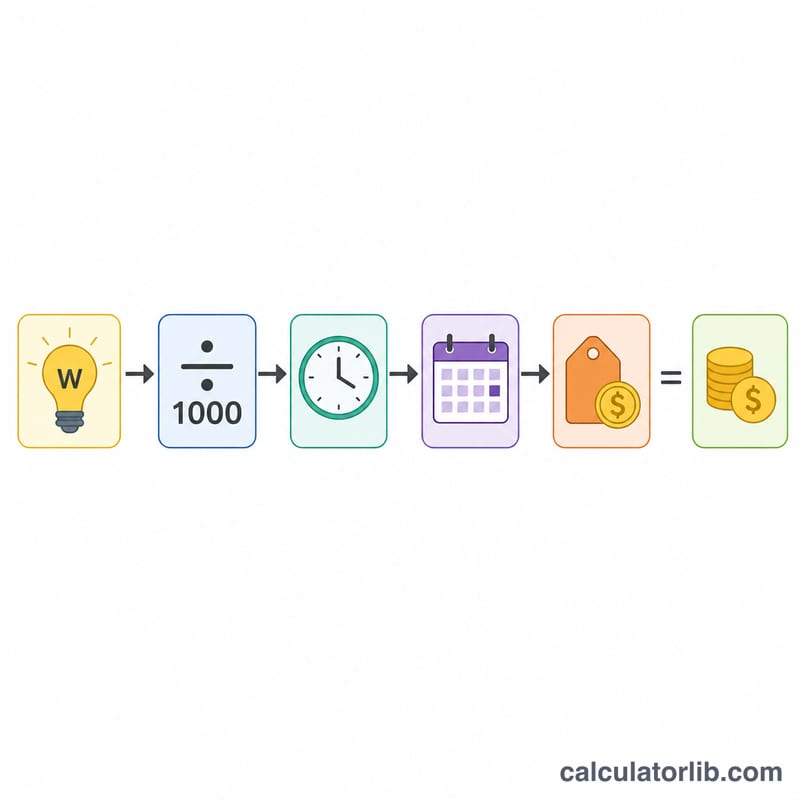
Electricity is billed by energy, measured in kilowatt-hours. Since power is given in watts, we divide by 1000 to convert to kilowatts. Multiplying by hours of use gives kWh, and multiplying by your unit price gives the cost:
$$\text{Cost} = \frac{\text{Power (W)}}{1000} \times \text{Hours/day} \times \text{Days} \times \text{Price/kWh}$$
Worked Example
Suppose a 1000 W space heater runs 5 hours a day for 30 days at a price of $0.15 per kWh. Energy per day = \((1000 \div 1000) \times 5 = 5\) kWh. Over 30 days that is 150 kWh. Total cost = $$150 \times 0.15 = \mathbf{\$22.50}$$ or $0.75 per day.
Typical Appliance Wattage Reference
The values below are approximate typical ranges. Actual power draw varies by model, age, settings and operating mode. The rating label or manual for your specific appliance always takes precedence over these figures. Many appliances (refrigerators, air conditioners, heaters with thermostats) cycle on and off, so their average draw is lower than their peak rating.
| Appliance | Typical power (W) | Typical use (hours/day) |
|---|---|---|
| LED bulb | 8-12 W | 3-6 |
| Laptop | 50-100 W | 4-10 |
| Refrigerator (average running) | 100-250 W | 24 (compressor runs roughly 6-10 h of that) |
| Television | 50-200 W | 3-6 |
| Microwave oven | 800-1500 W | 0.1-0.5 |
| Space heater | 1000-1500 W | 2-8 (seasonal) |
| Window air conditioner | 500-1500 W | 4-10 (seasonal) |
| Washing machine | 400-1300 W | 0.5-1.5 |
| Electric kettle | 1500-3000 W | 0.1-0.3 |
Enter the wattage into the calculator together with hours per day, number of days and your price per kWh to get energy used and cost.
Cost Comparison for Common Appliances
The table compares 30-day usage at an example price of $0.15 per kWh. Your own rate will differ, so replace it with the price on your electricity bill. Formulas: \(\text{kWh} = \frac{W}{1000} \times \text{hours} \times \text{days}\) and \(\text{Cost} = \text{kWh} \times \text{price}\).
| Scenario | Energy calculation | Energy (kWh/month) | Cost calculation | Cost/month |
|---|---|---|---|---|
| 10 W LED bulb, 5 h/day | 0.010 × 5 × 30 | 1.5 | 1.5 × 0.15 | $0.225 (about $0.23) |
| 100 W TV, 4 h/day | 0.100 × 4 × 30 | 12 | 12 × 0.15 | $1.80 |
| 150 W refrigerator, about 8 h/day of compressor running | 0.150 × 8 × 30 | 36 | 36 × 0.15 | $5.40 |
| 1500 W heater, 5 h/day | 1.5 × 5 × 30 | 225 | 225 × 0.15 | $33.75 |
| 1000 W AC, 8 h/day | 1.0 × 8 × 30 | 240 | 240 × 0.15 | $36.00 |
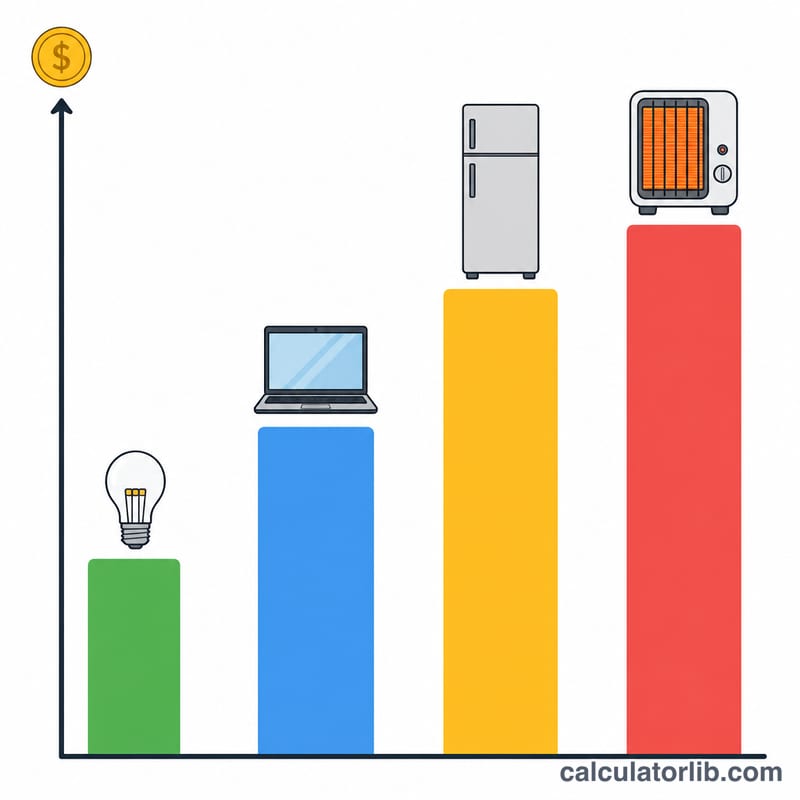
Heating and cooling appliances dominate the bill because they combine high wattage with long running hours. A bulb or TV, though always on in many homes, costs comparatively little. The refrigerator row assumes the compressor is effectively on about 8 hours per day; if a 150 W draw were continuous for 24 hours, it would be 108 kWh, or $16.20.
Power and Energy Unit Conversions
| Quantity | Equivalent |
|---|---|
| 1 kilowatt (kW) | 1000 W |
| 1 mechanical horsepower (HP) | ≈ 745.7 W |
| 1 metric horsepower | ≈ 735.5 W |
| 1 BTU/h | ≈ 0.29307 W |
| 1 kWh | 3.6 MJ ≈ 3412 BTU |
| Electrical power | \(P = V \times I\) (watts = volts × amps) for resistive loads; for AC motors and similar loads \(P = V \times I \times \text{PF}\), where PF is the power factor |
Example 1: a heater drawing 10 A at 120 V (resistive load) uses \(120 \times 10 = 1200\) W, or 1.2 kW.
Example 2: a 12,000 BTU/h air conditioner has a cooling capacity of \(12{,}000 \times 0.29307 \approx 3517\) W. This is thermal cooling capacity, not electrical input; the unit's actual electrical draw is usually much lower, depending on its efficiency rating.
Related tools
- kWh to cost: the cost of a meter reading or a known number of kWh.
- Bulb energy cost: the running cost of light bulbs, LED or incandescent.
- Lighting kWh usage: all the lights in a room or home over any period.
- Watts to amps: the current an appliance draws on a 120 V or 240 V circuit.
FAQ
Where do I find the wattage? Check the rating label on the device, the power supply, or the user manual. Amps \(\times\) volts also gives watts.
What price should I enter? Use the per-kWh rate on your electricity bill, including any standing or supply charges divided in if you want a fuller estimate. If you do not have a bill at hand, the U.S. average residential price from the EIA (about 18 cents per kWh in 2026) is a reasonable starting point; state averages ranged from about 12 cents (North Dakota) to about 46 cents (Hawaii) in January–August 2026 (EIA).
Does it account for standby power? No — it assumes the appliance draws its rated power only during the hours you enter. For always-on standby loads, use 24 hours and the standby wattage.