
What is the Lumens to Watts Calculator?
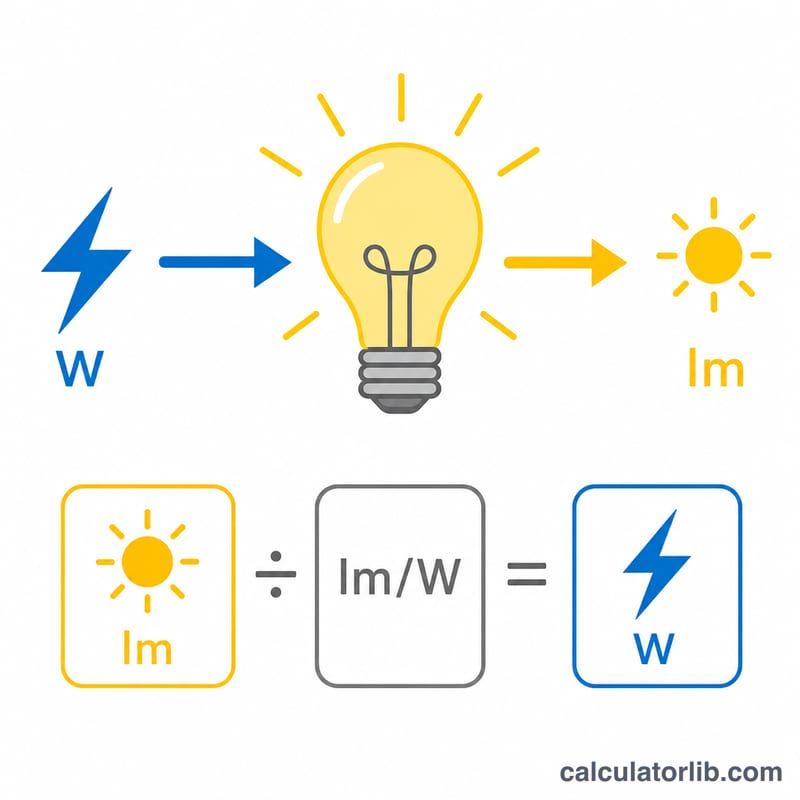
This calculator converts a light source's brightness, measured in lumens (lm), into the electrical power it consumes, measured in watts (W). Lumens describe how much visible light a lamp emits, while watts describe how much electricity it draws. The bridge between the two is luminous efficacy — how many lumens a device produces per watt of power.
How to use it
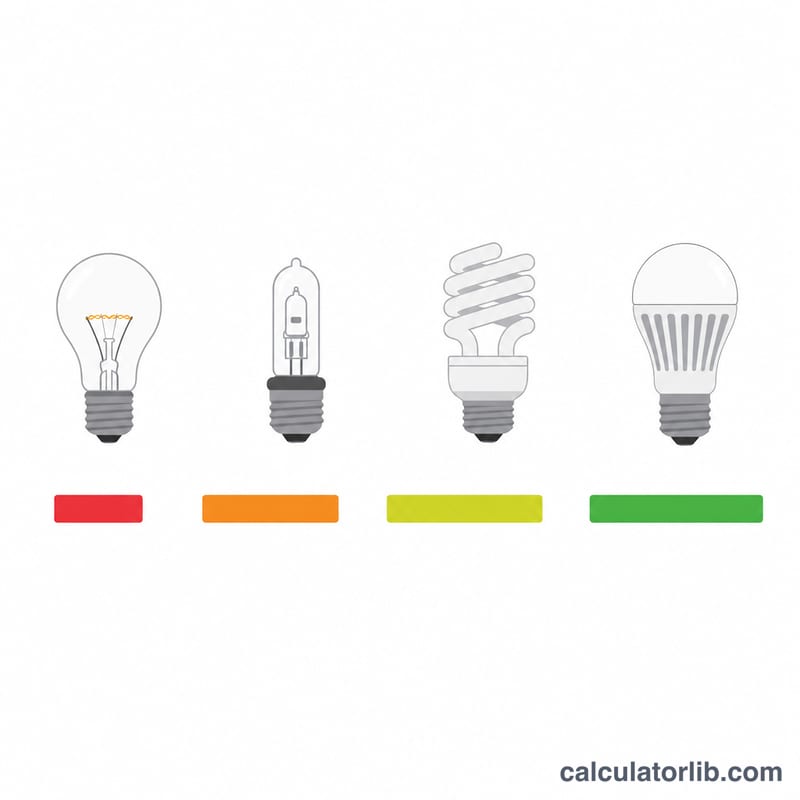
Enter the luminous flux of the light source in lumens, then enter the luminous efficacy in lumens per watt. The calculator divides one by the other to return the power requirement. Typical efficacy values: incandescent bulbs ≈ 15 lm/W, halogen ≈ 20 lm/W, compact fluorescent (CFL) ≈ 60 lm/W, and modern LEDs ≈ 80–120 lm/W.
The formula explained
The relationship is simply:
$$P_{(W)} = \frac{\text{Luminous flux (lm)}}{\text{Efficacy (lm/W)}}$$
Because efficacy is measured in lumens per watt, dividing total lumens by it leaves you with watts. Higher efficacy means more light for fewer watts, which is why LEDs use far less energy than incandescent bulbs for the same brightness.
Worked example
Suppose you want a 800-lumen LED with an efficacy of 80 lm/W. Power $$= 800 \div 80 = \textbf{10 watts}.$$ The same 800 lumens from an incandescent bulb at 15 lm/W would require \(800 \div 15 \approx 53.3\) watts — over five times the energy.
FAQ
Can I convert watts directly to lumens? No — wattage alone does not define brightness. You always need the efficacy to relate the two.
What efficacy should I use? Check the product spec sheet. If unknown, use a typical value for the bulb type (e.g. 80 lm/W for LED).
Why does my LED use so few watts? LEDs convert electricity to light very efficiently, achieving high lumens per watt, so they deliver the same brightness at a fraction of the power.