
What Is the Pool Shock Calculator?
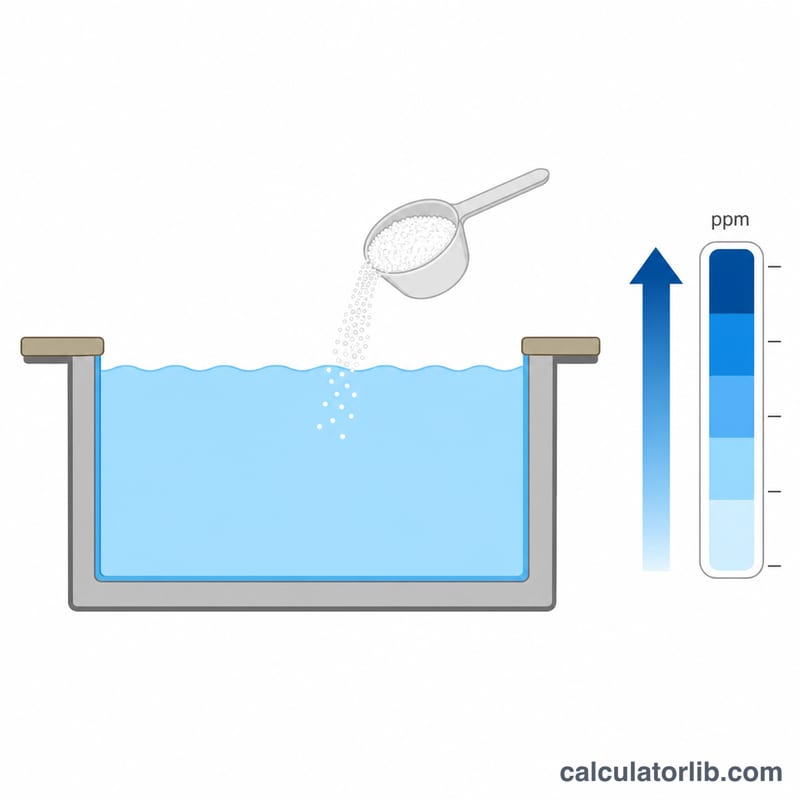
Shocking a pool means adding a concentrated dose of chlorine (or another oxidizer) to quickly raise the free chlorine level, kill algae and bacteria, and burn off combined chloramines. This calculator tells you how many ounces of shock product to add based on your pool's volume in gallons and the free-chlorine (FC) increase you want, measured in parts per million (ppm).
How to Use It
Enter your pool's water volume in gallons, the ppm increase you are targeting, and select the type of shock product you use. The tool returns the dose in ounces and the equivalent in pounds. A typical maintenance shock raises FC by 10 ppm; a heavy algae shock may aim for 20–30 ppm.
The Formula Explained
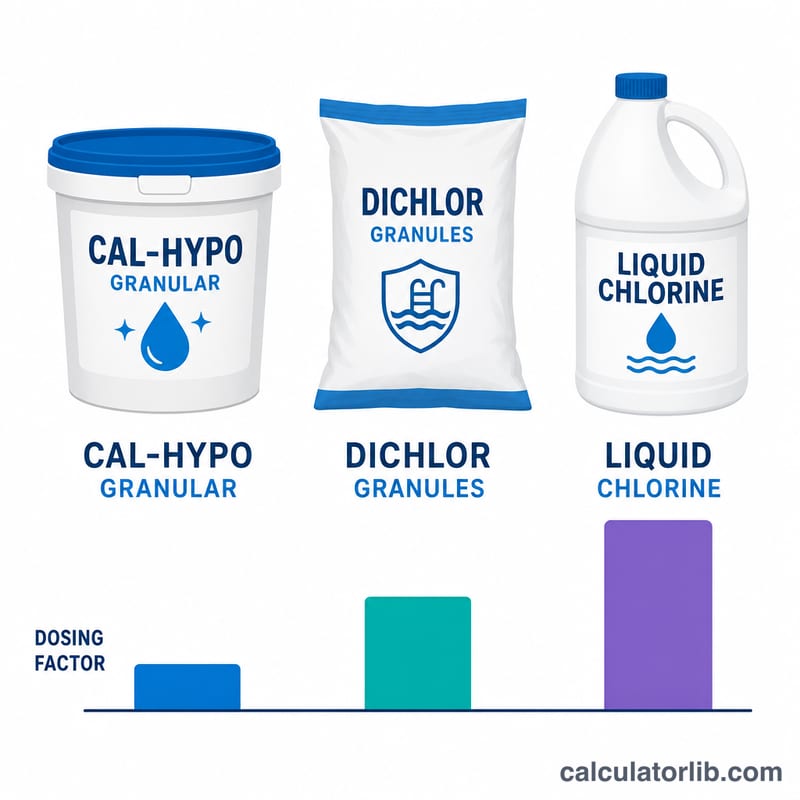
The dose scales linearly with both volume and the target ppm: $$\text{oz} = \frac{\text{Volume}}{10000} \times \text{ppm} \times \text{factor} \times 100$$ The conversion factor depends on the available chlorine of the product. Cal-hypo 65% is far more concentrated than liquid chlorine, so it has a smaller factor and requires fewer ounces for the same result.
Worked Example
For a 20,000-gallon pool, raising FC by 10 ppm using Cal-Hypo 65% (factor 0.013): $$\text{oz} = \frac{20000}{10000} \times 10 \times 0.013 \times 100 = 2 \times 10 \times 1.3 = 26 \text{ ounces}$$ or about 1.625 lb of product.
FAQ
How often should I shock my pool? Most pools benefit from a shock once a week in summer, and after heavy use, rain, or visible algae.
Can I swim right after shocking? Wait until free chlorine drops back to 1–3 ppm, usually 8–24 hours depending on the dose.
Why do products have different factors? Each product has a different percentage of available chlorine, so the same weight delivers a different ppm boost.