
What Is the Pool Volume Calculator?
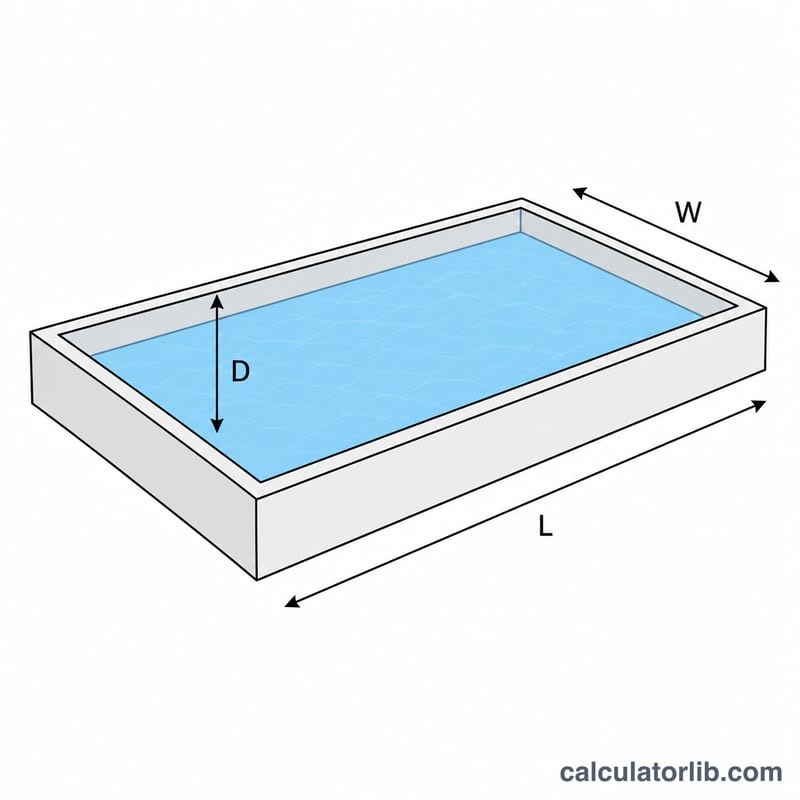
This calculator estimates how much water your swimming pool holds. Knowing the volume is essential for dosing chemicals correctly, sizing a pump or heater, budgeting for water, and balancing chlorine and pH. Enter the pool's length, width and average depth in feet, and the tool returns the volume in US gallons, cubic feet and liters.
How to Use It
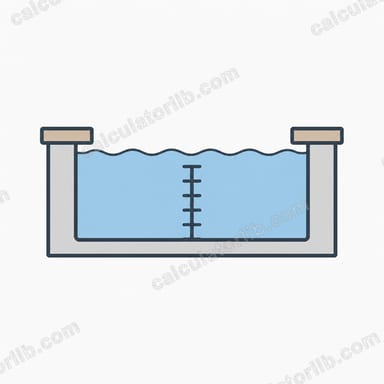
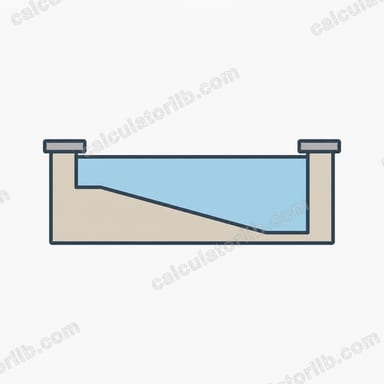
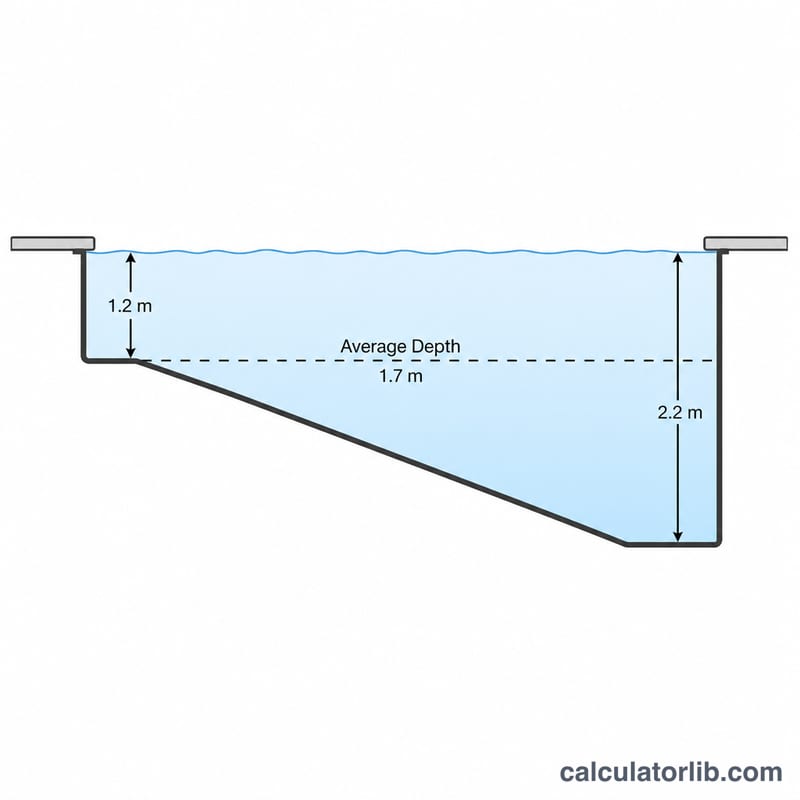
Measure your pool's length and width at the water surface. For depth, use the average depth — for a pool that slopes, add the shallow-end depth to the deep-end depth and divide by two. Enter all three values in feet and read the volume instantly. The formula assumes a roughly rectangular pool; for round or oval pools this gives a close approximation when using the longest dimensions.
The Formula Explained
The core calculation is simple geometry combined with a unit conversion:
$$\text{Gallons} = \text{Length (ft)} \times \text{Width (ft)} \times \text{Avg Depth (ft)} \times 7.48$$
Length × Width × Average Depth gives the volume in cubic feet. One cubic foot of water equals about 7.48 US gallons, so multiplying by 7.48 converts the result into gallons. To get liters, the gallon figure is multiplied by 3.78541.
Worked Example
Consider a rectangular pool 20 ft long, 10 ft wide with an average depth of 5 ft:
$$\text{Cubic feet} = 20 \times 10 \times 5 = 1{,}000 \ \text{ft}^3$$
$$\text{Gallons} = 1{,}000 \times 7.48 = \mathbf{7{,}480 \ \textbf{US gallons}}$$
$$\text{Liters} = 7{,}480 \times 3.78541 \approx 28{,}315 \ \text{L}$$
FAQ
How do I find average depth? Add the shallowest and deepest points and divide by two. For pools with multiple slopes, average all measured depths.
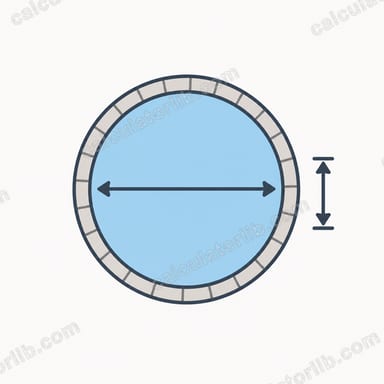
Does this work for round pools? It gives a rough estimate. For greater accuracy on round pools, use \( \pi \times \text{radius}^2 \times \text{depth} \times 7.48 \).
Why 7.48? Because one cubic foot contains approximately 7.48 US liquid gallons. This is a standard conversion factor for water volume.