
What is the Box Fill Calculator?
This tool applies the United States National Electrical Code (NEC) section 314.16(B) to determine the minimum volume an electrical outlet, switch or junction box must have. Box fill rules prevent overcrowding that can damage insulation and cause overheating. The calculator uses the 2020 NEC volume allowances and assumes all conductors in the box share the largest gauge entered.
How to use it
Select the largest conductor gauge in the box, enter the box's marked cubic-inch volume, then enter the count of current-carrying conductors, equipment grounds, internal cable clamps and devices (such as receptacles or switches). The calculator returns the required volume, fill percentage and whether the box is adequate.
The formula explained
NEC 314.16(B) assigns a free-space volume per conductor by gauge (for example \(2.00\ \text{in}^3\) for 14 AWG, \(2.25\ \text{in}^3\) for 12 AWG). Each current-carrying conductor counts as one allowance. All equipment grounding conductors together count as a single allowance. All internal cable clamps together count as one. Each strap-mounted device (yoke) counts as two. Multiply the total allowances by the per-conductor volume to get the required box volume.
$$\begin{gathered} V_{req} = N \times V_{unit} \\[1.5em] \text{where}\quad \left\{ \begin{aligned} N &= \text{Conductors} + [\text{Grounds}>0] + [\text{Clamps}>0] + 2\,\text{Devices} \\ V_{unit} &= f(\text{AWG}) \end{aligned} \right. \end{gathered}$$ $$\text{Fill}\% = \frac{V_{req}}{\text{Box Volume (in}^3)} \times 100 \qquad V_{free} = \text{Box Volume} - V_{req}$$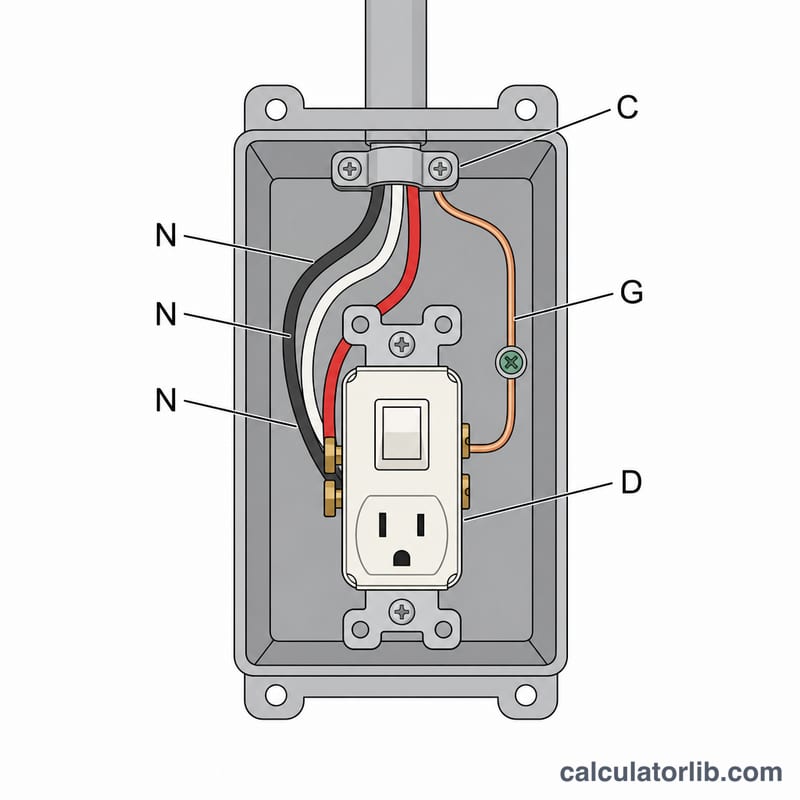
Worked example
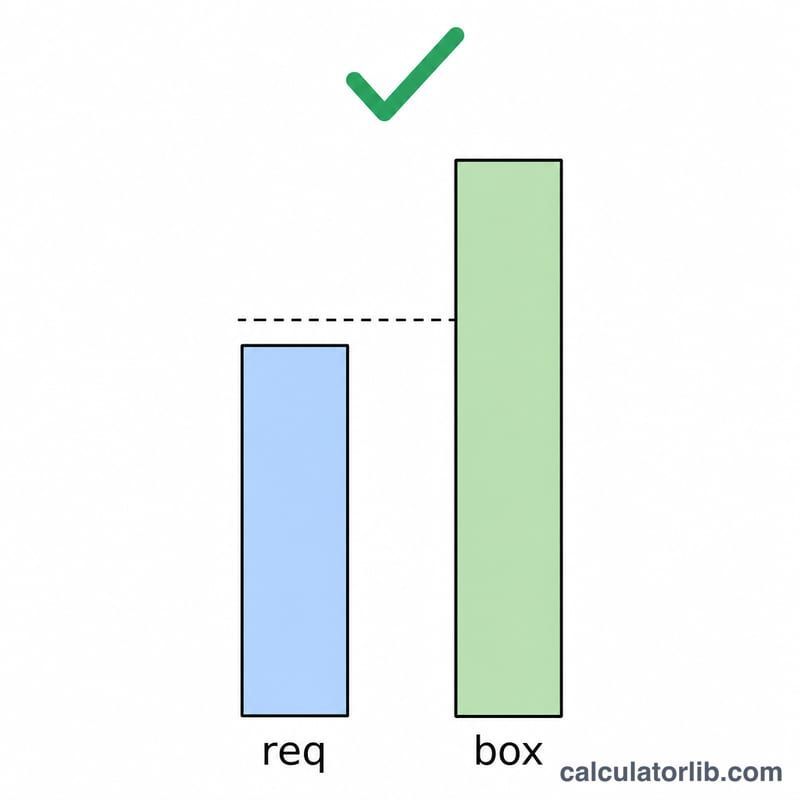
Six 14 AWG conductors, a ground, a clamp and one device in an 18 in³ box: allowances = \(6 + 1 + 1 + 2 = 10\). Required volume = \(10 \times 2.00 = 20.00\ \text{in}^3\). Since \(20 > 18\), the box is too small by \(2\ \text{in}^3\).
NEC 314.16(B) Volume Allowance per Conductor by Gauge
NEC Table 314.16(B) assigns each insulated conductor a fixed free-space volume based only on its wire size (AWG). The box-fill total is the sum of every counted conductor times the per-conductor allowance for the largest gauge involved in each count category.
| Conductor Size (AWG) | Free-Space Allowance per Conductor (in³) |
|---|---|
| 18 | 1.50 |
| 16 | 1.75 |
| 14 | 2.00 |
| 12 | 2.25 |
| 10 | 2.50 |
| 8 | 3.00 |
| 6 | 5.00 |
How conductors are counted under 314.16(B):
- Current-carrying conductors — each conductor that passes through or terminates in the box counts as 1. A conductor that originates outside and terminates inside counts once; a conductor passing straight through (looped, no splice) also counts once unless looped ≥ twice the required length, in which case it counts twice.
- Equipment grounds — all grounding conductors together count as a single allowance based on the largest ground present (1 if any are present).
- Cable clamps — one or more internal clamps together count as a single allowance based on the largest conductor in the box.
- Devices (yokes/straps) — each switch or receptacle on a single yoke counts as 2 conductor allowances, based on the largest conductor connected to the device.
For example, with 14 AWG conductors the per-unit volume is 2.00 in³ per counted item.
Standard Box Volumes (NEC Table 314.16(A))
NEC Table 314.16(A) lists the assigned volume of common standard metal boxes. For any box not listed here (and for nonmetallic boxes), the manufacturer must mark the box with its cubic-inch capacity, which you should use directly. Dimensions are width × length × depth in inches.
| Box Type | Trade Size (in) | Listed Volume (in³) |
|---|---|---|
| Device box | 3 × 2 × 2 | 10.0 |
| Device box | 3 × 2 × 2½ | 12.5 |
| Device box | 3 × 2 × 2¾ | 14.0 |
| Device box | 3 × 2 × 3½ | 18.0 |
| Square box | 4 × 4 × 1½ | 21.0 |
| Square box | 4 × 4 × 2⅛ | 30.3 |
| Square box | 4¹₁/₁₆ × 4¹₁/₁₆ × 1½ | 29.5 |
| Square box | 4¹₁/₁₆ × 4¹₁/₁₆ × 2⅛ | 42.0 |
| Octagonal box | 4 × 1½ | 15.5 |
| Octagonal box | 4 × 2⅛ | 21.5 |
Note: When a box assembly includes a plaster ring, raised cover, or extension ring marked with its own volume, that marked volume may be added to the box volume. The total available volume is what you compare against the required fill.
FAQ
Do grounds count individually? No — all equipment grounding conductors together count as a single volume allowance.
How are devices counted? Each yoke or strap-mounted device counts as two allowances based on the largest conductor connected to it.
Does this replace an inspection? No. It is a planning aid; always verify against the current adopted code and have work inspected.