What Is the Fill Dirt Calculator?
Fill dirt is soil used to raise the grade of a site, backfill a foundation, level a yard, or build up low spots. This calculator tells you how much fill dirt to order by computing the volume of your project in cubic yards, the approximate weight in tons, and an optional total cost. Suppliers usually sell dirt by the cubic yard or by the ton, so knowing both figures helps you order the right amount and compare prices.
How to Use It
Enter the length and width of the area in feet and the desired fill depth in inches. Provide the material density (fill dirt is typically about 1.3–1.5 tons per cubic yard; the default is 1.45). Optionally add a price per cubic yard to estimate the cost. The calculator returns cubic yards, tons, total cubic feet, and cost.
The Formula Explained
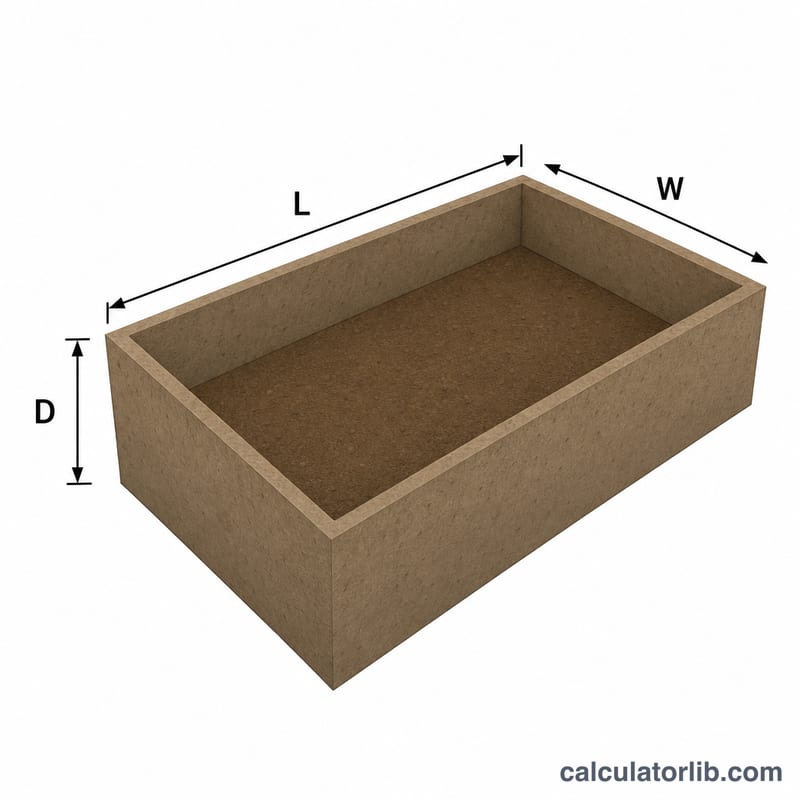
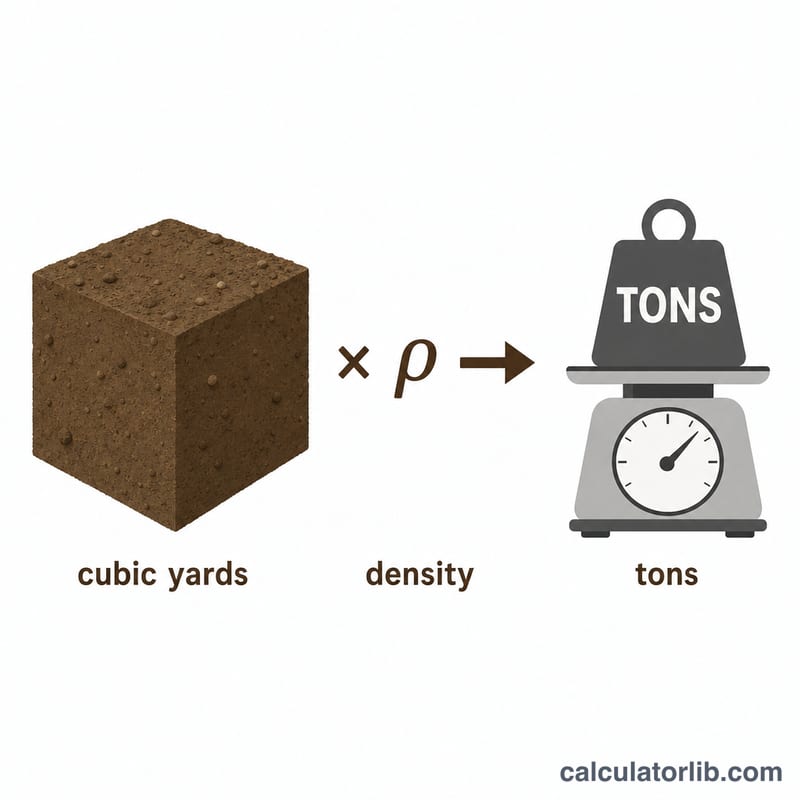
Volume is length × width × depth, but depth is entered in inches, so it is divided by 12 to convert to feet. The result is in cubic feet, which is divided by 27 (the number of cubic feet in a cubic yard) to give cubic yards: $$V = \frac{L \times W \times \dfrac{D}{12}}{27}$$ Weight is volume × density: $$\text{tons} = V \times \rho$$
Worked Example
For a 20 ft × 10 ft area filled to 6 inches deep with dirt at 1.45 tons/yd³: depth = \(6/12 = 0.5\) ft, volume = \(20 \times 10 \times 0.5 = 100\) cubic feet = \(100 \div 27 \approx 3.70\) cubic yards. Weight = \(3.70 \times 1.45 \approx 5.37\) tons.
Typical Weight of Fill Materials per Cubic Yard
Use these approximate values for the Density field. They are typical ranges, not exact figures. Actual weight varies by supplier, material source, particle size and especially moisture content. Ask your supplier for the weight per cubic yard of the material you are buying. Tons here are US short tons (1 ton = 2,000 lb).
| Material | Tons per cubic yard (approx.) | Pounds per cubic yard (approx.) |
|---|---|---|
| Dry, loose fill dirt | 1.1 – 1.3 | 2,200 – 2,600 |
| Typical fill dirt | 1.3 – 1.5 | 2,600 – 3,000 |
| Moist or compacted clay / fill | 1.5 – 1.7+ | 3,000 – 3,400+ |
| Sand, dry | 1.3 – 1.4 | 2,600 – 2,800 |
| Sand, wet | 1.6 – 1.7 | 3,200 – 3,400 |
| Gravel | 1.35 – 1.5 | 2,700 – 3,000 |
| Topsoil | 1.0 – 1.3 | 2,000 – 2,600 |
| Crushed stone / road base | 1.4 – 1.6 | 2,800 – 3,200 |
Wet material is heavier than the same volume of dry material, so the tonnage on a delivery ticket can be higher after rain even though the volume is unchanged.
Cubic Feet, Cubic Yards and Depth Conversions
One cubic yard of material spreads over a different area depending on the depth. Coverage is calculated as \(\text{Area} = \dfrac{27 \times 12}{\text{depth in inches}}\) square feet per cubic yard.
| Depth | Area covered by 1 cubic yard |
|---|---|
| 2 in | 162 sq ft |
| 4 in | 81 sq ft |
| 6 in | 54 sq ft |
| 8 in | 40.5 sq ft |
| 12 in | 27 sq ft |
Useful unit equivalents
- 1 cubic yard = 27 cubic feet
- 1 cubic yard ≈ 0.7646 cubic meters
- 1 ton (US short ton) = 2,000 lb
- 1 foot = 12 inches, so depth in inches ÷ 12 = depth in feet
Practical Ordering Tips
- Allow for compaction and settling. Add about 5–10% to the calculated volume. For heavily compacted structural fill, allow 15–20%.
- Round up. Order to the next half or whole cubic yard. Running short means a second delivery fee.
- Know the truck size. A tandem dump truck typically carries about 10–14 cubic yards. Smaller loads may cost more per yard.
- Check how it is sold. Some suppliers price by volume (cubic yard) and others by weight (ton). Use the density and price fields that match the supplier's unit.
- Include extra costs. Delivery fees, minimum load charges and distance surcharges are often not in the per-yard price.
- Place in lifts. Spread and compact fill in layers of about 6–8 inches rather than dumping it all at once.
Quick example
A 20 ft × 10 ft area filled to 6 in deep needs:
$$\text{Cubic yards} = \frac{20 \times 10 \times \frac{6}{12}}{27} = \frac{100}{27} \approx 3.70$$
Adding 10% for compaction gives about 4.07 cubic yards, so you would round up and order 4.5 cubic yards.
This is general information for estimating. Requirements for structural fill, drainage and compaction depend on your site, soil and local codes, so consult a qualified contractor or engineer for load-bearing work.
FAQ
How much does a cubic yard of fill dirt weigh? Roughly 1.3 to 1.5 tons when dry, but moisture and compaction can raise this to 1.7+ tons.
Should I order extra? Yes—add 5–10% for compaction and settling, especially for structural fill.
What's the difference between fill dirt and topsoil? Fill dirt is subsoil with little organic matter, ideal for grading and structural support; topsoil is for planting.