
What is the Topsoil Calculator?
This topsoil calculator tells you exactly how much soil you need to cover a garden bed, lawn, planter or construction area to a chosen depth. It reports the result as volume (cubic yards, cubic feet, cubic meters and liters), as weight (US short tons, pounds and kilograms), as a count of bagged product, and as an estimated cost whether you buy in bulk or by the bag. The core math is universal geometry, \(V = A \times D\); only the bag-size list references common US, Canada and UK retail bag presets.
How to use it
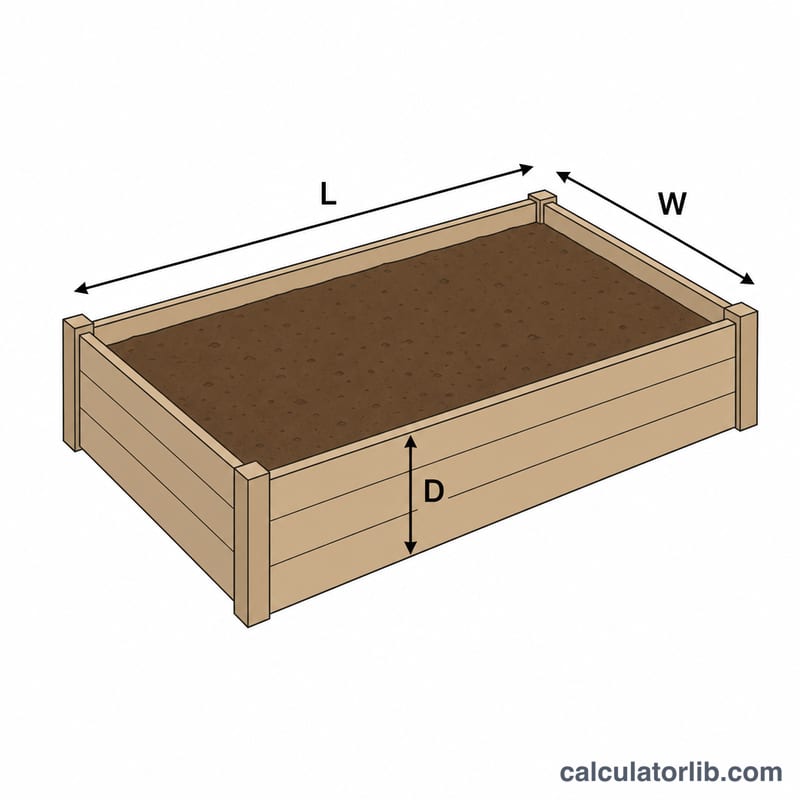
Pick how you want to define the surface: enter a total area directly, or let the tool compute the area from a rectangle (length x width), a circle (diameter) or a triangle (base x height). Choose units freely for every length, area and depth field. Set the depth you want to spread, pick a topsoil blend (this only affects weight), and optionally add a settling and waste allowance of 10-20% so you do not come up short. Finally choose bulk or bag pricing and enter a price to get a cost estimate.
The formula explained
The calculator converts your area to square meters and your depth to meters, multiplies them for a raw volume, then multiplies by \(\left(1 + \frac{w}{100}\right)\). The full relationship is
$$V = A \times D \times \left(1 + \frac{w}{100}\right)$$That cubic-meter volume is converted to the other units. Weight comes from cubic feet times the blend density (about 100 lb/ft3 for screened topsoil), and bag counts follow
$$\text{lb} = V_{ft^3}\times\rho,\quad \text{bags} = \left\lceil \frac{V_{ft^3}}{b}\right\rceil$$Volume bags use cubic feet divided by the bag's cubic-foot volume; a 40 lb weight bag is converted to volume via the density. Bag counts are always rounded up because you cannot buy part of a bag.
Worked example
Cover 100 ft2 to a depth of 3 inches with screened topsoil, plus 10% waste, using 0.75 cu ft bags at $4 each. Area = \(9.2903\ \text{m}^2\), depth = \(0.0762\ \text{m}\), raw volume = \(0.70792\ \text{m}^3\), with waste \(0.77871\ \text{m}^3 = 27.5\ \text{ft}^3 = 1.02\) cubic yards.
$$\text{Weight} = 27.5 \times 100 = 2750\ \text{lb} = 1.375\ \text{tons}$$$$\text{Bags} = \left\lceil \frac{27.5}{0.75} \right\rceil = 37$$$$\text{Cost} = 37 \times \$4 = \$148$$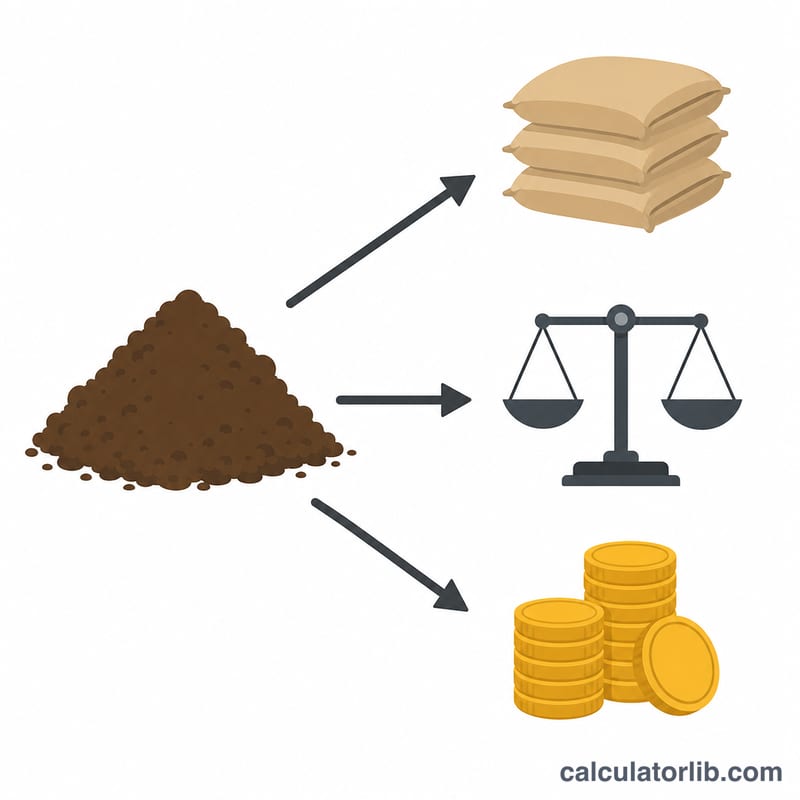
FAQ
How deep should topsoil be? For new lawns and seeding, 2-4 inches is common; for raised beds and vegetable gardens, 6-12 inches.
How many cubic feet are in a cubic yard? Exactly 27 cubic feet make one cubic yard.
Why add a waste percentage? Soil settles, compacts and is lost to spillage; a 10-20% buffer prevents a second trip to the supplier.