
What Is a Topsoil Calculator?
A topsoil calculator estimates how much soil you need to fill a garden bed, lawn area, or raised planter. By entering the length, width, and desired depth of the area, it returns the required volume in cubic yards and cubic feet, plus an approximate weight in pounds and US tons. This helps you order the right amount and avoid costly over- or under-buying.
How to Use It
Measure your area in feet for length and width, and decide on a depth in inches (2–4 inches is common for top dressing, 6–12 inches for new beds). Enter a soil density — bulk topsoil typically weighs about 2,000–2,400 lb per cubic yard, with 2,200 lb/yd³ a reasonable default. Click calculate to see your estimate.
The Formula Explained
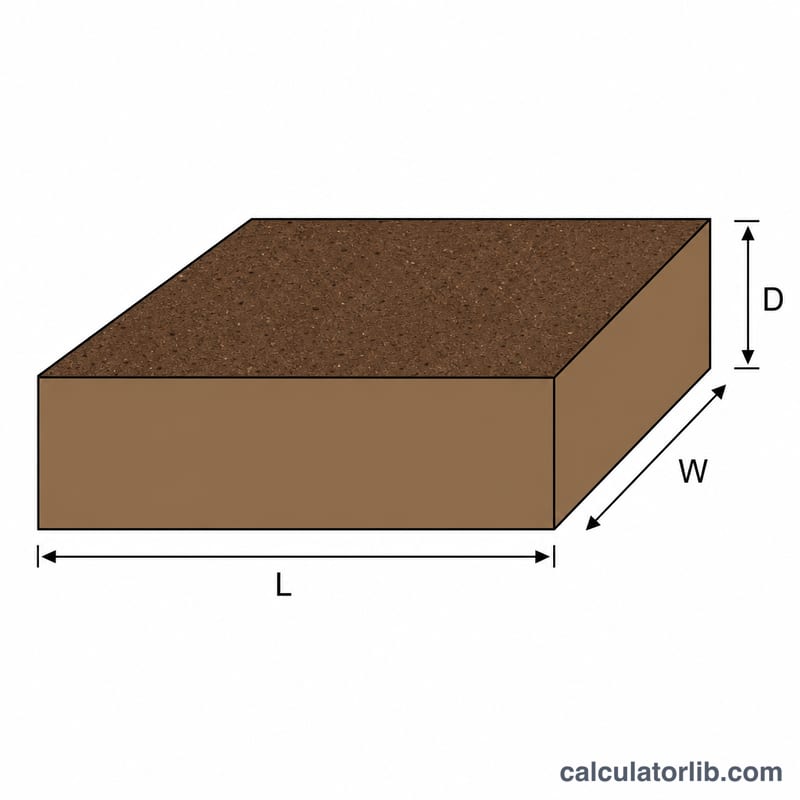
First the depth is converted from inches to feet (÷12). The raw volume in cubic feet is length × width × depth-in-feet. Since soil is sold by the cubic yard, this is divided by 27 (there are 27 cubic feet in a cubic yard). Weight is the cubic-yard volume multiplied by the soil density, and US tons divide pounds by 2,000.
$$\text{Volume} = \dfrac{L \times W \times (D/12)}{27}, \quad \text{Weight} = \text{Volume} \times \rho$$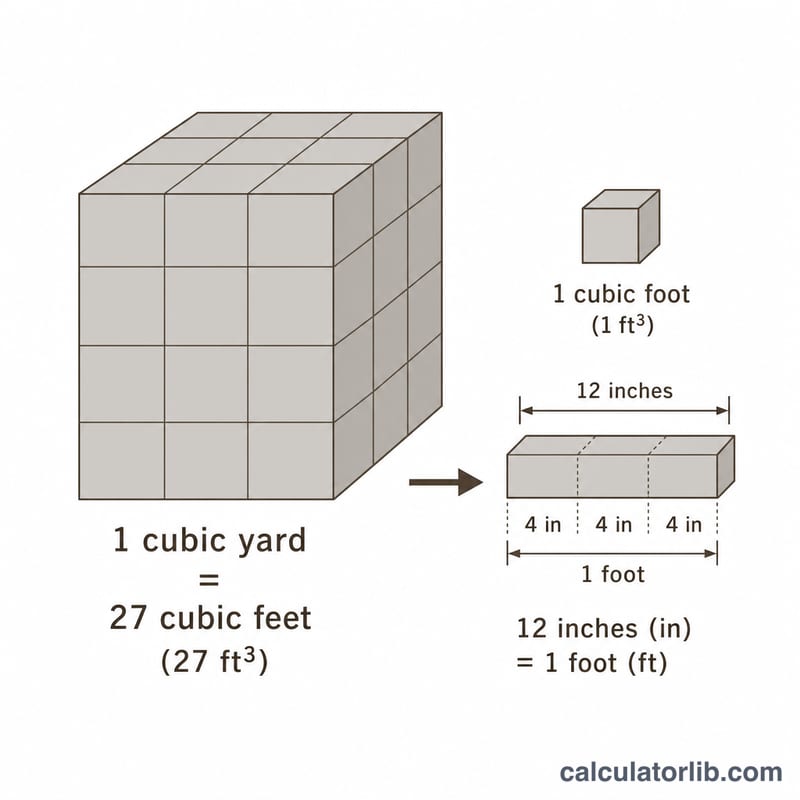
Worked Example
Suppose a bed is 20 ft long, 10 ft wide, and you want 6 inches of topsoil at 2,200 lb/yd³. Depth = \(6/12 = 0.5\) ft. Volume = \(20 \times 10 \times 0.5 = 100\) ft³, which is \(100 / 27 \approx 3.70\) cubic yards. Weight = \(3.70 \times 2{,}200 \approx 8{,}148\) lb, or about 4.07 US tons.
$$V_{yd^3} = \dfrac{20 \times 10 \times (6/12)}{27} \approx 3.70 \text{ yd}^3$$$$W = 3.70 \times 2{,}200 \approx 8{,}148 \text{ lb}$$FAQ
How deep should topsoil be? For seeding a new lawn, 4–6 inches is typical; for vegetable beds, 8–12 inches gives roots room to grow.
How much does topsoil weigh? Dry topsoil averages roughly 2,000–2,200 lb per cubic yard; moist or clay-rich soil can exceed 2,400 lb. Adjust the density field to match your supplier's figure.
Should I order extra? Yes — add about 5–10% to account for settling, uneven ground, and compaction.