
What is a triangular prism?
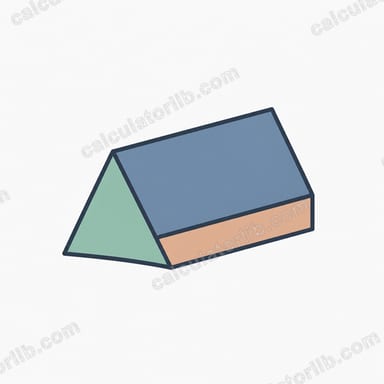
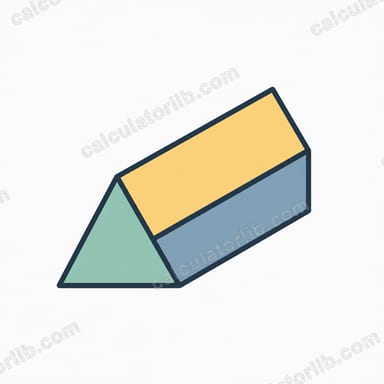
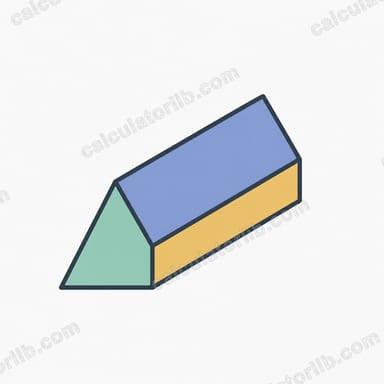
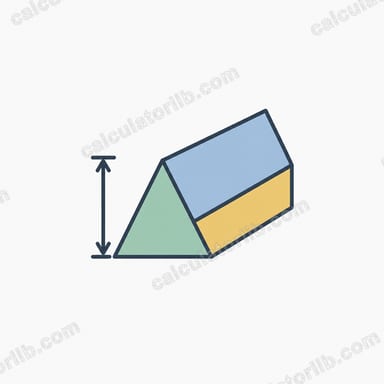
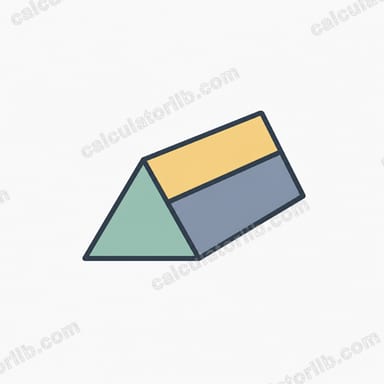
A triangular prism is a three-dimensional solid with two identical triangular ends (the bases) joined by three rectangular side faces. It is one of the most common prism shapes, appearing in everything from roof trusses and tents to optical prisms and chocolate bars. This calculator finds both its volume and its total surface area.
How to use this calculator
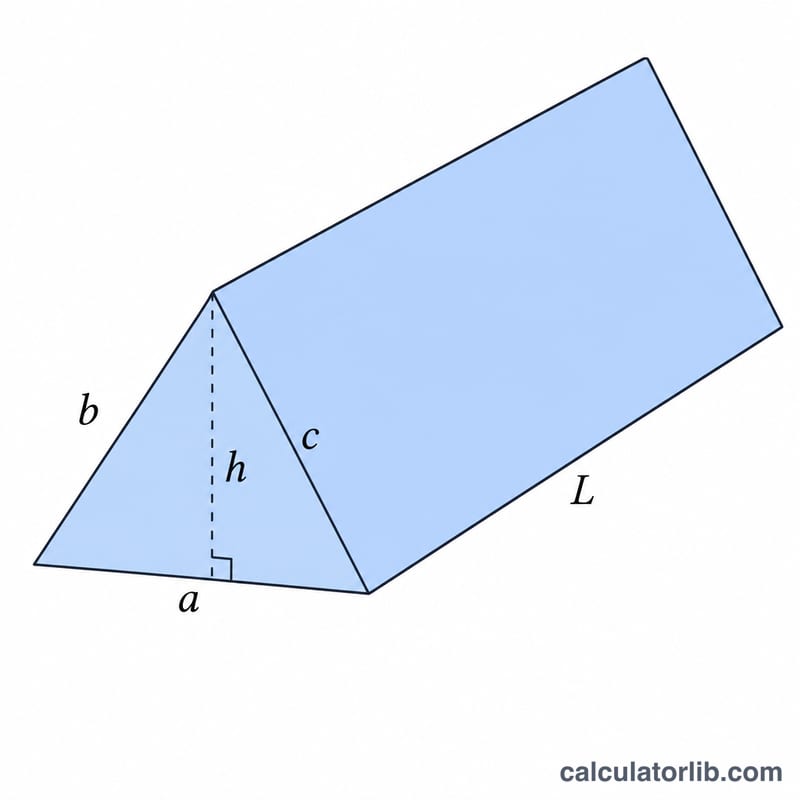
Enter the dimensions of the triangular cross-section — the triangle's base (b) and perpendicular height (h) — along with the prism's length (L). Then enter the three side lengths of the triangle (a, b, c) so the surface area can include the three rectangular faces. All measurements must use the same unit (cm, m, in, etc.). Results are returned in those units cubed (volume) and squared (area).
The formula explained
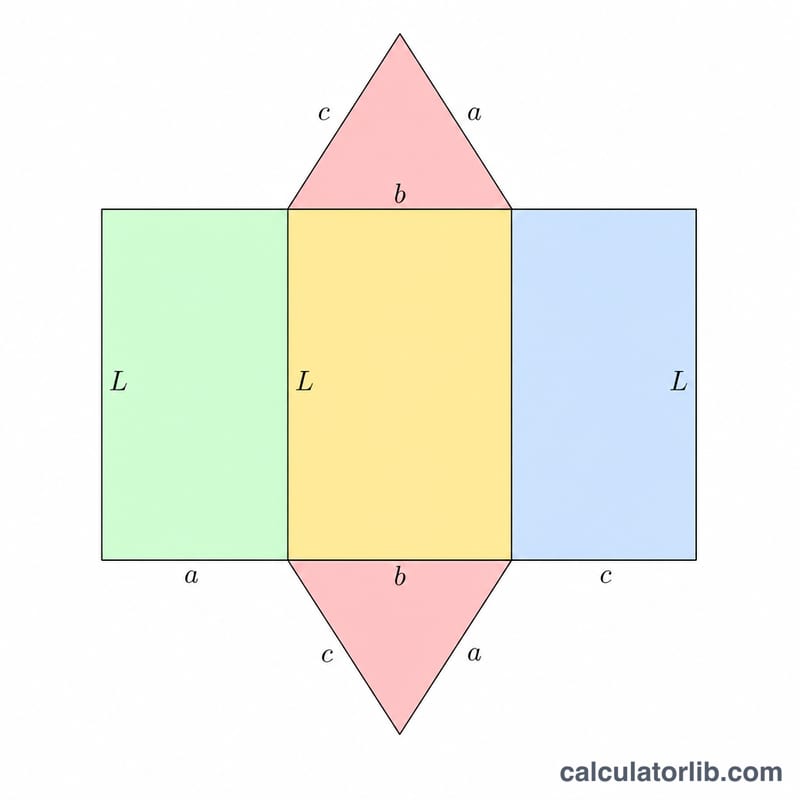
The volume is the area of the triangular cross-section multiplied by the length of the prism: $$V = \tfrac{1}{2} \times b \times h \times L$$. The surface area adds the two triangular faces (each \(\tfrac{1}{2} b h\), so together \(b h\)) to the three rectangular side faces, whose combined area is the triangle's perimeter times the length: $$SA = b h + (a + b + c) \times L$$.
Worked example
Take a prism with triangle base 6, height 4, length 10 and triangle sides 5, 5, 6. The cross-section area is \(\tfrac{1}{2} \times 6 \times 4 = 12\), so the volume is \(12 \times 10 = \mathbf{120}\). The lateral area is \((5 + 5 + 6) \times 10 = 160\), and the two triangular faces total \(6 \times 4 = 24\), giving a surface area of 184.
FAQ
Why do I enter both the triangle height and the three sides? The height is needed for the area (and volume), while the three side lengths are needed for the rectangular faces in the surface area.
What if my triangle is a right triangle? Use the two legs as base and height, and the three sides (two legs plus hypotenuse) for the surface area.
What units does the answer use? Whatever unit you input. Volume is in cubic units and surface area in square units.