
What is an equilateral triangular prism?
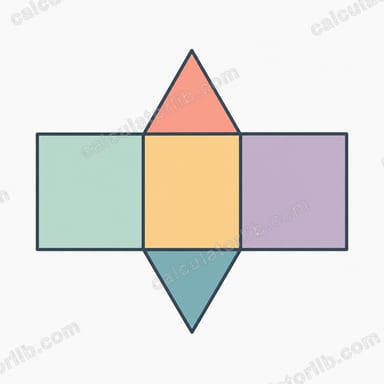
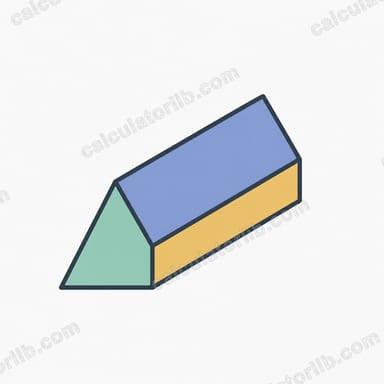
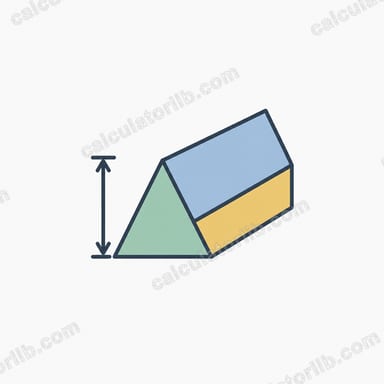
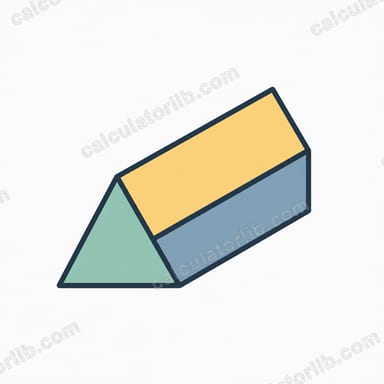
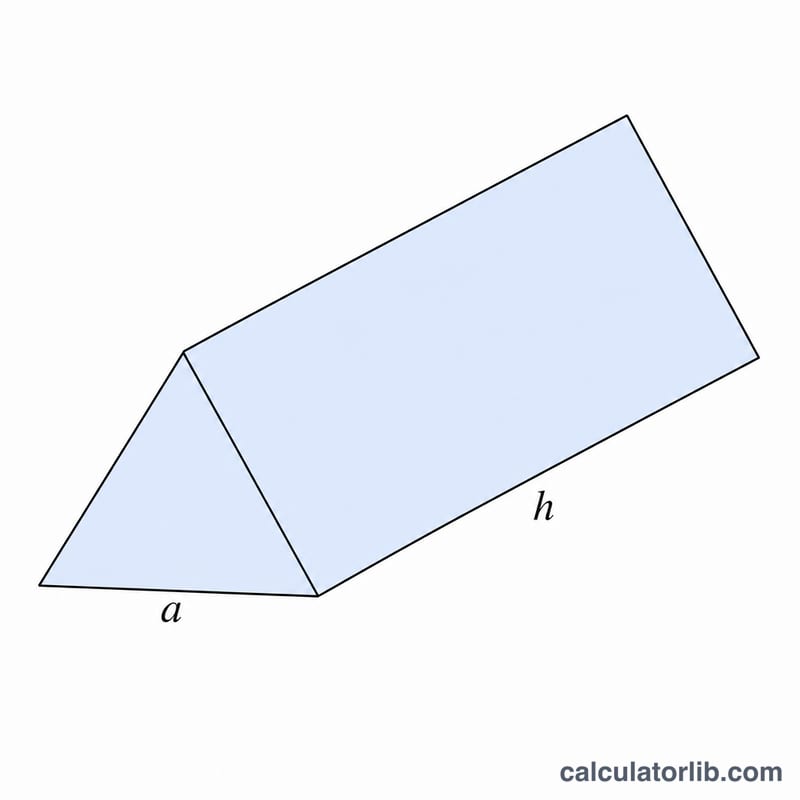
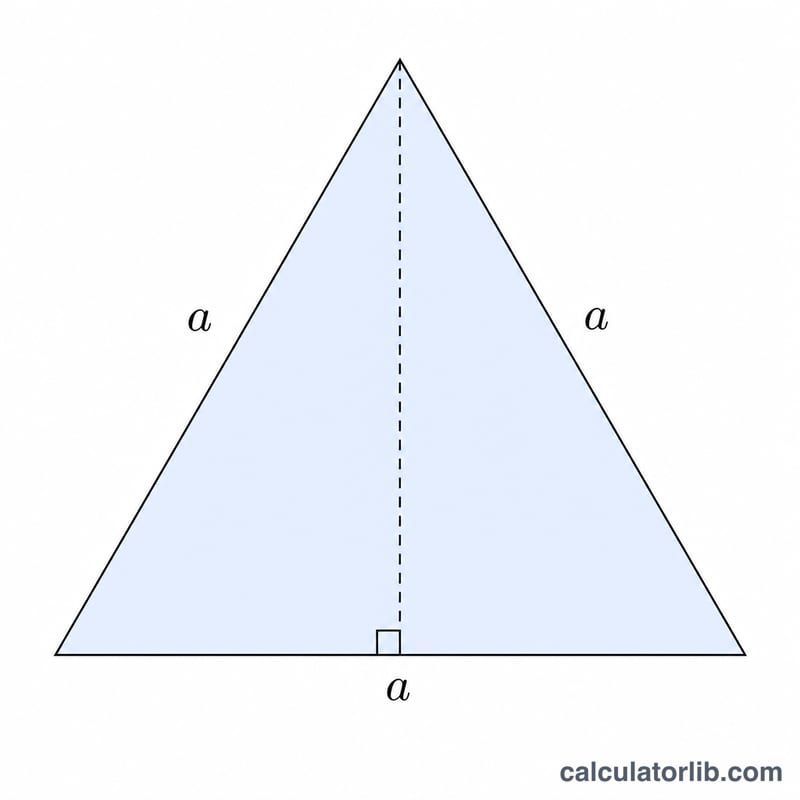
An equilateral triangular prism is a right prism whose cross-section is an equilateral triangle (all three sides equal to a length we call a). The prism is formed by extruding that triangle a perpendicular distance h, the prism height. This calculator returns its volume and total surface area directly from the side length and height. Both inputs must be expressed in the same length unit; the volume then comes out in that unit cubed and the surface area in that unit squared.
How to use it
Enter the side length of the equilateral triangle a and the prism height h, then read off the volume and surface area. Both values must be greater than zero for a real prism to exist. There are no unit dropdowns: pick a single consistent unit (for example centimeters) for both numbers.
The formulas explained
The area of an equilateral triangle of side a is \(\frac{\sqrt{3}}{4}\cdot a^{2}\). Multiplying by the prism height gives the volume:
$$V = \frac{\sqrt{3}}{4}\cdot a^{2}\cdot h$$
The surface consists of two triangular end faces and three identical rectangular sides. Two triangles give \(2\cdot\frac{\sqrt{3}}{4}a^{2} = \frac{\sqrt{3}}{2}a^{2}\), and three rectangles give \(3\cdot(a\cdot h)\):
$$S = \frac{\sqrt{3}}{2}\cdot a^{2} + 3ah$$
Worked example
For a = 1 and h = 2: $$V = \frac{1.7320508}{4} \times 1 \times 2 = 0.4330127 \times 2 \approx 0.8660254$$ cubic units. $$S = \frac{1.7320508}{2} \times 1 + 3 \times 1 \times 2 = 0.8660254 + 6 \approx 6.8660254$$ square units.
FAQ
Do a and h need the same unit? Yes. Use one consistent length unit for both; volume is then in that unit cubed and surface area in that unit squared.
What if I enter zero or a negative value? A prism requires \(a > 0\) and \(h > 0\). Non-positive inputs do not describe a real solid, so the calculator returns zero.
Is the prism a right prism? Yes. The height is assumed perpendicular to the triangular base, and the triangle is equilateral with all sides equal to a.