
What this calculator does
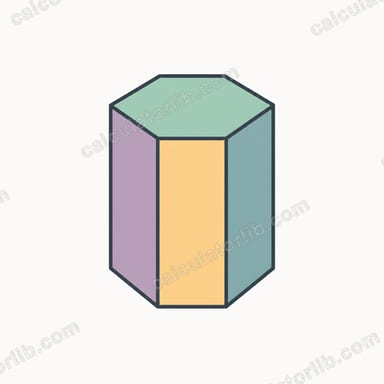
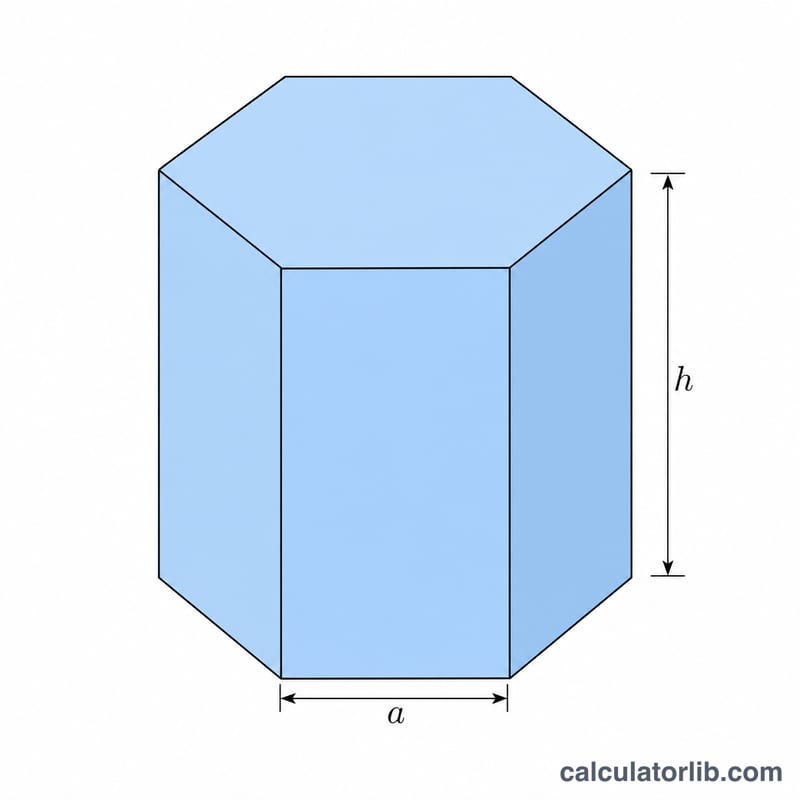
A regular hexagonal prism is a solid whose two parallel bases are regular hexagons (six equal sides, six 120° interior angles) joined by six identical rectangular lateral faces. This tool computes the volume and surface area of such a prism directly from the base side length a and the prism height h. It is a pure geometry calculator, so it applies anywhere — no country or unit system is assumed.
How to use it
Enter the side length of the hexagonal base (a) and the height of the prism (h) in any single, consistent length unit (for example centimeters). Both values must be positive. The volume result comes out in that unit cubed and the surface area in that unit squared. No unit conversion is performed — values are used exactly as entered.
The formula explained
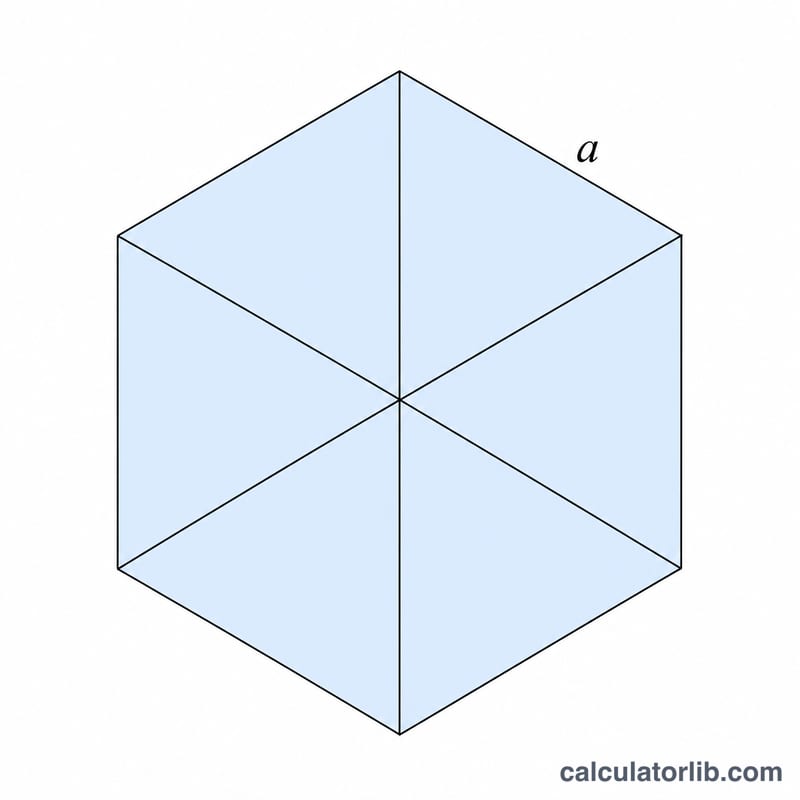
The area of a regular hexagon of side a is \(A = \frac{3\sqrt{3}}{2}\cdot a^{2}\), and its perimeter is \(P = 6a\). The prism volume is the base area multiplied by the height:
$$V = \frac{3\sqrt{3}}{2}\cdot a^{2}\cdot h$$The surface area is the two hexagonal bases plus the lateral surface (perimeter \(\times\) height):
$$S = 2A + Ph = 3\sqrt{3}\cdot a^{2} + 6ah$$Here \(\sqrt{3} \approx 1.7320508\).
Worked example
With \(a = 1\) and \(h = 2\): the hexagon area \(A = 1.5 \times 1.7320508 = 2.5980762\). Volume \(V = 2.5980762 \times 2 =\) 5.196152. Perimeter \(P = 6\), lateral surface \(= 6 \times 2 = 12\), two bases \(= 5.196152\), so surface area \(S =\) 17.196152.
FAQ
Does this work for an irregular hexagonal prism? No. The formulas assume a regular hexagon with all six sides equal and all angles 120°. Irregular cross-sections need a different method.
What units does it use? Any consistent linear unit you choose. If you enter centimeters, volume is in cm³ and surface area in cm².
What if I enter zero or a negative value? Side length and height must both be positive for a physical prism; non-positive inputs do not describe a real solid.