What Is the Surface Area of a Rectangular Prism?
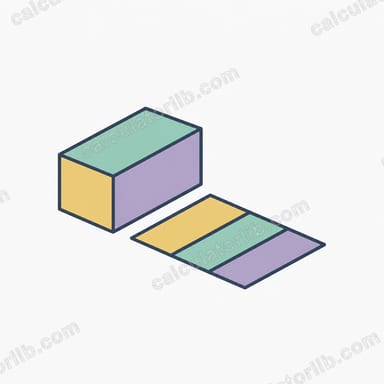
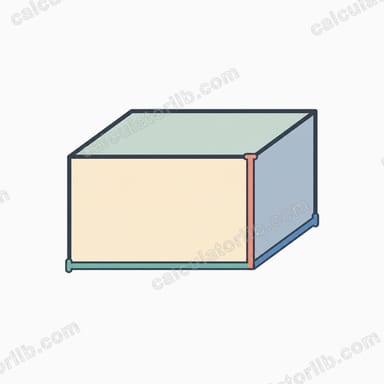
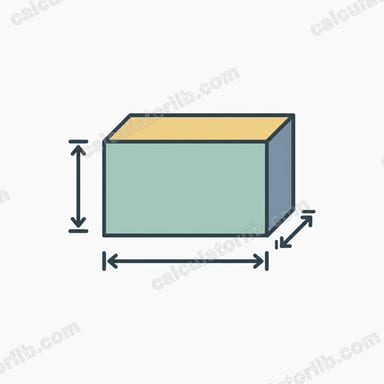
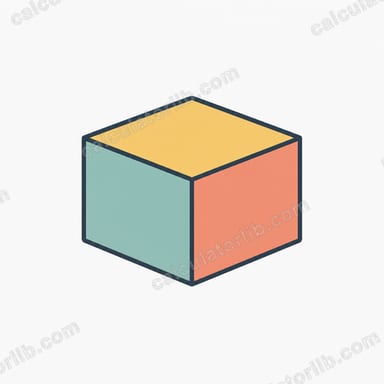
A rectangular prism, also called a cuboid, is a six-sided box where every face is a rectangle and opposite faces are equal. Its surface area is the total area of all six faces added together. This calculator instantly computes that total from the box's length, width, and height, and also reports the volume for convenience.

How to Use the Calculator
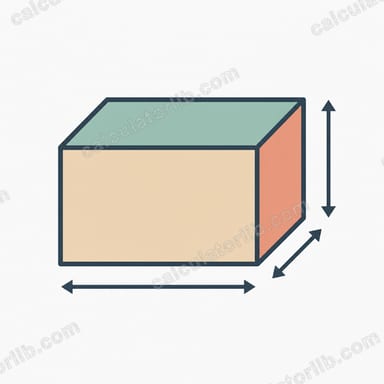
Enter the three dimensions of your box — length (\(l\)), width (\(w\)), and height (\(h\)) — in any single unit of measurement (cm, m, inches, feet). The result is returned in square units of that same measurement. For example, if you enter centimeters, the surface area is in square centimeters and the volume in cubic centimeters.
The Formula Explained
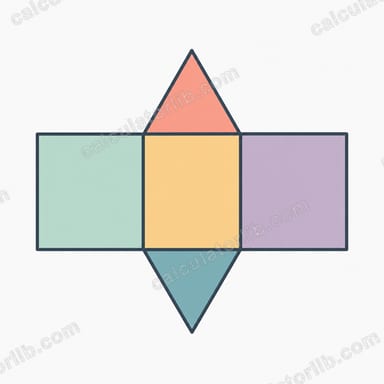
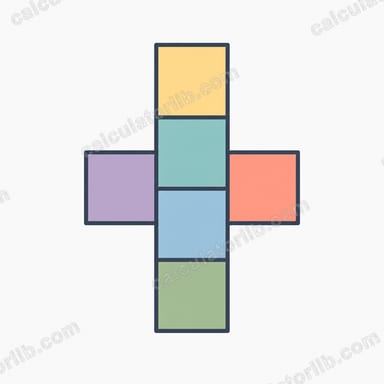
The surface area formula is $$A = 2(lw + lh + wh)$$ A rectangular prism has three distinct pairs of identical faces: the two \(l \times w\) faces (top and bottom), the two \(l \times h\) faces (front and back), and the two \(w \times h\) faces (left and right). Summing one of each pair gives \(lw + lh + wh\), and multiplying by 2 accounts for both faces in each pair.

Worked Example
Suppose a box measures \(l = 5\), \(w = 4\), and \(h = 3\). Then \(lw = 20\), \(lh = 15\), and \(wh = 12\). Their sum is 47, and doubling it gives $$A = 2 \times 47 = 94 \text{ square units}$$ The volume is \(5 \times 4 \times 3 = 60\) cubic units.
Practical Tips for Painting, Wrapping and Packaging
The surface area of a rectangular prism tells you how much material covers the outside of a box, room or container. These tips help you turn the number into a realistic material quantity.
- Add 5–10% extra. Overlap, seams, trimming and mistakes use more material than the geometric area. Use about 5% for simple wrapping with careful cutting, and closer to 10% for patterned paper, multiple coats or awkward cuts.
- Subtract open faces. The formula \(A = 2(lw + lh + wh)\) assumes all six faces are covered. For an open-top box, use \(A = lw + 2lh + 2wh\). For other shapes, add up only the faces you actually need (each is length × width, length × height or width × height).
- Keep units consistent. Enter length, width and height in the same unit. Mixing centimetres and metres gives a wrong answer. The result is in square units of whatever you entered.
- Round purchases up. Buy whole units: the next full sheet, roll, can or pack. Coverage figures are on the product label, so divide your area (with the extra allowance) by that coverage and round up.
Example: A box measures 40 cm × 30 cm × 20 cm. Closed, it has \(A = 2(40 \cdot 30 + 40 \cdot 20 + 30 \cdot 20) = 2(1200 + 800 + 600) =\) 5200 cm². With a 10% allowance, plan for \(5200 \times 1.10 = 5720\) cm² of wrapping. Without the top face it is \(1200 + 2(800) + 2(600) = 4000\) cm² before the allowance.
This is general guidance for estimating materials; always check the manufacturer's coverage figures for your specific product.
Area Unit Conversion Table
Area conversion factors are the square of the linear conversion factors. For example, 1 in = 2.54 cm, so 1 in² = 2.54² cm² = 6.4516 cm². Convert your length, width and height to one unit before calculating, or convert the final area using the table below.
| From | To | Factor |
|---|---|---|
| 1 cm² | mm² | 100 |
| 1 m² | cm² | 10,000 |
| 1 m² | ft² | ≈ 10.7639 |
| 1 ft² | in² | 144 |
| 1 in² | cm² | 6.4516 |
| 1 yd² | ft² | 9 |
| 1 yd² | m² | ≈ 0.8361 |
Why the factors are squared: 1 m = 100 cm, so 1 m² = 100 × 100 cm² = 10,000 cm². Likewise 1 ft = 12 in gives 1 ft² = 12 × 12 = 144 in², and 1 yd = 3 ft gives 1 yd² = 3 × 3 = 9 ft².
FAQ
What units does the result use? Whatever unit you input — surface area comes out in those units squared, volume in those units cubed.
Is a cube a rectangular prism? Yes. A cube is a special case where \(l = w = h\), giving \(A = 6s^2\) for side length \(s\).
What is the difference between surface area and volume? Surface area measures the outer skin you would paint or wrap (square units); volume measures the space inside the box (cubic units).