
What is the camera angle of view calculator?
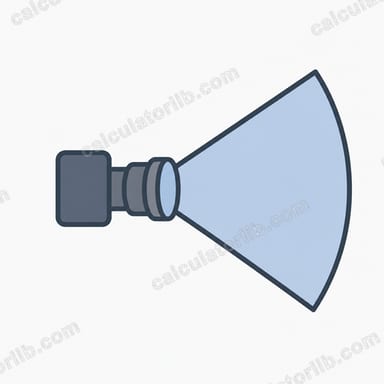
This tool computes a camera lens's angle of view (also called field of view) in degrees from the lens focal length and the size of the image sensor or film. It is pure optics and works the same everywhere, with no country-specific rules. Because a sensor is rectangular, there are three angles of view: horizontal (using sensor width), vertical (using sensor height), and diagonal (using the sensor diagonal).
How to use it
Enter the lens focal length in millimetres, then the sensor width and height in millimetres. You can pick a common sensor format from the preset dropdown to auto-fill the dimensions (full frame, APS-C, Micro Four Thirds, 1-inch, and more). The calculator returns the horizontal, vertical, and diagonal angles of view, plus the 35mm-equivalent focal length.
The formula explained
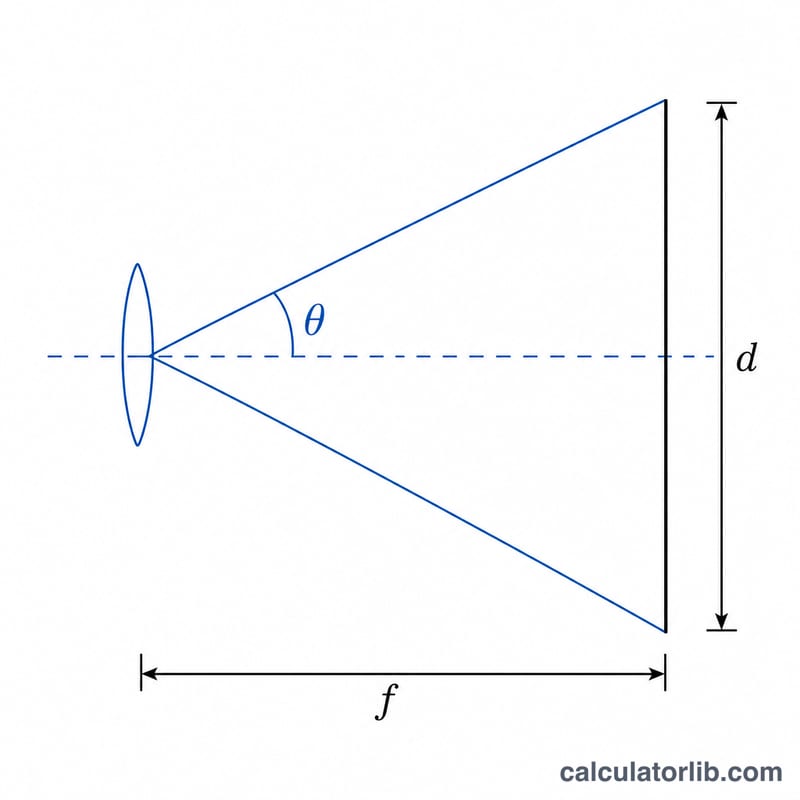
For a rectilinear lens focused at infinity, the angle of view along a sensor dimension \(d\) is the angle that dimension subtends through the lens: $$\text{AOV} = 2 \arctan\!\left(\frac{d}{2 \cdot \text{Focal Length}}\right) \times \frac{180}{\pi}$$ where \(f\) is the focal length and \(d\) and \(f\) share the same unit. The result is in radians, so multiply by \(180/\pi\) for degrees. The diagonal uses \(d = \sqrt{\text{width}^{2} + \text{height}^{2}}\). The 35mm-equivalent focal length scales \(f\) by the ratio of the full-frame diagonal (43.27 mm) to the sensor diagonal.
Worked example
A 50mm lens on full-frame (36 × 24 mm): horizontal $$= 2\cdot\arctan(36/100) = 39.6\degree,$$ vertical $$= 2\cdot\arctan(24/100) = 27.0\degree,$$ diagonal with \(d = \sqrt{36^{2}+24^{2}} = 43.27\) mm gives $$2\cdot\arctan(0.4327) = 46.8\degree.$$ These match standard textbook values for a 50mm "normal" lens.
FAQ
Why are there three angles? The sensor is rectangular, so it captures a wider angle horizontally than vertically; the diagonal is the largest and is the figure manufacturers usually quote.
Do I need to convert mm to other units? No. The formula uses only the ratio \(d/(2f)\), so as long as focal length and sensor dimensions share a unit, the angle is exact.
What is the 35mm-equivalent focal length? It is the full-frame focal length that would give the same diagonal angle of view on your smaller sensor, useful for comparing lenses across camera systems.