
What is the critical angle?
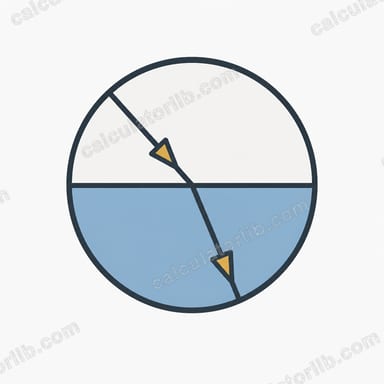
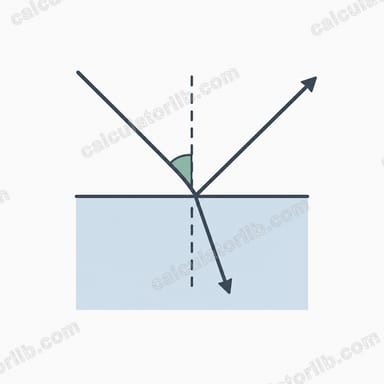
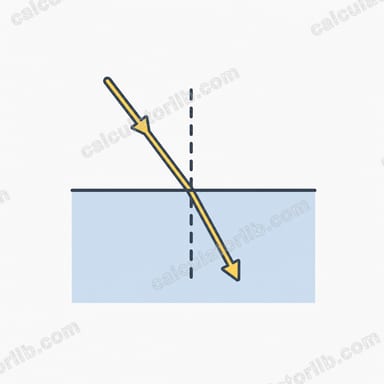
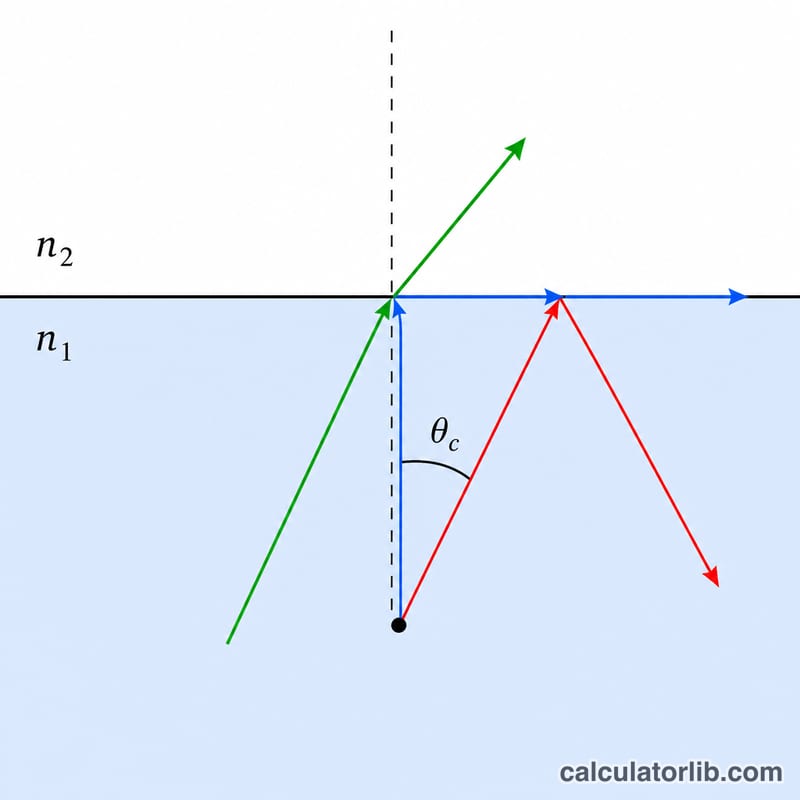
When light travels from an optically denser medium (higher refractive index, \(n_1\)) into a less dense medium (lower index, \(n_2\)), it bends away from the normal. As the angle of incidence increases, the refracted ray bends further until it skims along the boundary. The angle of incidence at which this happens is the critical angle (\(\theta_c\)). Beyond it, no light refracts out — instead it is completely reflected back, a phenomenon called total internal reflection (TIR). TIR is what makes optical fibres carry light over long distances and what makes diamonds sparkle.
How to use this calculator
Enter the refractive index of the denser medium (\(n_1\)) the light is currently travelling in, and the index of the less dense medium (\(n_2\)) it is trying to enter. Press calculate to get the critical angle in degrees and radians. The tool only returns a result when \(n_1 > n_2\), because a critical angle physically cannot exist otherwise.
The formula explained
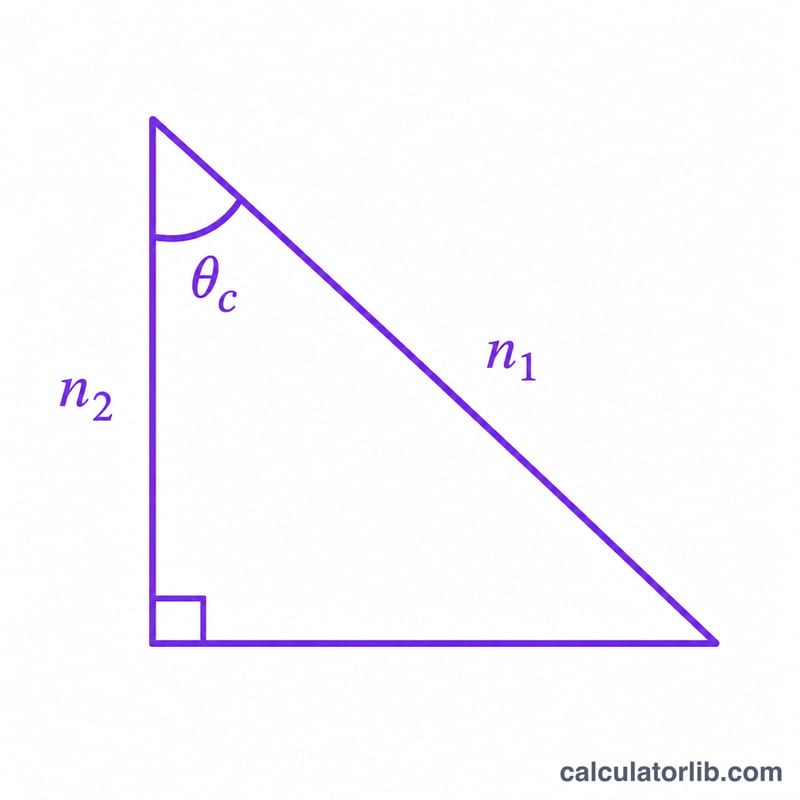
The critical angle comes directly from Snell's law, \(n_1\cdot\sin(\theta_c) = n_2\cdot\sin(90\degree)\). Since \(\sin(90\degree) = 1\), this rearranges to \(\sin(\theta_c) = n_2/n_1\), and therefore $$\theta_c = \arcsin\!\left(\frac{n_2}{n_1}\right)$$ The ratio \(n_2/n_1\) must be less than or equal to 1 for the arcsine to be defined, which is exactly the \(n_1 > n_2\) condition.
Worked example
Light travels inside glass (\(n_1 = 1.5\)) toward air (\(n_2 = 1.0\)). The ratio is \(1.0/1.5 = 0.6667\), so $$\theta_c = \arcsin(0.6667) \approx 41.81\degree$$ Any ray hitting the glass-air boundary at more than about 41.8° from the normal will be totally internally reflected.
FAQ
Why does my calculation give no result? The critical angle only exists when going from a denser to a less dense medium. If \(n_2\) is greater than or equal to \(n_1\), light always refracts out and there is no TIR.
What is the critical angle for a diamond in air? With \(n_1 \approx 2.42\) and \(n_2 = 1.0\), \(\theta_c = \arcsin(1/2.42) \approx 24.4\degree\), which is why diamonds trap and reflect so much light.
Does the wavelength matter? Slightly. Refractive index varies with wavelength (dispersion), so use the index for your specific light colour for precise work.