
What Is a Mass-to-Mass Stoichiometry Calculator?
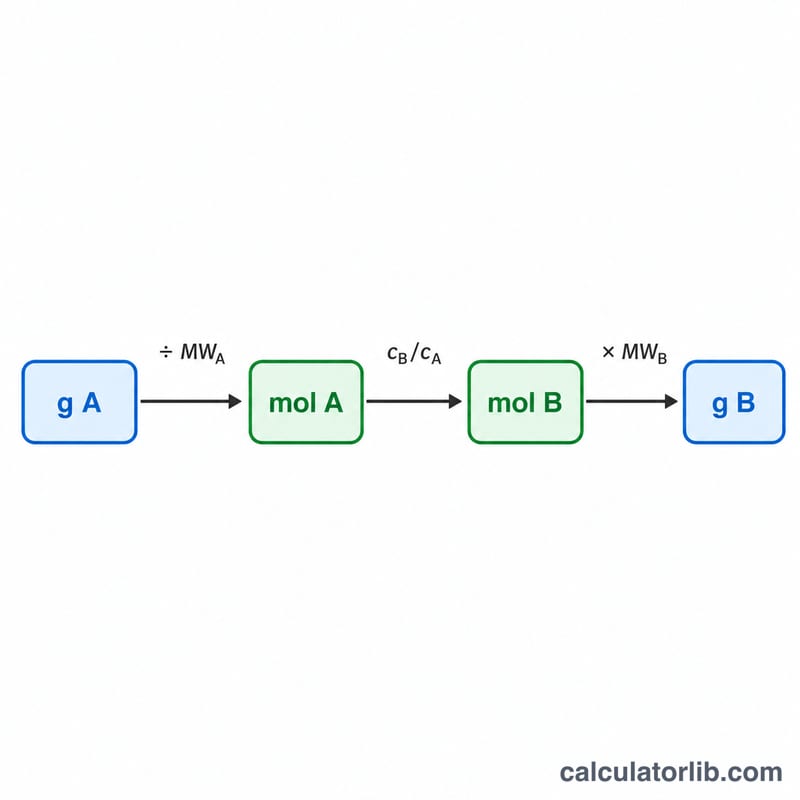
This calculator performs a classic stoichiometry conversion: given the mass of a reactant (A) in a balanced chemical reaction, it finds the mass of a product or other species (B). It works for any universal chemistry problem — there is no country or unit restriction. The three-step "mass → moles → moles → mass" map is the backbone of quantitative chemistry, and this tool automates all three steps at once.
How to Use It
Enter the known mass of substance A in grams. Provide the molar mass (g/mol) of both A and B — you can read these off the periodic table by summing the atomic masses in each formula. Finally enter the stoichiometric coefficients of A and B taken directly from your balanced equation. The calculator returns the mass of B, plus the intermediate moles of A and B so you can check your work.
The Formula Explained
The conversion chains three factors:
$$\text{Mass}_B = \frac{\text{Mass}_A}{\text{MW}_A} \cdot \frac{\text{Coef}_B}{\text{Coef}_A} \cdot \text{MW}_B$$
First, dividing the mass of A by its molar mass converts grams to moles. Next, the mole ratio \(\left(\text{Coef}_B/\text{Coef}_A\right)\) from the balanced equation converts moles of A to moles of B. Finally, multiplying by the molar mass of B converts moles back to grams.
Worked Example
Decomposition of water: 2 H2O → 2 H2 + O2. Suppose we have 10 g of H2 (MW 2.016, coefficient 2) and want the mass of H2O produced in reverse — using A = H2 and B = H2O (MW 18.015, coefficient 2): moles of A = \(10 / 2.016 = 4.9603\) mol; moles of B = \(4.9603 \times (2/2) = 4.9603\) mol; mass of B = \(4.9603 \times 18.015 = 89.36\) g.
FAQ
Where do the coefficients come from? They are the numbers in front of each substance in your balanced chemical equation.
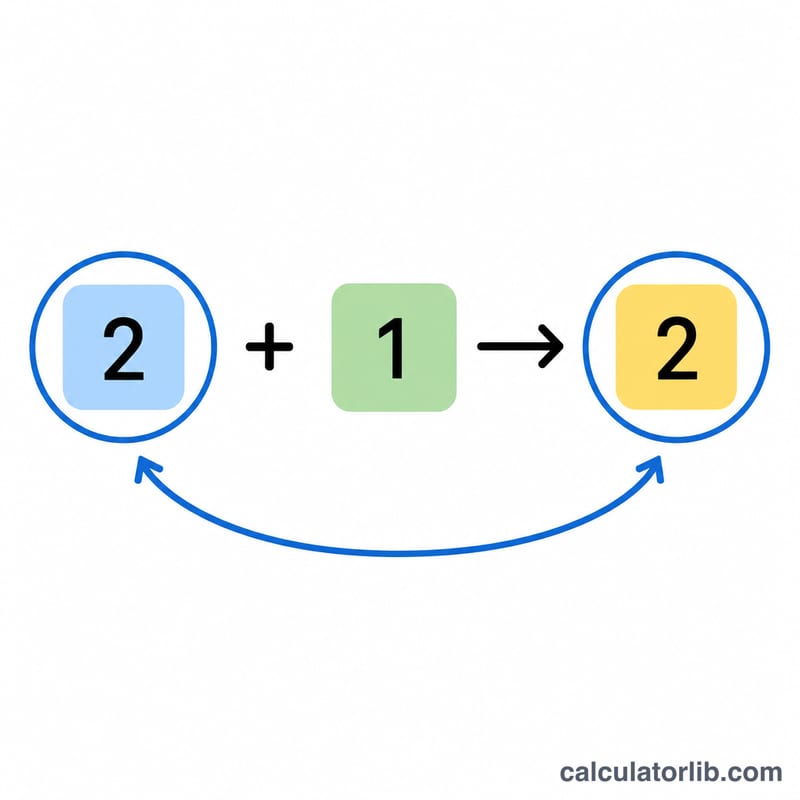
What if A and B have a 1:1 ratio? Set both coefficients to 1 (or any equal value); the ratio becomes 1 and only molar masses matter.
Can I convert product back to reactant? Yes — just assign your known substance as A and the unknown as B; the math is symmetric.