
What is molar mass?
The molar mass of a substance is the mass of one mole (\(6.022 \times 10^{23}\) particles) of that substance, expressed in grams per mole (g/mol). It is found by adding up the standard atomic weights of every atom in the chemical formula. This calculator parses a formula you type — including parentheses and subscripts — and returns the molar mass instantly.
How to use this calculator
Type a chemical formula using correct element capitalization: the first letter is uppercase and any second letter is lowercase. For example NaCl is sodium chloride, while NACL would be misread. Use numbers as subscripts (H2O) and parentheses for repeating groups (Ca(OH)2, Al2(SO4)3). Press calculate to see the molar mass in g/mol and the total number of atoms per formula unit.
The formula explained
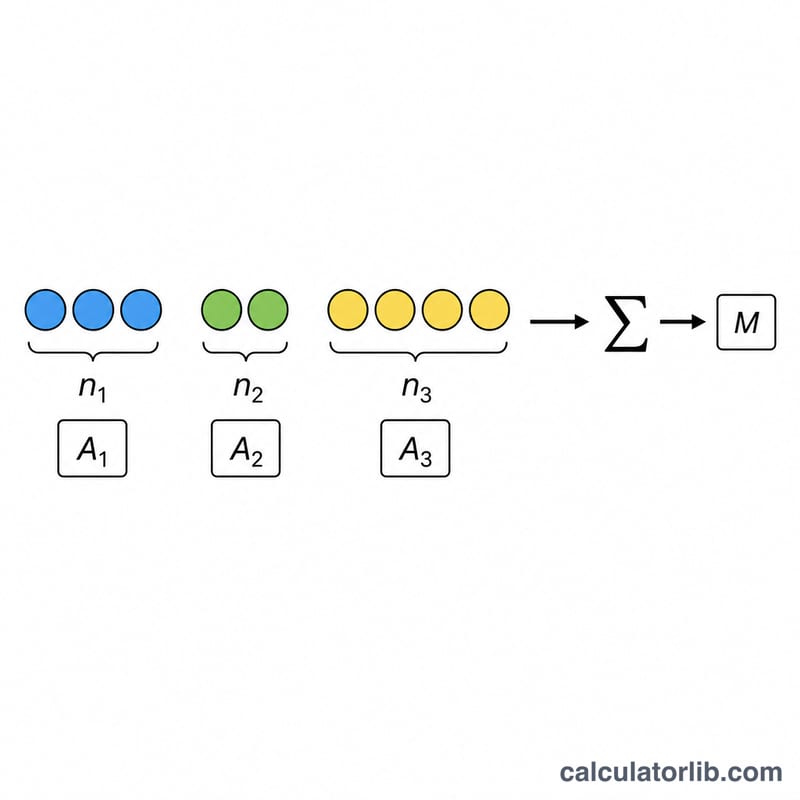
The equation is $$M = \sum_{i} n_i \cdot A_i \quad \text{from } \text{Chemical Formula}$$ where \(n_i\) is the number of atoms of element i in the formula and \(A_i\) is that element's standard atomic weight. The calculator expands parentheses first (multiplying the inner counts), tallies how many atoms of each element appear, multiplies each count by the atomic weight, and sums the products.
Worked example: glucose (C₆H₁₂O₆)
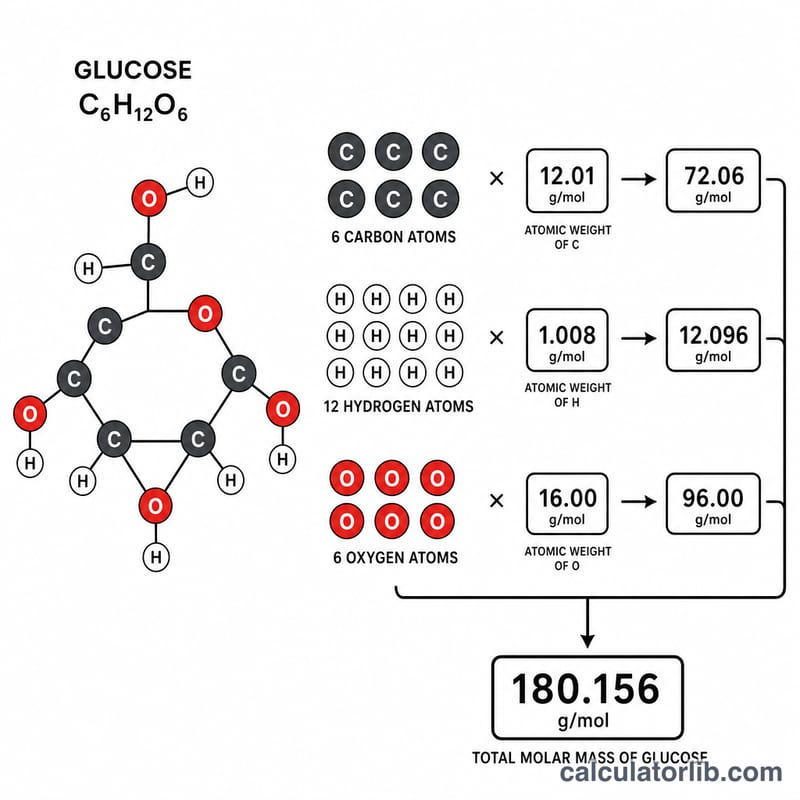
Glucose has 6 carbon, 12 hydrogen, and 6 oxygen atoms. Using \(A(\text{C})=12.011\), \(A(\text{H})=1.008\), \(A(\text{O})=15.999\): $$M = 6 \times 12.011 + 12 \times 1.008 + 6 \times 15.999 = 72.066 + 12.096 + 95.994 = 180.156 \text{ g/mol}.$$
FAQ
Where do the atomic weights come from? The values are standard atomic weights based on IUPAC data, rounded to common textbook precision, so small rounding differences from other sources are normal.
Does it handle hydrates or charges? Plain formulas and parentheses are supported. Dot-separated hydrates and ionic charges are not parsed; combine the atoms manually if needed.
Is molar mass the same as molecular weight? Numerically yes for molecules — molecular weight (in amu) equals molar mass (in g/mol). The difference is just the unit and context.