
What is the Young's Double-Slit Calculator?
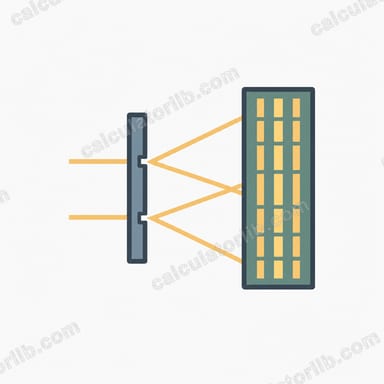
This tool models Young's classic double-slit experiment, which demonstrated the wave nature of light through interference. When coherent light passes through two narrow slits separated by a distance d, the waves overlap and produce a pattern of bright and dark fringes on a screen a distance L away. This calculator finds the position of any bright fringe, the spacing between fringes, and the diffraction angle.
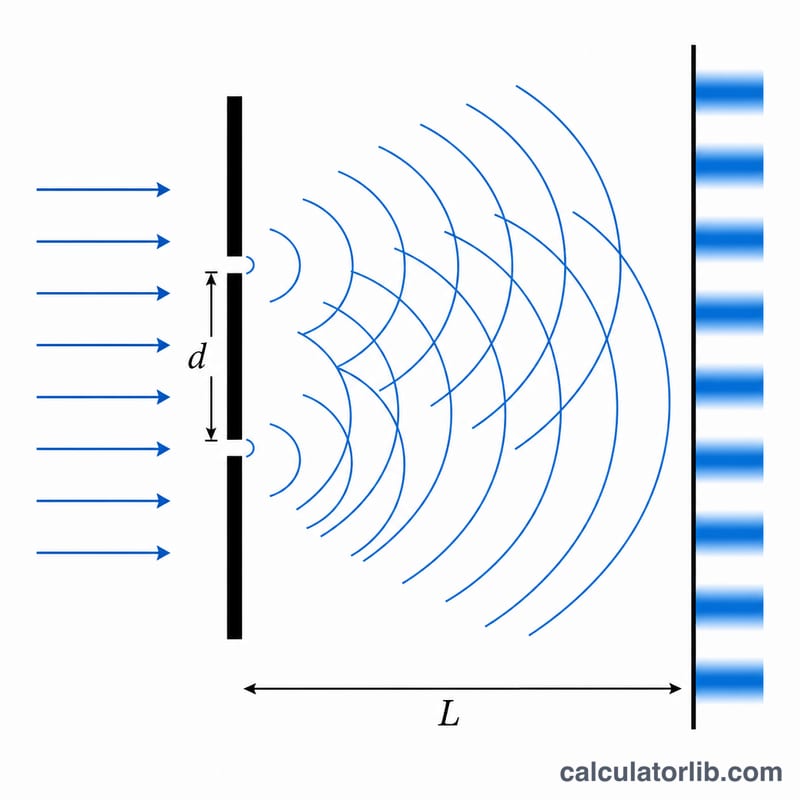
How to use it
Enter the wavelength of light in nanometres (visible light is roughly 380–750 nm), the slit separation in millimetres, the distance to the screen in metres, and the fringe order m (m = 0 is the central maximum, m = 1 the first bright fringe, and so on). The calculator returns the fringe position y in millimetres, the diffraction angle θ in degrees, and the spacing between adjacent fringes.
The formula explained
Constructive interference occurs when the path difference equals a whole number of wavelengths: \(d\cdot\sin\theta = m\lambda\). For small angles, \(\sin\theta \approx \tan\theta = y/L\), which gives the convenient fringe-position formula $$y = \frac{m\lambda L}{d}$$ The spacing between neighbouring bright fringes is $$\Delta y = \frac{\lambda L}{d}$$ independent of the order.
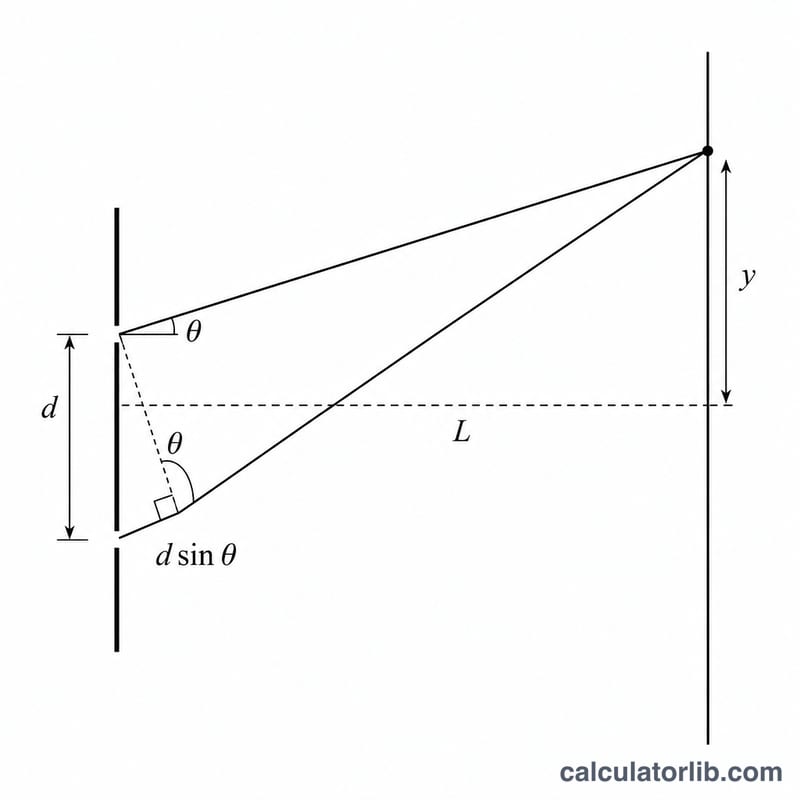
Worked example
Suppose \(\lambda = 500\ \text{nm}\), \(d = 0.1\ \text{mm}\), \(L = 1\ \text{m}\), and \(m = 1\). Converting units: \(\lambda = 5\times10^{-7}\ \text{m}\), \(d = 1\times10^{-4}\ \text{m}\). Then $$y = \frac{1 \times 5\times10^{-7} \times 1}{1\times10^{-4}} = 5\times10^{-3}\ \text{m} = 5\ \text{mm}$$ The fringe spacing equals the same 5 mm, and \(\sin\theta = m\lambda/d = 0.005\), so \(\theta \approx 0.2865^\circ\).
FAQ
Does the small-angle approximation always hold? The \(y = m\lambda L/d\) formula assumes θ is small (a few degrees). The diffraction angle θ output uses the exact \(d\cdot\sin\theta = m\lambda\) relation, so compare both for large angles.
What is fringe order m? It counts bright maxima from the centre. m = 0 is the central peak; higher m values are farther out.
Why convert wavelength to nm and d to mm? Those are the natural lab units; the calculator converts everything to metres internally for consistency.