
What is Young's Modulus?
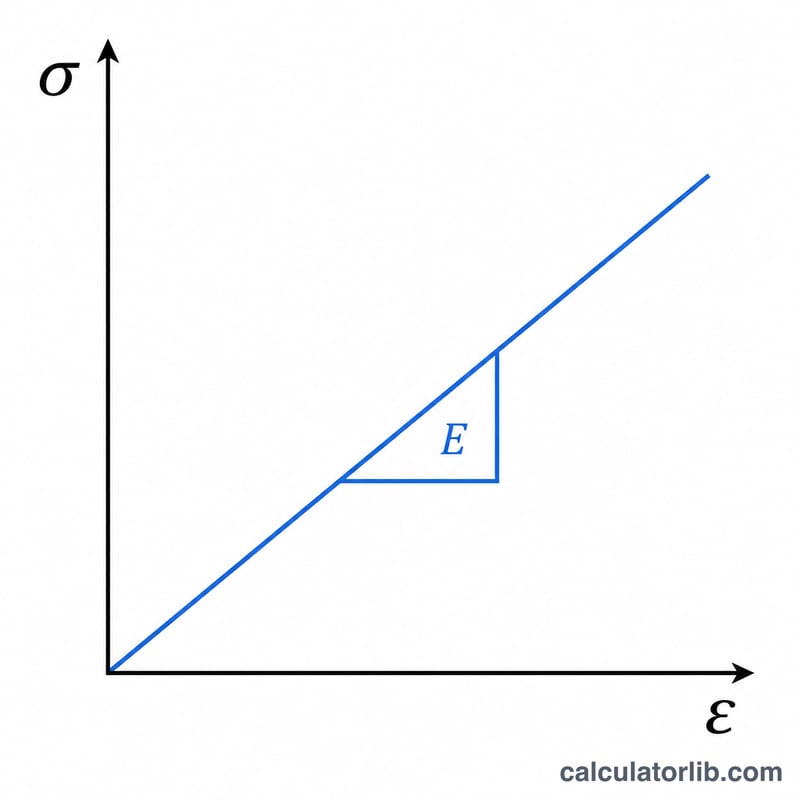
Young's modulus (E), also called the modulus of elasticity, measures a material's stiffness — how strongly it resists being stretched or compressed elastically. It is defined as the ratio of tensile stress to tensile strain within the linear (Hookean) region of a material's stress–strain curve. A high Young's modulus (like steel, ~200 GPa) means the material is very stiff, while a low value (like rubber) means it deforms easily.
How to use this calculator
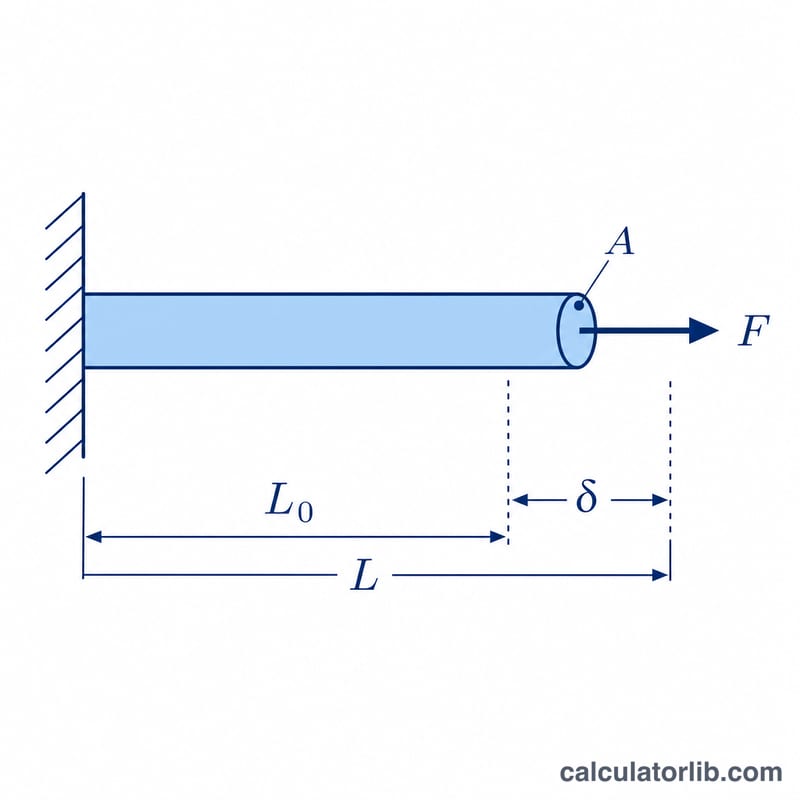
Enter the applied force F in newtons, the cross-sectional area A in square metres, the original length L₀ in metres, and the measured change in length ΔL in metres. The calculator returns Young's modulus in pascals and gigapascals, along with the underlying stress and strain values so you can check each step.
The formula explained
Stress is force divided by area, \(\sigma = F/A\), expressed in pascals (N/m²). Strain is the fractional elongation, \(\varepsilon = \Delta L / L_0\), which is dimensionless. Young's modulus is their ratio:
$$E = \frac{\sigma}{\varepsilon} = \frac{F \cdot L_0}{A \cdot \Delta L}$$Because strain is small for stiff materials, E is usually a very large number, which is why values are commonly reported in gigapascals (1 GPa = 10⁹ Pa).
Worked example
Suppose a wire with cross-sectional area \(A = 0.0001 \text{ m}^2\) and original length \(L_0 = 2 \text{ m}\) is pulled with force \(F = 1000 \text{ N}\), stretching by \(\Delta L = 0.0005 \text{ m}\). Stress:
$$\sigma = \frac{1000}{0.0001} = 10{,}000{,}000 \text{ Pa}$$Strain:
$$\varepsilon = \frac{0.0005}{2} = 0.00025$$Therefore:
$$E = \frac{10{,}000{,}000}{0.00025} = 4 \times 10^{10} \text{ Pa} = 40 \text{ GPa}$$FAQ
What units should I use? Use SI units — newtons for force, square metres for area, metres for length — to get E directly in pascals. Convert mm² to m² (divide by 1,000,000) before entering.
Is Young's modulus the same as stiffness? They are related but not identical. Stiffness depends on geometry as well, whereas Young's modulus is an intrinsic material property independent of shape.
Does it only apply to tension? The same modulus applies to small elastic compression for most materials, as long as you stay within the linear elastic region below the yield point.