
What is the Shear Modulus?
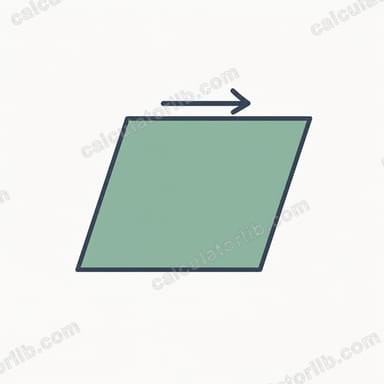
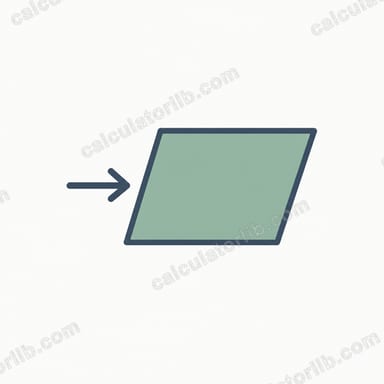
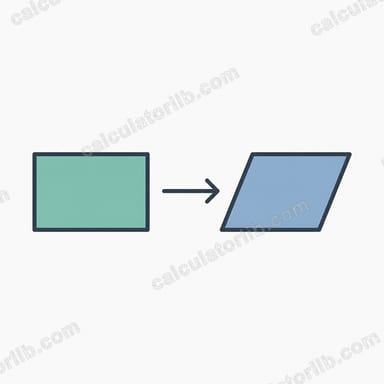
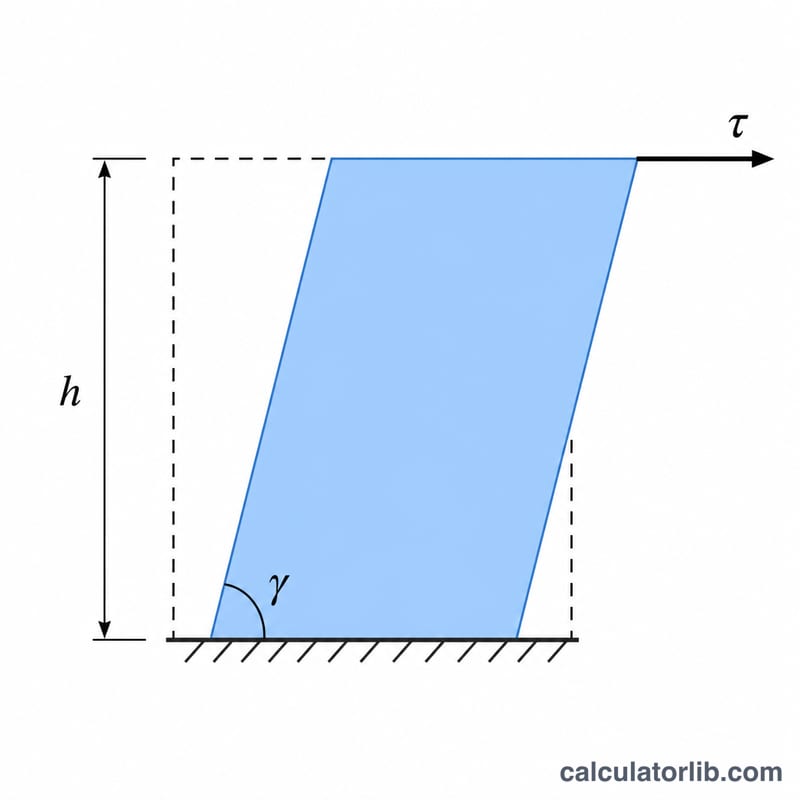
The shear modulus, also called the modulus of rigidity and denoted G, measures a material's resistance to shape change under shear loading. A high shear modulus means the material is stiff and deforms only slightly when twisted or sheared; a low value means it shears easily. It is one of the fundamental elastic constants used in engineering, materials science, and structural analysis.
How to Use This Calculator
Choose your input method. If you have measured a shear stress and the resulting shear strain, select From shear stress & strain and enter \(\tau\) in pascals and \(\gamma\) as a dimensionless ratio. If you instead know the material's Young's modulus and Poisson's ratio, select From Young's modulus & Poisson's ratio and enter \(E\) (Pa) and \(\nu\). The calculator returns \(G\) in pascals and gigapascals.
The Formula Explained
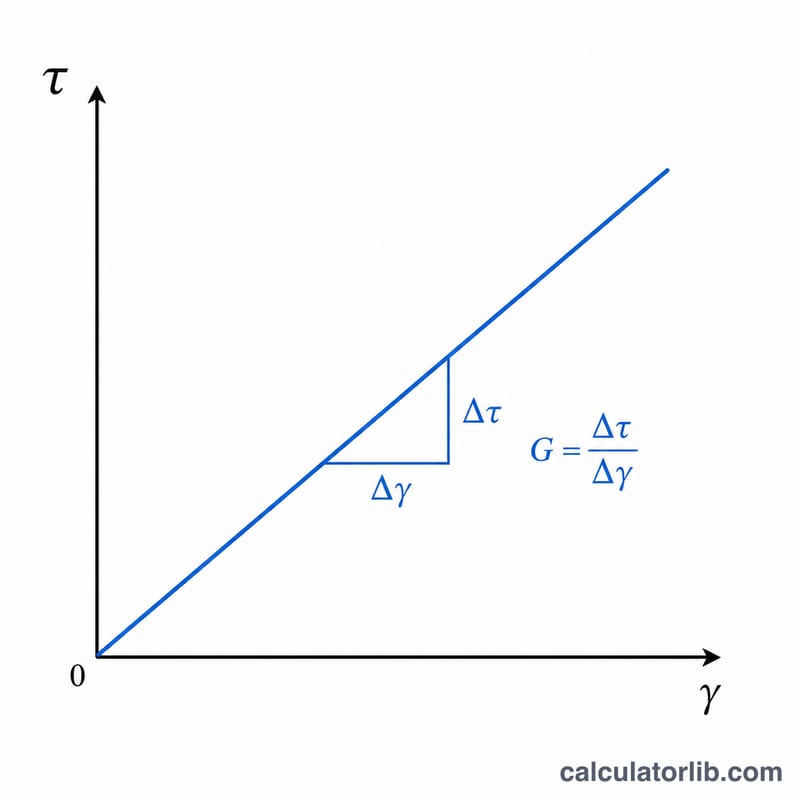
Within the elastic (linear) range, shear stress is proportional to shear strain: $$G = \frac{\tau}{\gamma}$$ For an isotropic material, the three primary elastic constants are linked, so the shear modulus can also be derived from the tensile modulus and Poisson's ratio: $$G = \frac{E}{2\left(1 + \nu\right)}$$ This relationship is exact for ideal isotropic solids.
Worked Example
Steel has a Young's modulus of \(E = 200\ \text{GPa}\) and a Poisson's ratio of \(\nu = 0.3\). Then $$G = \frac{200\ \text{GPa}}{2 \times 1.3} = \frac{200}{2.6} \approx 76.92\ \text{GPa}$$ This matches the typical published shear modulus of structural steel (~77 GPa).
FAQ
What are typical shear modulus values? Steel \(\approx 79\ \text{GPa}\), aluminum \(\approx 26\ \text{GPa}\), copper \(\approx 45\ \text{GPa}\), rubber a few MPa.
Is shear modulus the same as Young's modulus? No. Young's modulus governs stretching/compression, while the shear modulus governs shape distortion under shear. They are related through Poisson's ratio.
What units should I use? Use consistent SI units: stress in pascals (Pa) and strain dimensionless, giving \(G\) in pascals. The result is also shown in GPa for convenience.