
What Is Shear Wave Velocity?
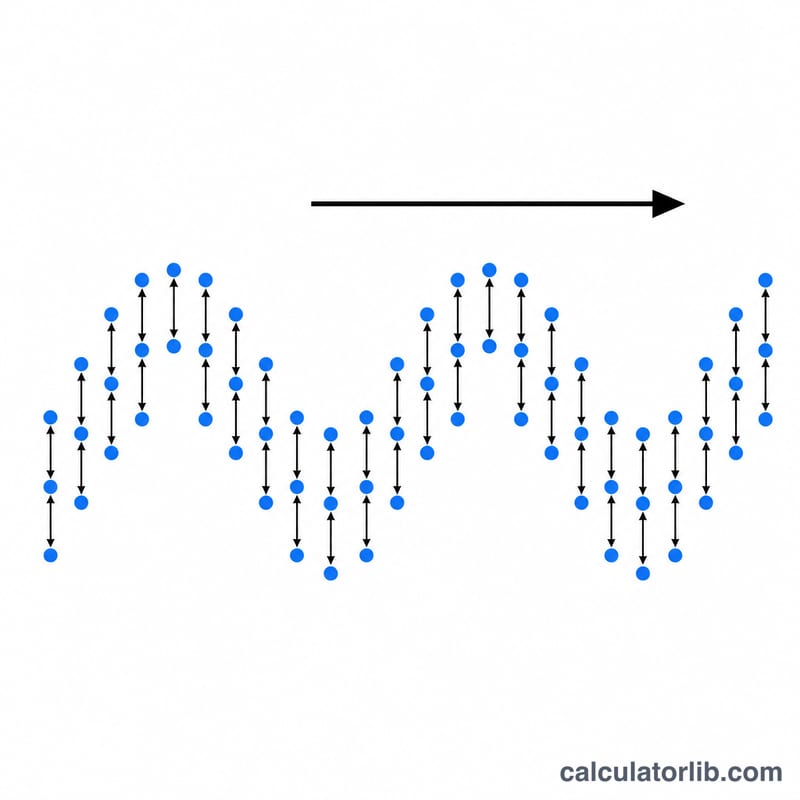
Shear wave velocity (Vs) is the speed at which a transverse, or secondary (S), wave propagates through a solid material. Unlike compressional (P) waves, shear waves displace particles perpendicular to the direction of travel and cannot pass through fluids. Vs is a fundamental parameter in seismology, geotechnical engineering, and materials science, used to characterize soil stiffness, rock properties, and the elastic behavior of metals and composites.
How to Use This Calculator
Enter the material's shear modulus G in pascals (Pa) and its mass density ρ in kilograms per cubic meter (kg/m³). The calculator returns the shear wave velocity in meters per second, plus a convenient kilometers-per-second conversion. Be sure your units are consistent SI units so the result is in m/s.
The Formula Explained
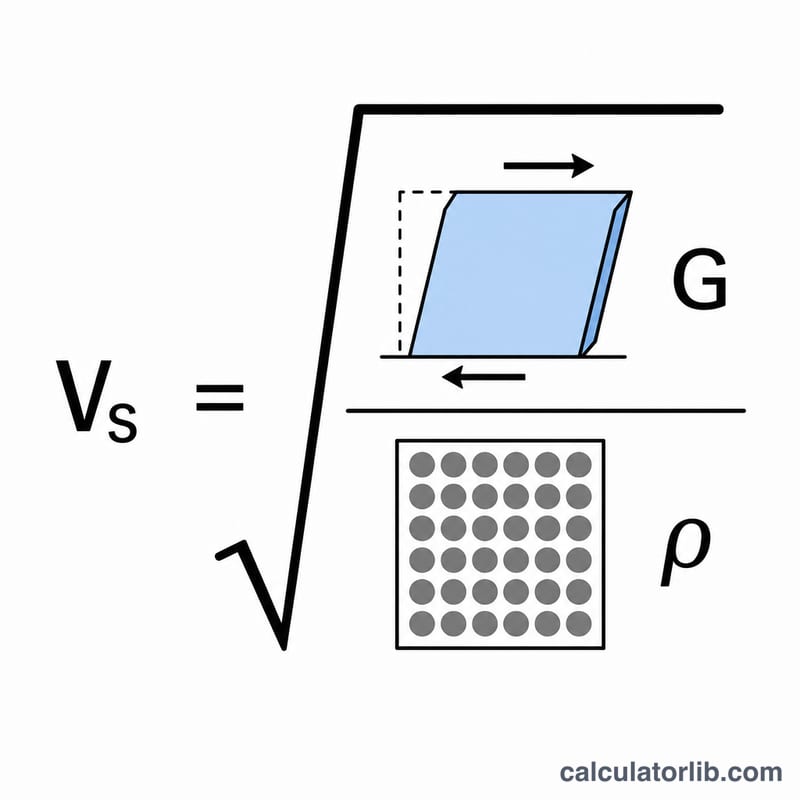
The governing equation is $$V_s = \sqrt{\dfrac{\text{Shear Modulus }G\text{ (Pa)}}{\text{Density }\rho\text{ (kg/m}^3\text{)}}}$$ The shear (rigidity) modulus \(G\) quantifies a material's resistance to shape change under shear stress, while \(\rho\) is its density. A stiffer material (higher \(G\)) transmits shear waves faster, whereas a denser material (higher \(\rho\)) slows them down. The square-root relationship means velocity scales with the square root of the stiffness-to-density ratio.
Worked Example
For aluminum, \(G \approx 26\text{ GPa}\) (26,000,000,000 Pa) and \(\rho \approx 2700\text{ kg/m}^3\). Then $$V_s = \sqrt{\frac{26{,}000{,}000{,}000}{2700}} = \sqrt{9{,}629{,}629.6} \approx 3103\text{ m/s},$$ or about 3.1 km/s — close to the textbook shear wave speed for aluminum.
FAQ
What units should I use? Use pascals for G and kg/m³ for ρ to get velocity in m/s. 1 GPa = 1,000,000,000 Pa.
Why is Vs always less than Vp? Compressional waves depend on both bulk and shear moduli, so they travel faster than shear waves in the same medium.
Can shear waves travel through liquids? No. Fluids have zero shear modulus (\(G = 0\)), so \(V_s = 0\) — fluids cannot support shear waves.