
What this calculator does
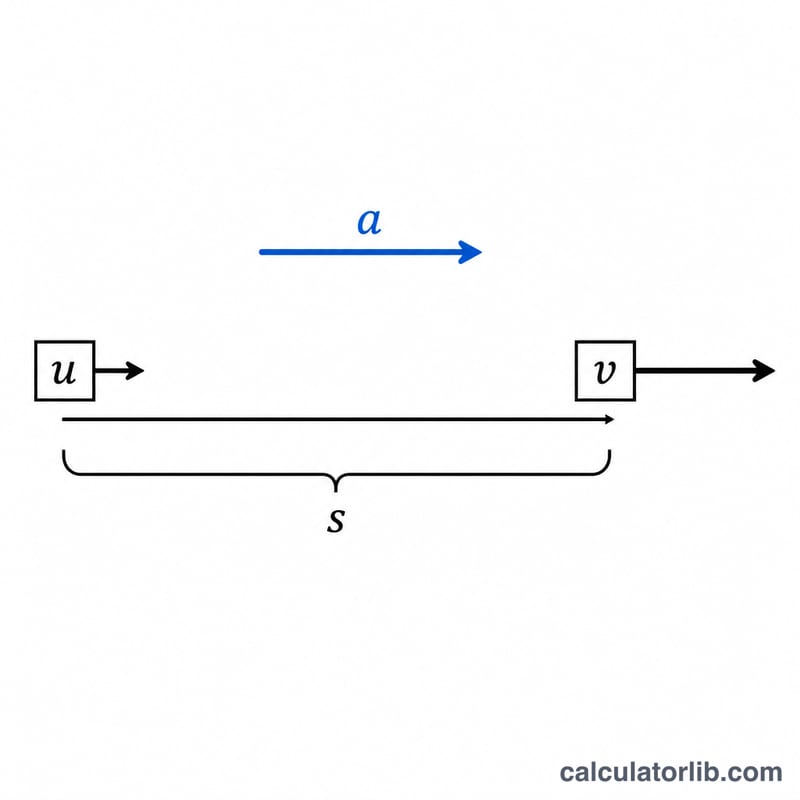
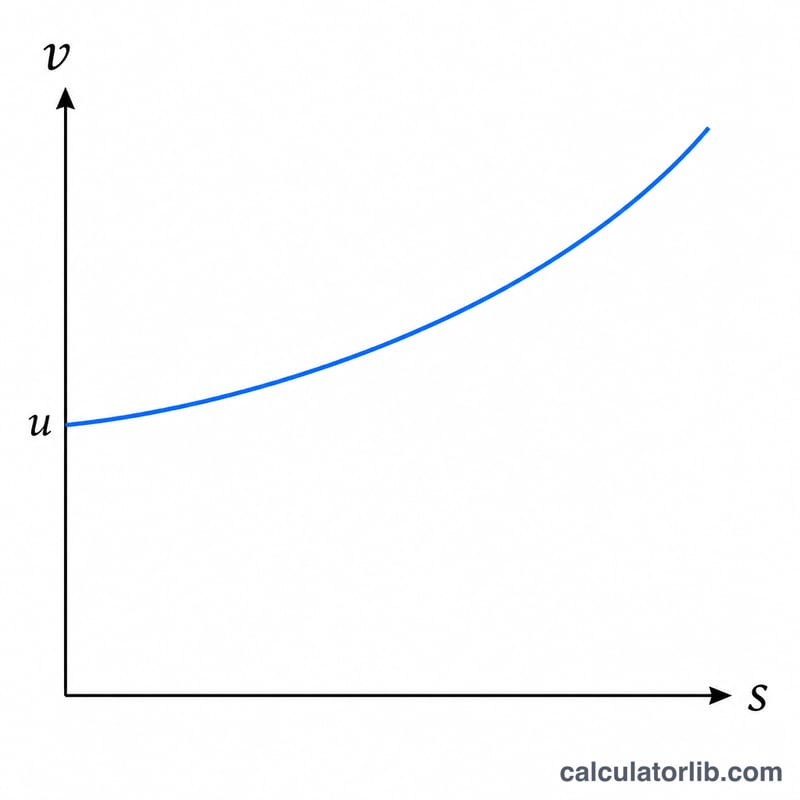
This tool solves the constant-acceleration kinematic equation \(v^{2} = u^{2} + 2as\) for any one of its four variables: final velocity (v), initial velocity (u), acceleration (a), or displacement (s). It is the one "big five" kinematics equation that contains no time term, so it is ideal when you know three of the four quantities and need the fourth quickly. Every input has its own unit menu, and the answer is converted back into whichever unit you choose.
How to use it
Pick what you want to find from the "Choose a Calculation" menu. Enter the three known quantities, selecting the correct unit for each (m/s, km/h, ft/s, knots, g, miles, etc.). Choose a significant-figure setting if you need a specific precision, then read the result. Internally the calculator converts everything to SI base units (m/s, m/s², m), applies the formula, and converts the answer back to your selected unit.
The formula explained
Starting from \(v^{2} = u^{2} + 2as\), the rearrangements are: $$v = \sqrt{u^{2} + 2as}, \quad u = \sqrt{v^{2} - 2as}, \quad a = \frac{v^{2} - u^{2}}{2s}, \quad s = \frac{v^{2} - u^{2}}{2a}.$$ The two velocity solutions use a square root, so the calculator returns the non-negative (magnitude) root. If the radicand is negative there is no real solution — physically the object stops or reverses before reaching that displacement.
Worked example
A car starts from rest (\(u = 0\) m/s) and accelerates at \(a = 3\) m/s² over \(s = 30\) m. Find v. $$v = \sqrt{0^{2} + 2\cdot 3\cdot 30} = \sqrt{180} \approx 13.42 \text{ m/s},$$ which is about 48.3 km/h.
FAQ
Why do I sometimes get "No real solution"? When solving for v or u, the term under the square root can go negative (e.g. heavy braking over a long distance). That means the motion never reaches that displacement, so no real velocity exists.
Why is acceleration "undefined" with zero displacement? Solving for a divides by \(2s\), and solving for s divides by \(2a\); a zero denominator makes the result undefined unless u and v are equal.
Does this account for direction? Velocities are treated as scalar components along the chosen positive direction. Use a negative acceleration value to represent deceleration.