
What Is the Wave Velocity Calculator?
The Wave Velocity Calculator finds how fast a wave travels through a medium based on its frequency and wavelength. Every periodic wave — whether sound, light, water ripples, or a vibrating string — obeys the same fundamental relationship: velocity equals frequency times wavelength. This tool works for any wave type and any consistent set of SI units, making it useful for students, engineers, and hobbyists alike.
How to Use It
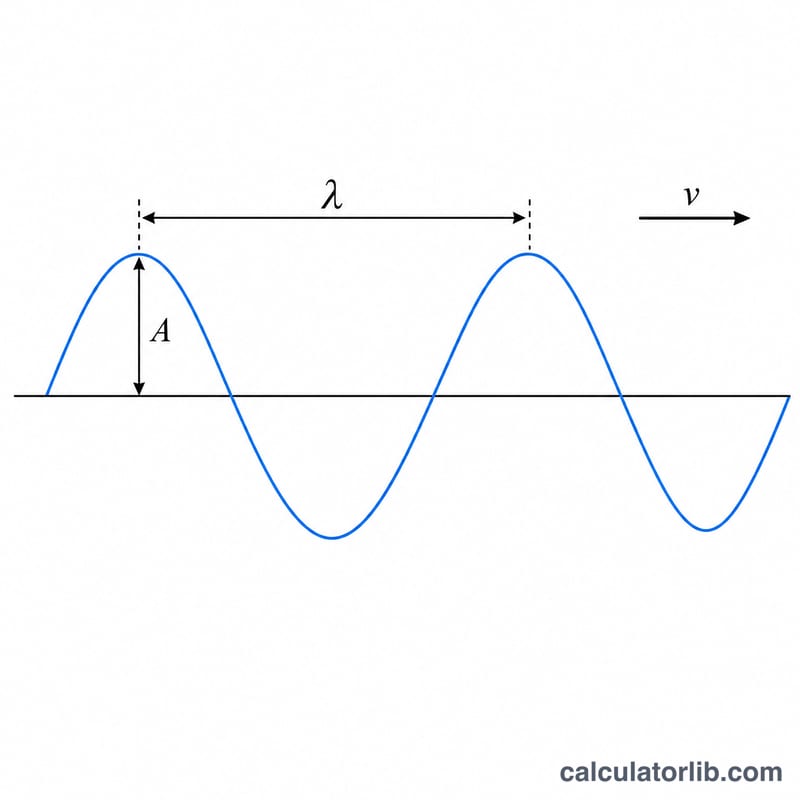
Enter the frequency of the wave in hertz (Hz), which is the number of cycles passing a point each second. Then enter the wavelength in meters (m), the distance between two consecutive crests. The calculator multiplies the two values and returns the wave velocity in meters per second (m/s).
The Formula Explained
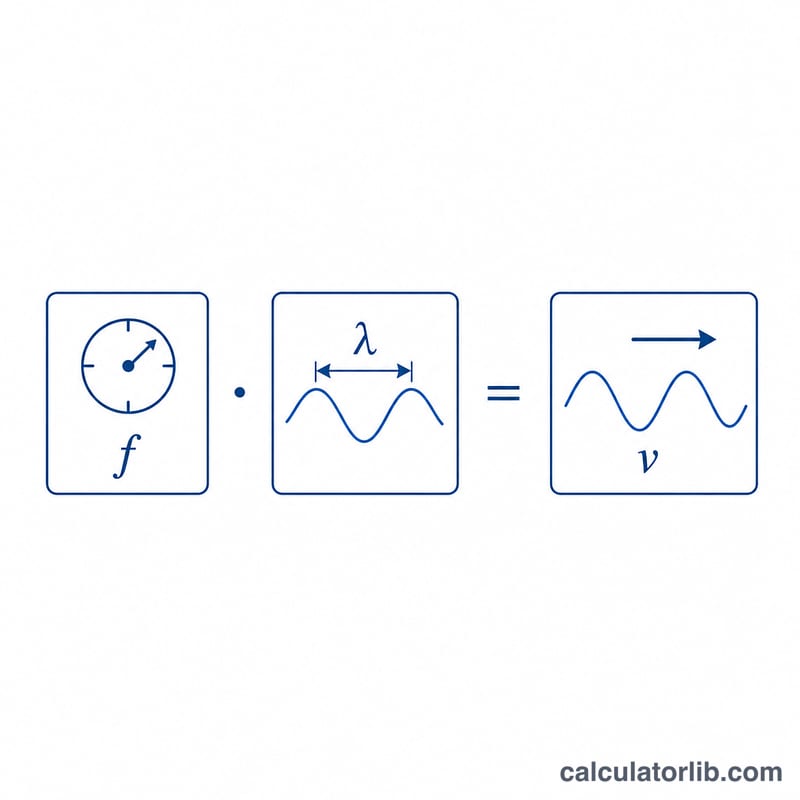
The wave equation is:
$$v = f \times \lambda$$
Here v is the wave velocity (m/s), f is the frequency (Hz, or 1/s), and λ (lambda) is the wavelength (m). Because frequency and period are inverses (\(f = 1/T\)), the equation can also be written as \(v = \lambda / T\). Rearranging lets you solve for any one variable when you know the other two.
Worked Example
Suppose a sound wave has a frequency of 440 Hz (musical note A4) and a wavelength of 0.78 m in air. The velocity is:
$$v = 440 \times 0.78 = 343.2 \text{ m/s}$$ — close to the real speed of sound in air at room temperature.
FAQ
Does this work for light waves? Yes. For light in a vacuum, v will come out near \(3 \times 10^8\) m/s if you use the correct frequency and wavelength.
What units should I use? Use hertz for frequency and meters for wavelength to get velocity in meters per second.
Can I find wavelength instead? Rearrange the formula: \(\lambda = v / f\). Divide the known velocity by the frequency.