
What Is On Base Percentage?
On Base Percentage (OBP) is a baseball statistic that measures how often a batter reaches base via a hit, walk, or hit by pitch. Unlike batting average, OBP rewards drawing walks, making it one of the best single measures of a hitter's ability to avoid making outs. A typical Major League OBP is around .320, while elite hitters routinely exceed .400.
How to Use This Calculator
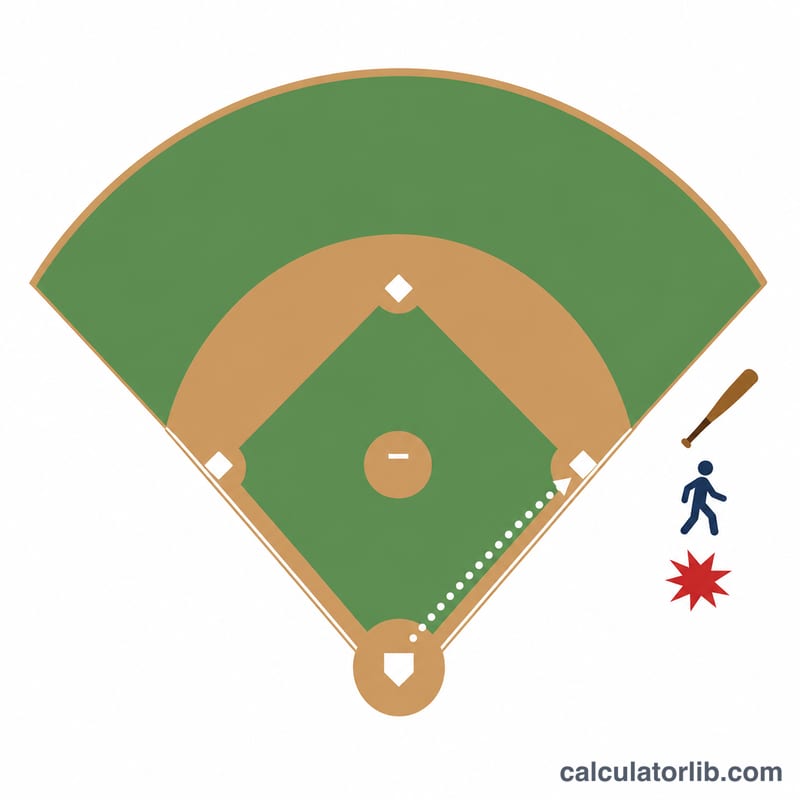
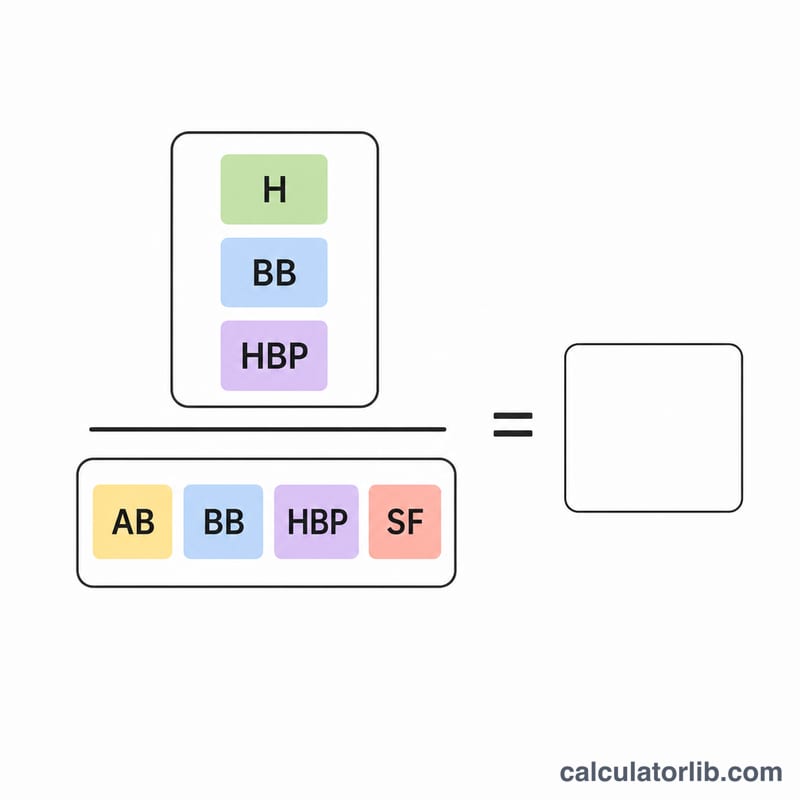
Enter the player's hits (H), walks/bases on balls (BB), hit by pitch (HBP), at bats (AB), and sacrifice flies (SF). The calculator instantly returns the OBP rounded to three decimal places, along with the total times reached base and the plate appearances counted in the denominator.
The Formula Explained
$$\text{OBP} = \frac{\text{H} + \text{BB} + \text{HBP}}{\text{AB} + \text{BB} + \text{HBP} + \text{SF}}$$ The numerator counts every way a batter safely reaches base. The denominator counts all qualifying plate appearances. Note that sacrifice bunts and catcher's interference are intentionally excluded from the standard OBP formula.
Worked Example
Suppose a player has 150 hits, 50 walks, 5 hit by pitch, 500 at bats, and 5 sacrifice flies. The numerator is \(150 + 50 + 5 = 205\). The denominator is \(500 + 50 + 5 + 5 = 560\). $$\text{OBP} = \frac{205}{560} = 0.366$$ an excellent on-base mark.
FAQ
What is a good OBP? An OBP above .350 is good and above .400 is outstanding; .320 is roughly league average.
How is OBP different from batting average? Batting average is hits divided by at bats and ignores walks and HBP. OBP includes those, so it credits patient hitters who draw walks.
Why are sacrifice flies in the denominator but not sacrifice bunts? By rule, sacrifice flies count as plate appearances that did not result in reaching base, while sacrifice bunts are excluded from OBP entirely.