
What is slugging percentage?
Slugging percentage (SLG) is a baseball and softball statistic that measures a hitter's power output by weighing each hit by the number of bases it produces. Unlike batting average, which counts every hit equally, slugging percentage gives more credit for extra-base hits. It is a standard, jurisdiction-independent statistic used worldwide. A value around .400 is solid, .500 is excellent, and the all-time single-season records sit near .800.
How to use this calculator
Choose an input pattern. In the default mode, enter the number of singles, doubles, triples and home runs, and the calculator sums them into total bases automatically. Alternatively, switch to direct mode and enter total bases yourself. In both modes, enter the number of official at-bats. The tool returns the at-bats, total bases, and the resulting slugging percentage rounded to three decimal places.
The formula explained
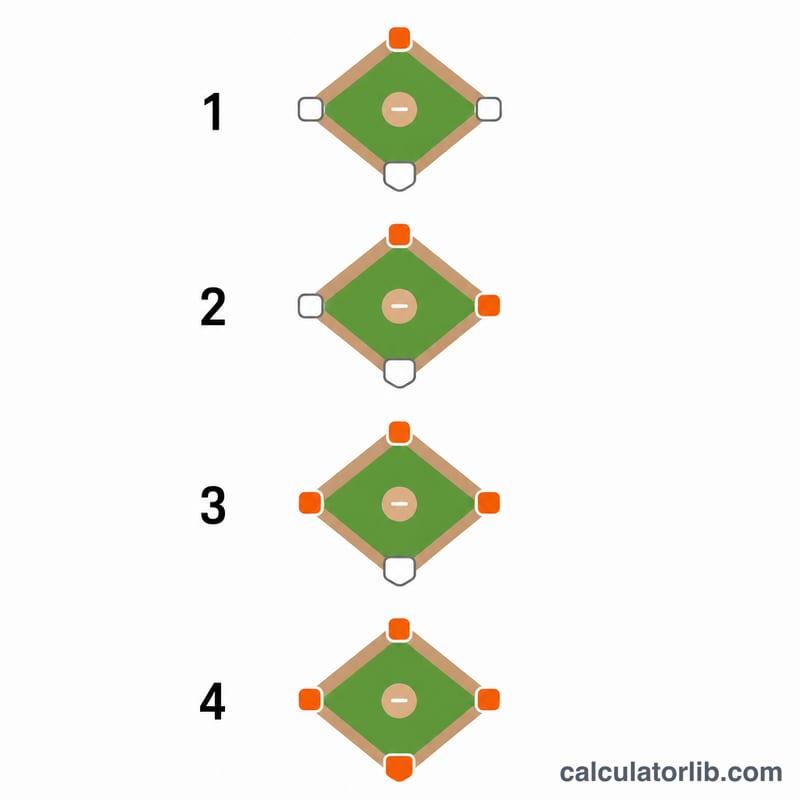
Total bases are computed as singles + 2×doubles + 3×triples + 4×home runs, because a single reaches one base, a double two, a triple three and a home run four. Slugging percentage then equals total bases divided by at-bats. The result is conventionally shown to three decimals and may exceed 1.000 (the theoretical maximum is 4.000, achieved only by hitting a home run in every at-bat).
$$\text{SLG} = \frac{\left(1 \times \text{1B}\right) + \left(2 \times \text{2B}\right) + \left(3 \times \text{3B}\right) + \left(4 \times \text{HR}\right)}{\text{At-Bats}}$$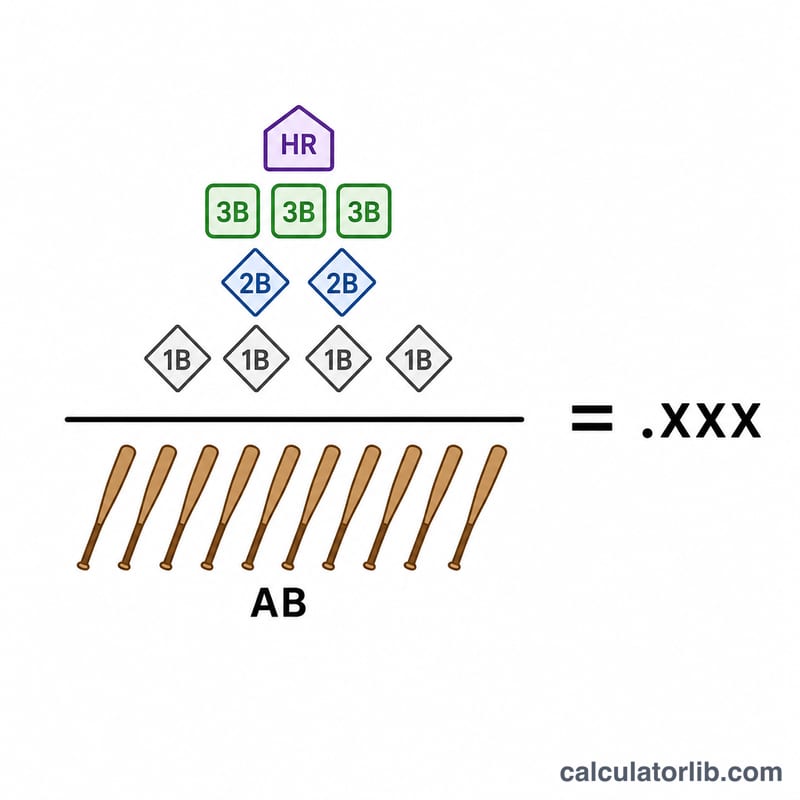
Worked example
A batter has 400 at-bats with 100 singles, 50 doubles, 10 triples and 10 home runs. Total bases = \(100 + (50\times2) + (10\times3) + (10\times4) = 100 + 100 + 30 + 40 = 270\).
$$\text{SLG} = \frac{270}{400} = 0.675$$displayed as .675.
Interpreting Your Slugging Percentage
Slugging percentage expresses the average bases earned per at-bat and can theoretically range from .000 to a maximum of 4.000 (a home run in every at-bat). In practice it falls well below 1.000. A higher SLG indicates greater power output — the batter is producing extra-base hits (doubles, triples, home runs) rather than only singles.
How SLG differs from batting average. Batting average (AVG) treats every hit equally: it is hits divided by at-bats, so a single and a home run count the same. Slugging percentage weights each hit by the number of bases it produces, so it credits power. A player can have a modest AVG but a strong SLG if a large share of their hits go for extra bases, or a high AVG with a low SLG if nearly all hits are singles.
How SLG relates to OBP and OPS. On-base percentage (OBP) measures how often a batter reaches base (including walks and hit-by-pitch), while SLG measures how far they advance when they do hit. OPS combines the two by simple addition:
$$\text{OPS} = \text{OBP} + \text{SLG}$$
Because OPS folds in both getting on base and hitting for power, it is widely used as a quick all-around offensive summary, whereas SLG isolates the power component alone.
League-average context. In Major League Baseball, the league-wide slugging percentage has historically sat broadly in the .390–.430 range across most modern seasons, so a qualified hitter above roughly .500 is generally considered a strong power producer, and elite single-season marks reach into the .600s and beyond. These reference points shift with era, ballpark and league, so always compare a player's SLG against the average for their own league and season rather than a fixed cutoff.
To see the full power-plus-on-base picture, the same hit totals can be carried into an OPS calculation that adds OBP and SLG together.
FAQ
Can slugging percentage be over 1.000? Yes. It is not capped at 100%; it can range from 0.000 up to a theoretical 4.000.
Are walks included? No. Walks, hit-by-pitches and sacrifices are not at-bats and do not contribute to total bases, so they are excluded from SLG.
What if at-bats is zero? Slugging percentage is undefined when at-bats is zero, so the calculator returns an error instead of dividing by zero.