
What is On-Base Percentage?
On-Base Percentage (OBP) measures how often a baseball or softball batter reaches base via a hit, a walk (base on balls), or a hit-by-pitch. It is one of the most important offensive statistics because it rewards every way of avoiding an out, not just getting a hit. OBP is a universal statistic used in every country that plays baseball; the formula is always the same.
How to Use This Calculator
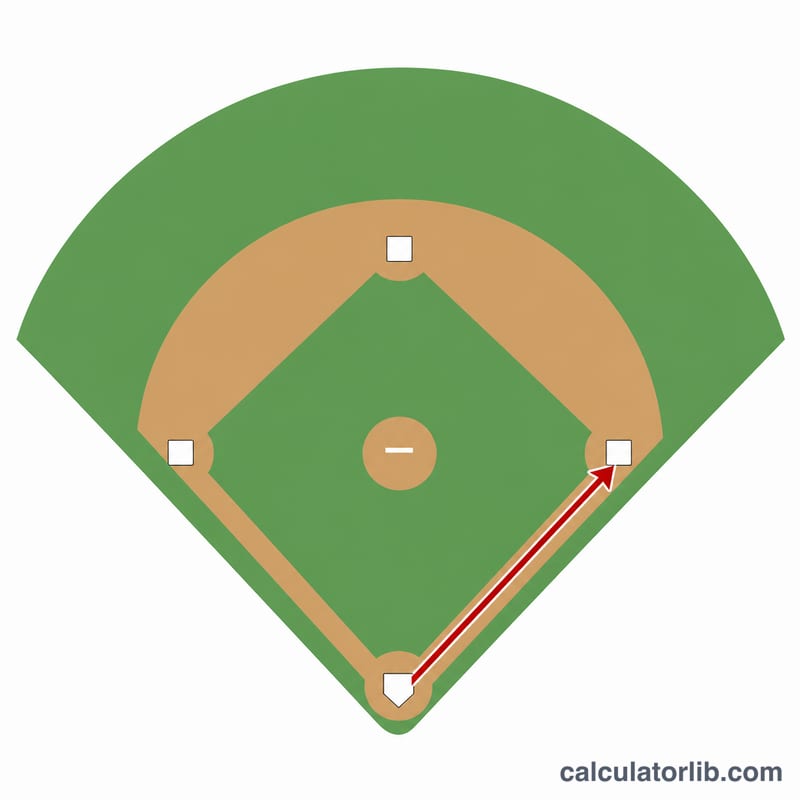
Enter the batter's season or career totals: At Bats, Hits, Walks, Hit By Pitch, and Sacrifice Flies. The calculator divides the times reached base by the qualifying plate appearances and shows the result to three decimal places, the way it appears on a stat line (for example .396). Hits should be the sum of singles, doubles, triples, and home runs.
The Formula Explained
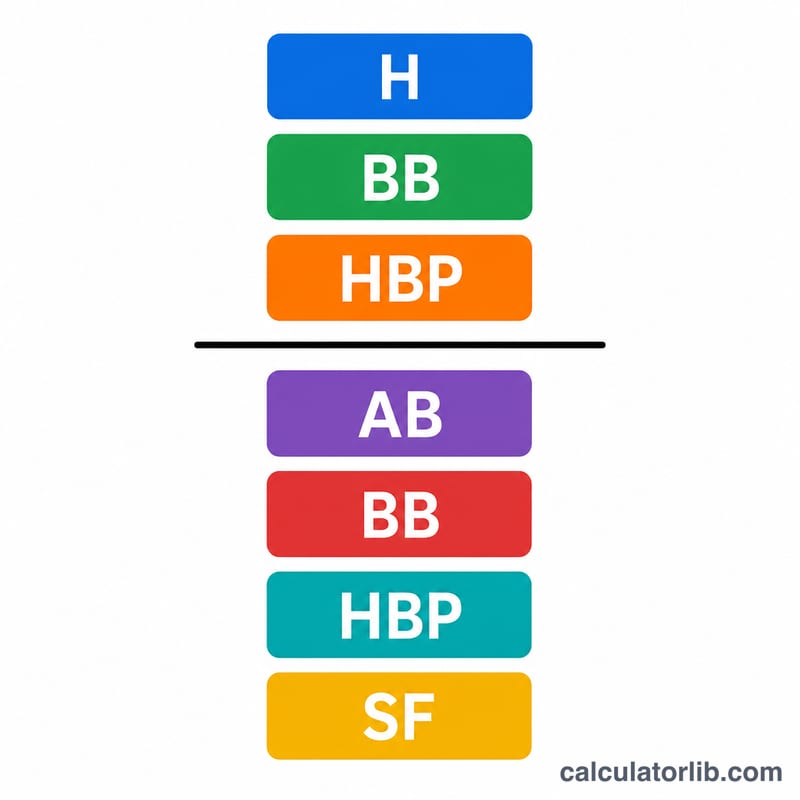
$$\text{OBP} = \frac{\text{Hits} + \text{Walks} + \text{Hit By Pitch}}{\text{At Bats} + \text{Walks} + \text{Hit By Pitch} + \text{Sacrifice Flies}}$$ At-bats already exclude walks, hit-by-pitch, and sacrifices, which is why those terms are added back into the denominator. Sacrifice bunts are deliberately left out of the denominator under official scoring rules.
Worked Example (Ichiro Suzuki, 2007)
Using the default values: numerator = \(238 + 49 + 3 = 290\); denominator = \(678 + 49 + 3 + 2 = 732\). $$\text{OBP} = \frac{290}{732} = 0.39617\ldots$$ which rounds to 0.396.
OBP Benchmarks: From Poor to Elite
On-Base Percentage (OBP) measures how often a batter reaches base via hits, walks, or being hit by a pitch. In modern Major League Baseball, a league-average OBP typically sits in the .310–.330 range, while the very best hitters routinely exceed .400. The table below gives general benchmarks for evaluating a full-season OBP.
| OBP Range | Rating | Interpretation |
|---|---|---|
| Below .300 | Poor | Struggles to reach base; a liability at the plate. |
| .300–.319 | Below Average | Reaches base less often than a typical regular. |
| .320–.339 | Average | Around the MLB league norm. |
| .340–.369 | Above Average / Good | A solid table-setter or middle-of-order contributor. |
| .370–.399 | Very Good | Among the better on-base hitters in the league. |
| .400 and above | Elite | Exceptional plate discipline and contact; rare over a full season. |
For context, a batter with 150 hits, 60 walks, 5 HBP in 500 at-bats and 5 sacrifice flies posts an OBP of .377 — squarely in the "very good" tier. Benchmarks differ in amateur and softball play, where higher OBPs are more common.
Definitions & Glossary
- At Bats (AB): Plate appearances that end in a hit or an out, excluding walks, hit-by-pitches, sacrifices, and times reaching on catcher's interference. AB is the denominator of batting average but only part of the OBP denominator.
- Hits (H): Any time the batter safely reaches base on a batted ball without the aid of an error or fielder's choice — singles, doubles, triples, and home runs.
- Walks / Base on Balls (BB): The batter is awarded first base after taking four pitches outside the strike zone. Walks count toward reaching base in OBP but are not at-bats.
- Hit By Pitch (HBP): The batter is awarded first base after being struck by a pitched ball. Like walks, HBP count in both the numerator and denominator of OBP.
- Sacrifice Fly (SF): A fly ball caught for an out that allows a runner to score. SF is not an at-bat but is added to the OBP denominator because it represents a plate appearance that did not result in reaching base.
- Plate Appearance (PA): Every completed turn at bat. PA = AB + BB + HBP + SF + sacrifice bunts + catcher's interference. OBP uses most plate-appearance outcomes but not all.
- Why sacrifice bunts are excluded: The OBP denominator is AB + BB + HBP + SF and deliberately leaves out sacrifice bunts (sacrifice hits). A sac bunt is considered a strategic, voluntary surrender of the at-bat to advance a runner, so it is neither counted against nor credited to the batter's on-base ability.
FAQ
Is OBP the same as batting average? No. Batting average is hits divided by at-bats only. OBP also credits walks and hit-by-pitch, so it is usually higher than the batting average.
Why might my OBP exceed 1.000? That signals inconsistent input, such as hits not being counted inside at-bats, or made-up numbers. A real OBP falls between 0 and 1.
What is a good OBP? In Major League Baseball, an OBP around .340 is roughly average, .370 is very good, and .400 or higher is elite.