
What Is an Attendance Percentage Calculator?
An attendance percentage calculator tells you what proportion of your classes, lectures, or work sessions you have actually attended. It is widely used by students who must meet a minimum attendance threshold (often 75%) to be eligible to sit exams, as well as by employees, trainers, and event organizers tracking participation.
How to Use It
Enter two numbers: the count of classes you attended and the total number of classes held. Click calculate and the tool returns your attendance percentage along with how many classes you missed. The math works for any session-based attendance, not just school.
The Formula Explained
The calculation is a simple ratio expressed as a percentage:
$$\text{Attendance \%} = \frac{\text{Classes Attended}}{\text{Total Classes}} \times 100$$Dividing attended by total gives a fraction between 0 and 1, and multiplying by 100 converts it to a percentage. Classes missed is simply \(\text{Total} - \text{Attended}\).

Worked Example
Suppose you attended 42 classes out of 50 total. Your attendance is
$$(42 \div 50) \times 100 = 0.84 \times 100 = 84\%$$and you missed \(50 - 42 = 8\) classes. With a 75% requirement, you are comfortably above the threshold.
Common Attendance Thresholds
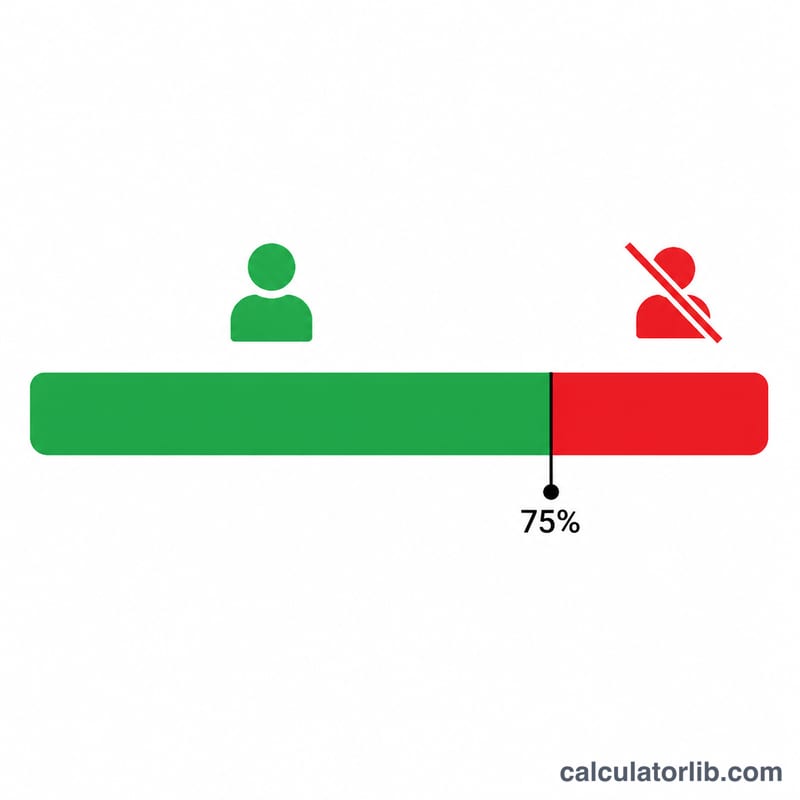
Most educational institutions set a minimum attendance percentage that students must meet to be eligible to sit for examinations. The exact value depends on the school, college, university or regulatory body, but the bands below are widely used. Always confirm the official figure in your own institution's regulations.
| Attendance % | Typical meaning |
|---|---|
| 75% | Most common minimum for exam eligibility at many colleges and universities |
| 65%–74% | Condonation / shortage band — may be allowed with a written request or fine in some institutions |
| Medical leave band | Documented illness or hospitalization may be excused, often raising the effective threshold to ~65% with proof |
| 85% | Stricter requirement used by some professional, medical and competitive programs |
| 90%+ | Often required for scholarships, hostel eligibility, or perfect-attendance recognition |
These thresholds vary by institution, course type and country. The numbers here are illustrative reference points, not official rules for any specific school.
Attendance Across Different Scenarios
The table below shows how the same formula \(\text{Attendance \%} = \frac{\text{Attended}}{\text{Total}} \times 100\) plays out for several realistic cases. "Missed" is simply total classes minus attended, and the last column compares against a common 75% eligibility cutoff.
| Attended | Total | Attendance % | Classes missed | Status vs 75% |
|---|---|---|---|---|
| 42 | 50 | 84% | 8 | Pass |
| 30 | 40 | 75% | 10 | Pass (exactly meets) |
| 60 | 80 | 75% | 20 | Pass (exactly meets) |
| 18 | 24 | 75% | 6 | Pass (exactly meets) |
| 95 | 100 | 95% | 5 | Pass |
Notice that 30/40, 60/80 and 18/24 all equal exactly 75% — the ratio matters, not the raw counts. A student who exactly meets the cutoff has no buffer, so any further absence drops them below the line.
Interpreting Your Attendance Percentage
Your attendance percentage is the share of all held classes you actually attended. Comparing it to your institution's threshold tells you where you stand:
- At or above 75%: Under the most common rule you would be eligible to sit for examinations. The further above the line you are, the more absences you can afford later without dropping below it.
- Below 75%: You may be classed as having a shortage of attendance, which can affect exam eligibility unless your institution allows condonation, a fine, or excused medical leave with documentation.
How many more classes you need to recover. If you have attended \(a\) of \(t\) classes and want to reach a target fraction \(p\) (for example 0.75) by attending the next \(x\) classes in a row, solve:
$$\frac{a + x}{t + x} \ge p \quad\Rightarrow\quad x \ge \frac{p\,t - a}{1 - p}$$
For example, with 27 attended out of 40 (67.5%) and a 75% target: \(x \ge \frac{0.75 \times 40 - 27}{1 - 0.75} = \frac{30 - 27}{0.25} = 12\) consecutive classes attended. Note that this only works while classes remain; once a term ends, the total is fixed and the percentage can no longer be raised.
Thresholds, condonation rules and how medical leave is counted are institution-specific and can differ between programs at the same school. This page explains the general arithmetic only — check your official handbook or registrar for the rules that apply to you. While reviewing your standing you may also want to check your current grade so far or your average of scores.
FAQ
How much attendance do I need to keep 75%? Multiply total classes by \(0.75\) to find the minimum number you must attend. For 50 classes, that is 38 (rounding up).
Can I use decimals? Yes — partial sessions or weighted hours work too, the formula divides whichever numbers you enter.
What if total classes is zero? Percentage is undefined when there are no classes; the calculator returns 0% in that case. Enter at least one total class for a meaningful result.