
What is Goals Against Average (GAA)?
Goals Against Average is a goalkeeper performance statistic that expresses how many goals a keeper concedes over the span of one full game, normalized over their total playing time. It works for any sport with a goalkeeper and a fixed game length — soccer, ice hockey, water polo, lacrosse and field hockey — because the game length is an explicit input. A lower GAA indicates a stronger defensive record.
How to use this calculator
Enter three numbers: the total goals conceded, the length of one full game, and the total time the goalkeeper has played. Use the same time unit for the two time fields (hours by default, but minutes work equally well). Because the two times appear as a ratio, the unit cancels and the result is the same. The output is the goals against average — the expected number of goals conceded per complete game.
The formula explained
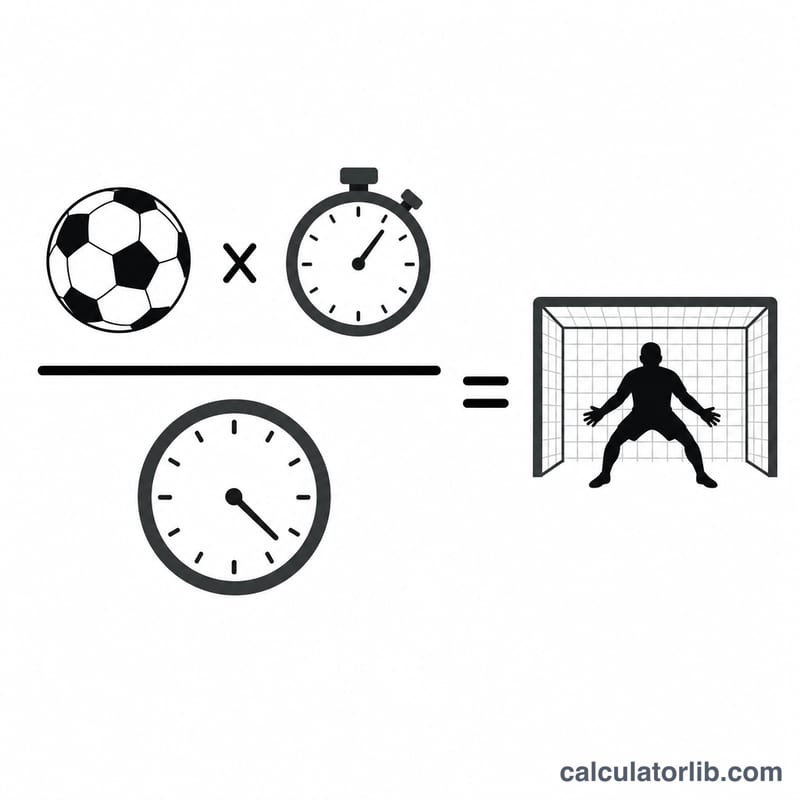
The formula is $$\text{GAA} = \frac{\text{Goals Against} \times \text{Game Length}}{\text{Total Playing Time}}$$ Multiplying the goals conceded by one game's length and dividing by total time scales the raw goal count to a per-game basis. For example, if a keeper has played the equivalent of three games, the calculation divides their total goals by three.
Worked example
A soccer goalkeeper conceded 5 goals across 4.5 hours of play, with each match lasting 1.5 hours (90 minutes). $$\text{GAA} = 5 \times 1.5 \div 4.5 = 7.5 \div 4.5 = 1.6667 \text{ goals per game}$$ This keeper concedes about 1.67 goals per full match.
FAQ
Does the time unit matter? No. As long as game length and total time played use the same unit, the ratio is identical whether you use minutes, hours or periods.
What if total time played is zero? The result is undefined, so the calculator returns zero rather than dividing by zero. Enter a positive total time.
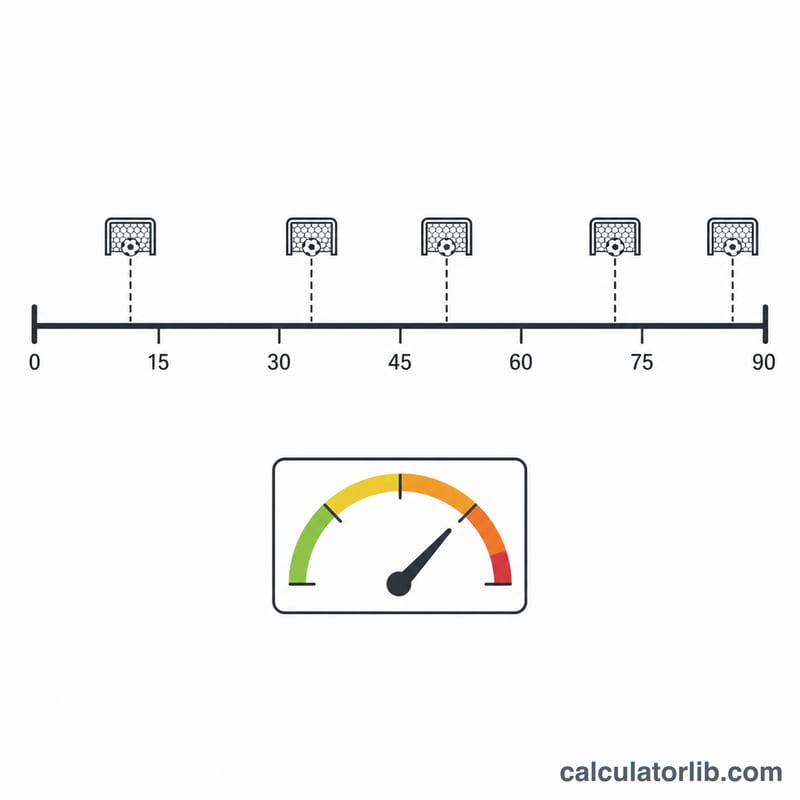
Is a lower or higher GAA better? A lower GAA is better — it means the goalkeeper concedes fewer goals per game.