
What Is Batting Average?
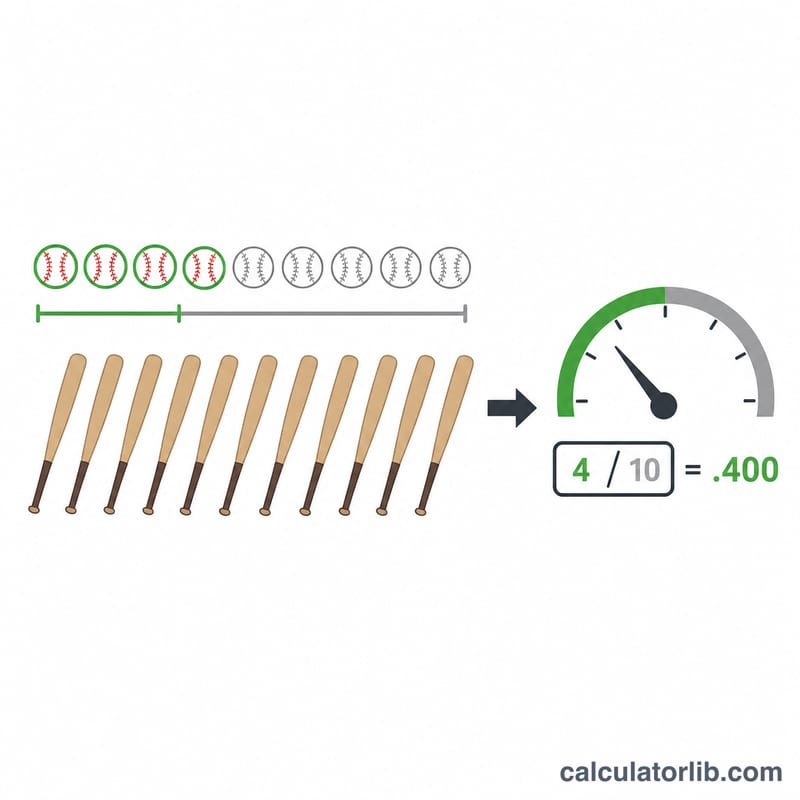
Batting average (AVG) is the most familiar offensive statistic in baseball and softball. It measures how often a batter gets a hit per official at-bat. An average of .300 — meaning 3 hits every 10 at-bats — is widely regarded as an excellent result, while .250 is roughly league-average.
How to Use This Calculator
Enter the player's total number of hits and total at-bats, then read the resulting average. Note that at-bats exclude walks, hit-by-pitch, sacrifice flies, and sacrifice bunts, so the number is usually lower than total plate appearances.
The Formula Explained
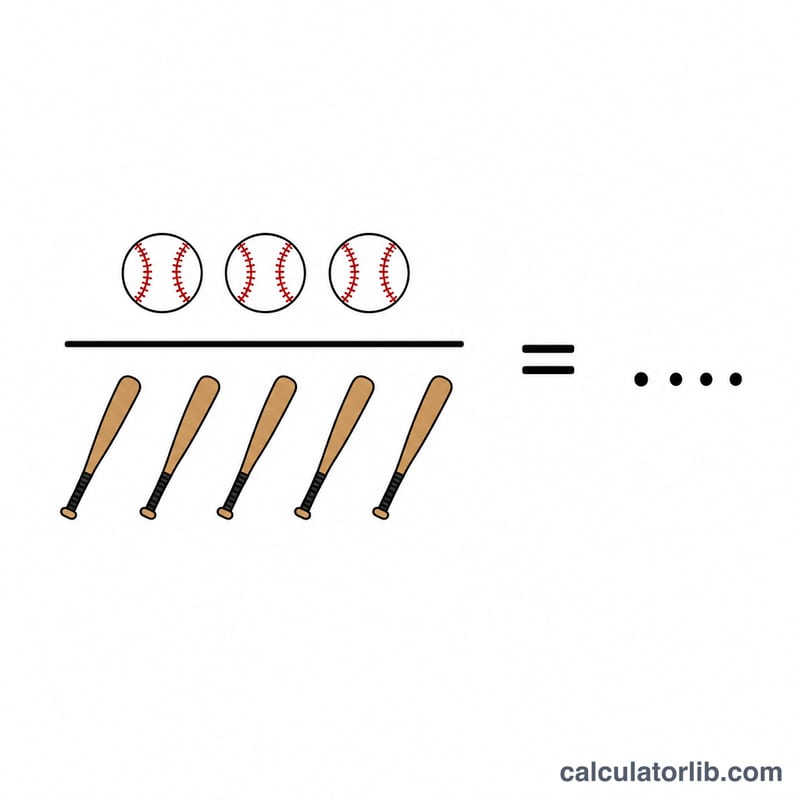
The calculation is a simple division:
$$\text{AVG} = \frac{\text{Hits}}{\text{At-Bats}}$$
The result is conventionally written as a three-decimal number without a leading zero — for example, 0.333 is read as "three thirty-three."
Worked Example
Suppose a batter has 50 hits in 150 at-bats. Then $$\text{AVG} = 50 \div 150 = 0.3333,$$ which rounds to .333. That is a strong, all-star-caliber season.
Interpreting Your Batting Average
Batting average (AVG) is one of the oldest and most familiar baseball statistics, defined simply as hits divided by at-bats:
$$\text{AVG} = \frac{\text{Hits}}{\text{At-Bats}}$$For example, a player with .300 has 45 hits in 150 at-bats. Because the result is conventionally shown to three decimal places, it is read aloud as "three hundred" rather than "point three."
It is essential to understand what AVG does not measure. Because walks (BB) and hit-by-pitches (HBP) are not counted as at-bats, AVG completely ignores a hitter's ability to reach base by drawing walks. It also treats every hit identically: a single and a home run each add exactly one hit to the numerator, so AVG tells you nothing about power or the value of extra-base hits. A patient slugger and a contact-only singles hitter can post identical averages while contributing very differently to run scoring.
AVG is also volatile over small samples. In a handful of games a few lucky bloops or unlucky line-outs can swing the number dramatically, so early-season or short-stint averages should be treated cautiously. The figure becomes more meaningful as at-bats accumulate over a full season.
For context, a .300 average is widely cited as the traditional benchmark for an excellent hitter, while the "Mendoza line" — roughly .200, named after infielder Mario Mendoza — is the informal marker of offensive futility for a position player. Most everyday hitters fall somewhere in between.
Because of its blind spots, AVG is best used alongside other rate stats rather than on its own. On-base percentage (OBP) credits walks and HBP, slugging percentage (SLG) rewards extra-base power, and OPS (OBP plus SLG) combines the two. AVG complements these measures but does not replace them — a complete picture of a hitter requires looking at all of them together.
Key Terms Defined
The terms below determine exactly what does and does not count toward the at-bats (AB) denominator of batting average. Understanding them clarifies why two players with the same number of times "up to bat" can have very different AVG calculations.
- Hit (H): A batted ball that allows the hitter to reach base safely without the benefit of a fielding error or a fielder's choice. Hits (singles, doubles, triples, home runs) form the numerator of AVG; each counts equally regardless of how many bases it produces.
- At-Bat (AB): A plate appearance that results in a hit, an out (other than a sacrifice), an error, or a fielder's choice. At-bats form the denominator of AVG. Notably, walks, hit-by-pitches, sacrifices, and catcher's interference are not counted as at-bats.
- Plate Appearance (PA): Any completed turn at the plate, regardless of outcome. PA is the broadest count and equals at-bats plus walks, HBP, sacrifices, and certain other outcomes. AVG uses AB, not PA, so PA is always greater than or equal to AB.
- Walk (Base on Balls, BB): Awarded first base after four pitches outside the strike zone. A walk counts as a plate appearance but does not count as an at-bat, so it has no effect on the AVG denominator (or numerator).
- Hit-by-Pitch (HBP): The batter is awarded first base after being struck by a pitch. Like a walk, an HBP is a plate appearance but is not an at-bat, so it does not change AVG.
- Sacrifice Fly (SF): A fly ball caught for an out that allows a runner to score after the catch. A sacrifice fly is not charged as an at-bat, so it does not lower the batter's AVG (though it does count as a plate appearance).
- Sacrifice Bunt (SH, sacrifice hit): A deliberate bunt that advances a runner while the batter is put out. It is not counted as an at-bat and therefore does not affect AVG.
In short, only outcomes scored as official at-bats land in the AVG denominator. Walks, hit-by-pitches, and sacrifices are excluded — which is precisely why a hitter can reach base often yet still post a modest batting average.
FAQ
Do walks count as at-bats? No. Walks, hit-by-pitch, and sacrifices are not at-bats and do not affect batting average.
What is a good batting average? Anything around .300 or higher is considered very good; .250 is about average for many leagues.
Why no leading zero? By baseball convention averages are shown as .300 rather than 0.300, though both mean the same value.