
What this calculator does
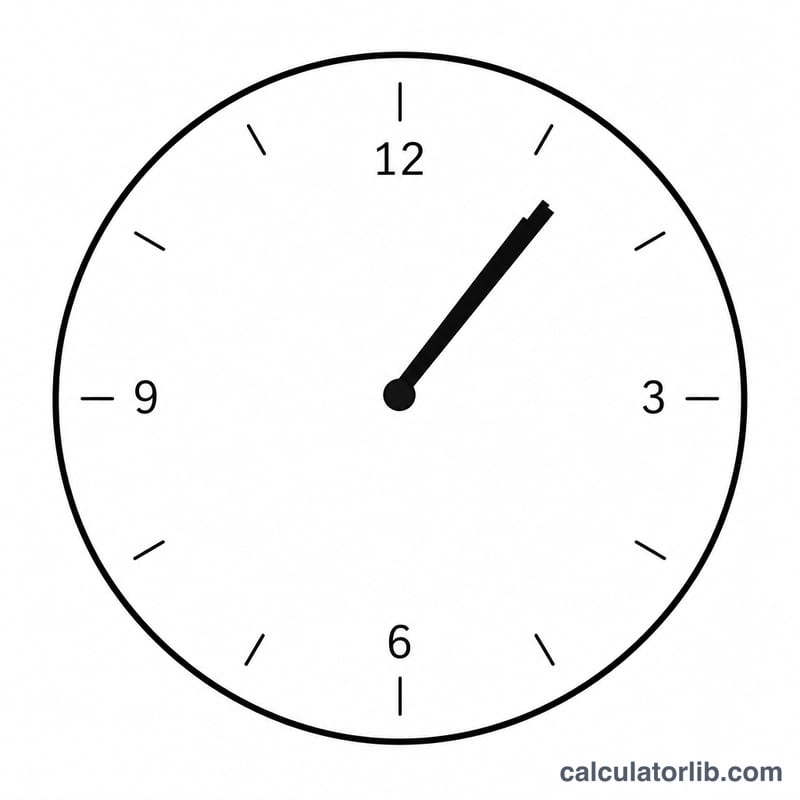
This tool solves the classic "clock problem": given a one-hour window on a standard 12-hour analog clock (for example "between 1 and 2 o'clock"), it finds the exact moment the long minute hand catches up to and overlaps the short hour hand. The mathematics is universal and requires no real timekeeping rules.
How to use it
Pick the one-hour interval from the dropdown. The calculator returns the overlap time as an exact fraction of minutes (\(60H/11\)), as a decimal, and as a clean clock time in H:MM:SS form, along with the initial angular gap.
The formula explained
The minute hand sweeps 360 degrees in 60 minutes, so it moves 6 degrees per minute. The hour hand sweeps 360 degrees in 720 minutes, so it moves 0.5 degrees per minute. The minute hand therefore gains on the hour hand at \(6 - 0.5 = 5.5\) degrees per minute. At exactly H o'clock the hour hand is \(H \times 30\) degrees ahead of the minute hand. Closing that gap takes
$$t = \frac{30 \times \text{Hour}}{5.5} = \frac{60 \times \text{Hour}}{11}\ \text{minutes after the hour}$$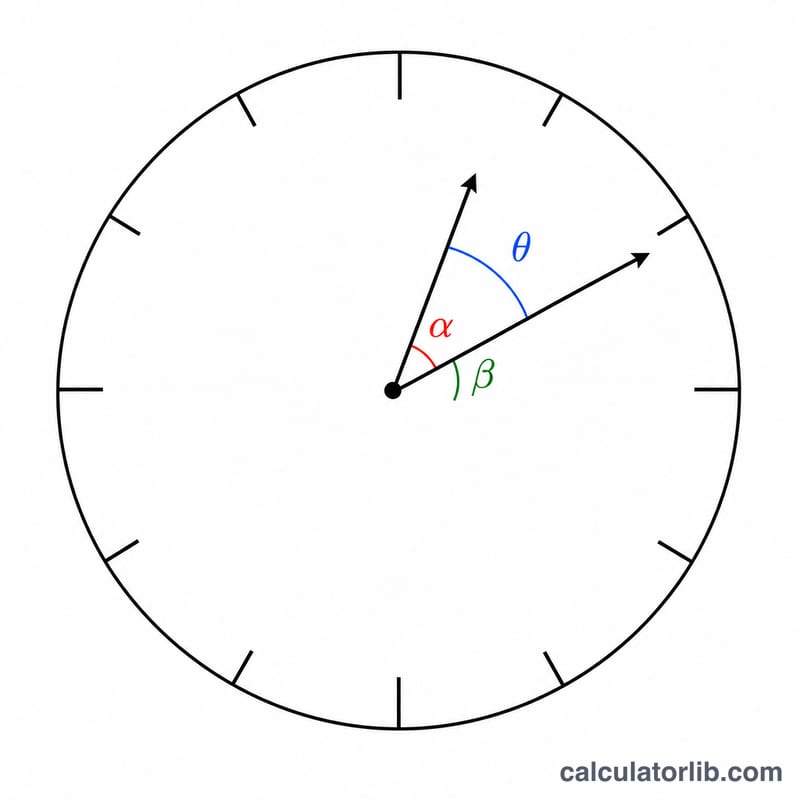
Worked example
For "between 3 and 4 o'clock" (\(H = 3\)): the gap at 3:00 is \(3 \times 30 = 90\) degrees. The overlap occurs
$$\frac{90}{5.5} = \frac{180}{11} = 16.3636\ldots \text{ minutes after 3:00}$$which is 3:16 plus \(\frac{4}{11} \times 60 = 21.8\) seconds, i.e. about 3:16:21.8.
FAQ
How many times do the hands overlap in 12 hours? Exactly 11 times, once every \(12/11\) hours (about 65.45 minutes), not 12 times as people often assume.
Why is \(60H/11\) a repeating decimal? Because the denominator 11 does not divide evenly into \(60H\), the decimal repeats with a period of 11. Using the exact fraction avoids rounding.
What about 11 to 12 or 12 to 1? The overlap there lands on 12:00 exactly (the trivial case), which is why those windows are often left out.