
What Is Shear Stress?
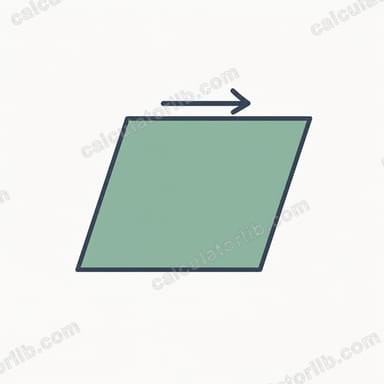
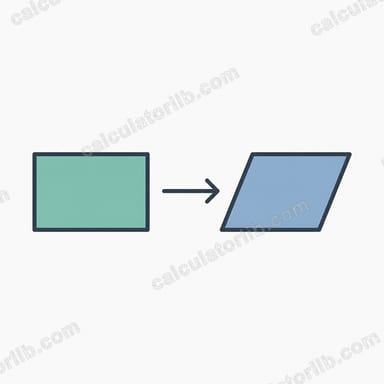
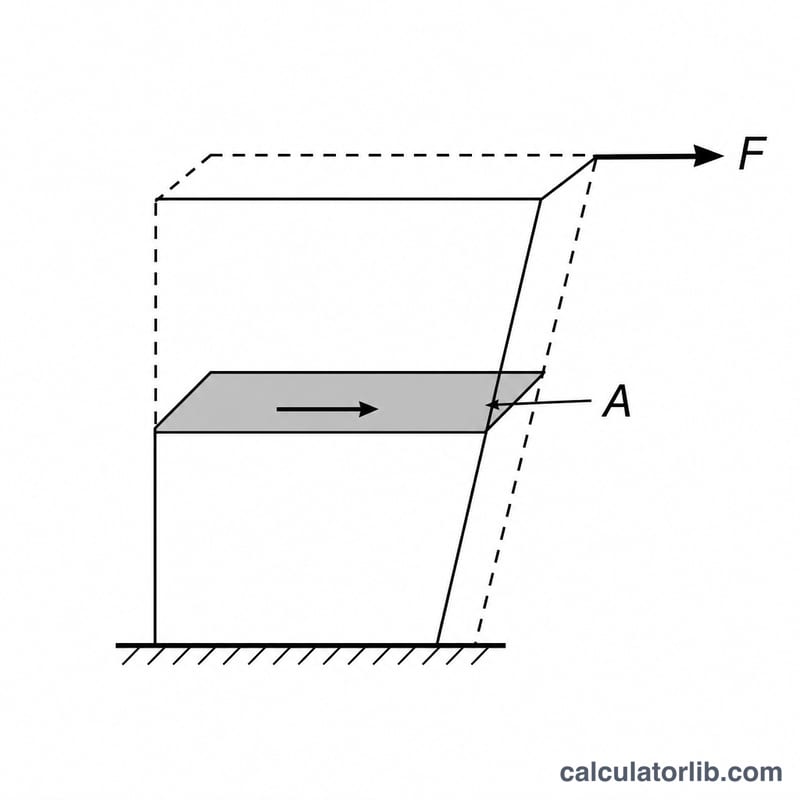
Shear stress (\(\tau\)) is the internal force per unit area that acts parallel (tangential) to the cross-section of a material, as opposed to normal stress which acts perpendicular. It arises whenever a force tends to make one part of a body slide past an adjacent part — such as a bolt under load, a riveted joint, or a beam transmitting transverse force. This calculator uses the basic average shear stress relation \(\tau = F / A\) and reports the result in pascals (Pa), kilopascals (kPa), and megapascals (MPa).
How to Use the Calculator
Enter the shear force F in newtons (N) and the cross-sectional area A in square meters (m²) over which the force acts. The tool divides force by area to give the average shear stress. If your area is in mm², convert first: \(1 \text{ mm}^2 = 1\times10^{-6} \text{ m}^2\).
The Formula Explained
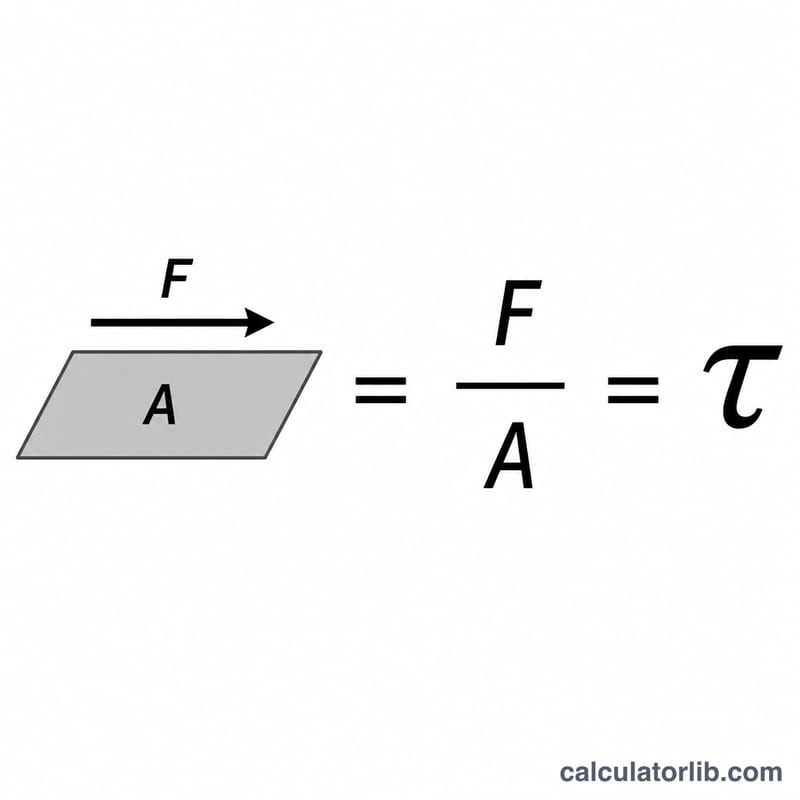
The governing equation is $$\tau = \frac{F}{A}$$ where \(\tau\) is shear stress (Pa = N/m²), \(F\) is the applied shear force (N), and \(A\) is the area over which it acts (m²). Because 1 Pa is a small unit, engineering results are often expressed in MPa (\(1 \text{ MPa} = 1{,}000{,}000 \text{ Pa}\)). The calculation assumes the stress is uniformly distributed across the area — a common simplifying assumption for average shear stress.
Worked Example
Suppose a pin carries a shear force of 5,000 N across a cross-sectional area of 0.01 m². Then $$\tau = \frac{5{,}000}{0.01} = 500{,}000 \text{ Pa} = 500 \text{ kPa} = 0.5 \text{ MPa}$$ If that exceeds the material's shear strength, the pin would fail in shear.
FAQ
What units should I use? Use newtons for force and square meters for area to get stress in pascals. The calculator also converts to kPa and MPa automatically.
Is this average or maximum shear stress? This gives the average shear stress. Maximum shear stress in beams or non-uniform sections may be higher and requires the appropriate shear-distribution formula.
How do I handle double shear? In double shear (two cross-sections resist the load), use the total area of both planes for A, which halves the stress compared to single shear.