
What Is Shear Stress in a Fluid?
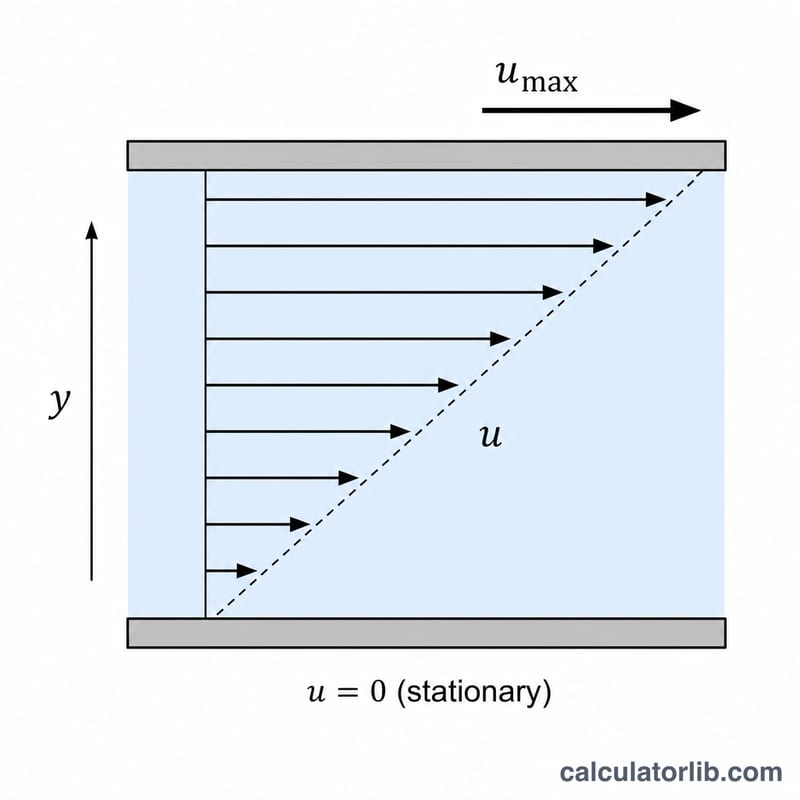
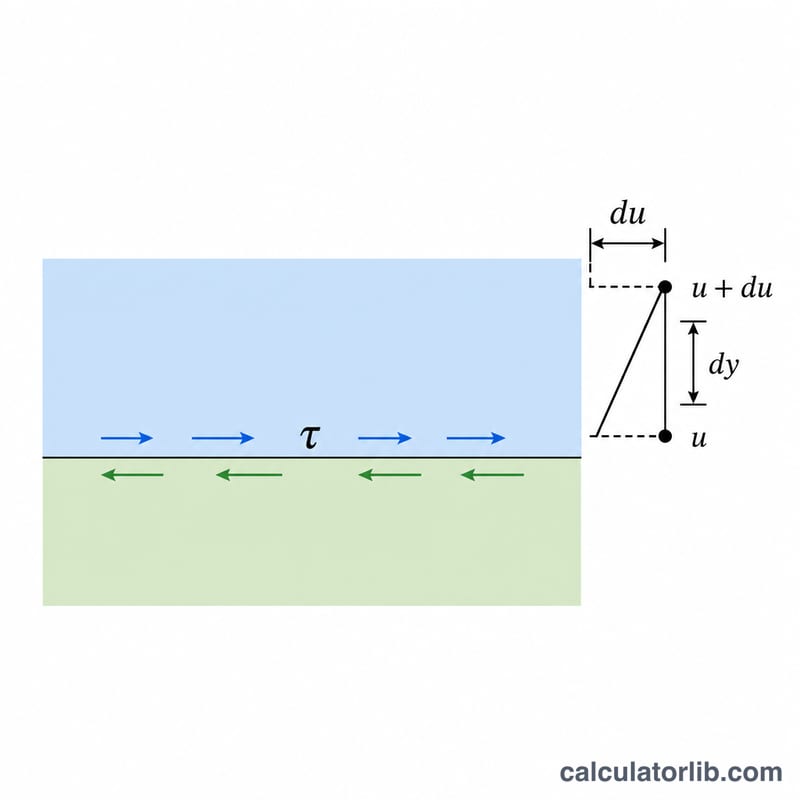
Shear stress (\(\tau\)) is the tangential force per unit area that develops within a fluid as adjacent layers slide past one another. For a Newtonian fluid — such as water, air, or light oils — the shear stress is directly proportional to the rate at which velocity changes across the flow. This relationship is described by Newton law of viscosity and is fundamental to fluid mechanics, lubrication, pipe flow, and rheology.
The Formula
The governing equation is:
$$\tau = \mu \cdot \frac{du}{dy}$$
where \(\tau\) is the shear stress in pascals (Pa = N/m²), \(\mu\) is the dynamic (absolute) viscosity in Pa·s, and \(\frac{du}{dy}\) is the velocity gradient (shear rate) in s⁻¹ — the change in fluid velocity (du, m/s) over the distance perpendicular to the flow (dy, m).
How to Use the Calculator
Enter the fluid dynamic viscosity \(\mu\), the velocity difference du between two fluid layers (or between a moving plate and a stationary surface), and the gap dy separating them. The calculator returns the shear stress and the shear rate. Keep all values in SI units for a result in pascals.
Worked Example
Water (\(\mu = 0.001\) Pa·s) flows so that velocity changes by \(du = 2\) m/s across a gap of \(dy = 0.01\) m. The shear rate is \(2 / 0.01 = 200\) s⁻¹, so $$\tau = 0.001 \times 200 = \mathbf{0.2 \text{ Pa}}$$
FAQ
Does this work for non-Newtonian fluids? No. For shear-thinning, shear-thickening, or Bingham fluids the viscosity changes with shear rate, so this linear law does not apply.
What units should I use? Use SI units (Pa·s, m/s, m) to get shear stress in pascals. Dynamic viscosity in centipoise (cP) must be converted: 1 cP = 0.001 Pa·s.
What is shear rate? Shear rate (\(\frac{du}{dy}\)) is how quickly velocity changes with distance perpendicular to flow, measured in reciprocal seconds (s⁻¹).