
What is Newton's Law of Cooling?
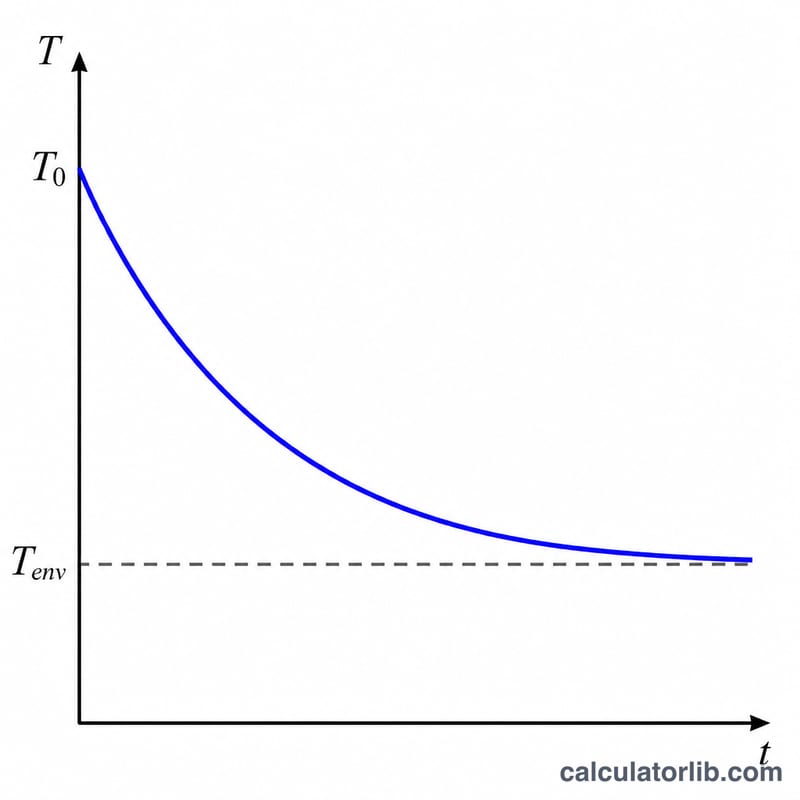
Newton's Law of Cooling describes how the temperature of an object approaches the temperature of its surroundings over time. The rate of heat loss is proportional to the difference between the object's temperature and the ambient (environmental) temperature. This universal physics relationship applies to a cooling cup of coffee, a forensic body-temperature estimate, a heated metal part, or an electronic component.
The formula
The temperature at time t is given by $$T(t) = \text{T}_{env} + \left(\text{T}_0 - \text{T}_{env}\right) e^{-\text{k}\,\text{t}}$$, where T₀ is the initial temperature, T_env is the constant ambient temperature, k is the cooling constant (units of inverse time), and e is Euler's number. As t grows, the exponential term shrinks toward zero and T(t) approaches T_env.
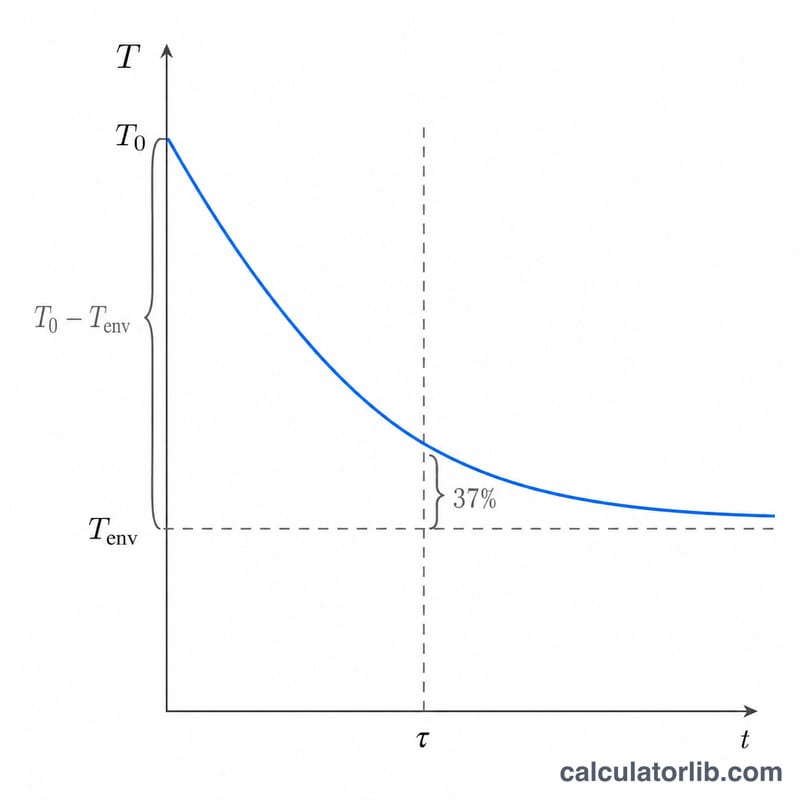
The thermal time constant \(\tau = \frac{1}{\text{k}}\) is the time it takes for the temperature difference from the surroundings to fall to about 36.8% (1/e) of its starting value — a handy single number describing how fast an object responds.
How to use it
Enter the initial temperature, the ambient temperature, the cooling constant k, and the elapsed time t. Use consistent units (e.g. °C with k in per-minute and t in minutes). The calculator returns the temperature at time t, how far it still sits above (or below) ambient, and the time constant τ.
Worked example
A coffee at 90°C cools in a 20°C room with k = 0.1 /min. After 10 minutes: $$T = 20 + (90 - 20)\cdot e^{-0.1\cdot 10} = 20 + 70\cdot e^{-1} = 20 + 70\cdot 0.367879 \approx 45.75°C$$. The difference from ambient is about 25.75°C and \(\tau = \frac{1}{0.1} = 10\) minutes.
FAQ
Does this work for heating too? Yes. If T₀ is below T_env the object warms toward ambient; the same equation applies and the difference is negative.
What units should k use? k must match your time unit: if t is in minutes, k is per minute. Larger k means faster cooling.
How do I find k? Measure temperature at two times and solve \(k = -\ln\left(\frac{\text{T}_1 - \text{T}_{env}}{\text{T}_0 - \text{T}_{env}}\right) / \text{t}_1\).