
What this calculator does
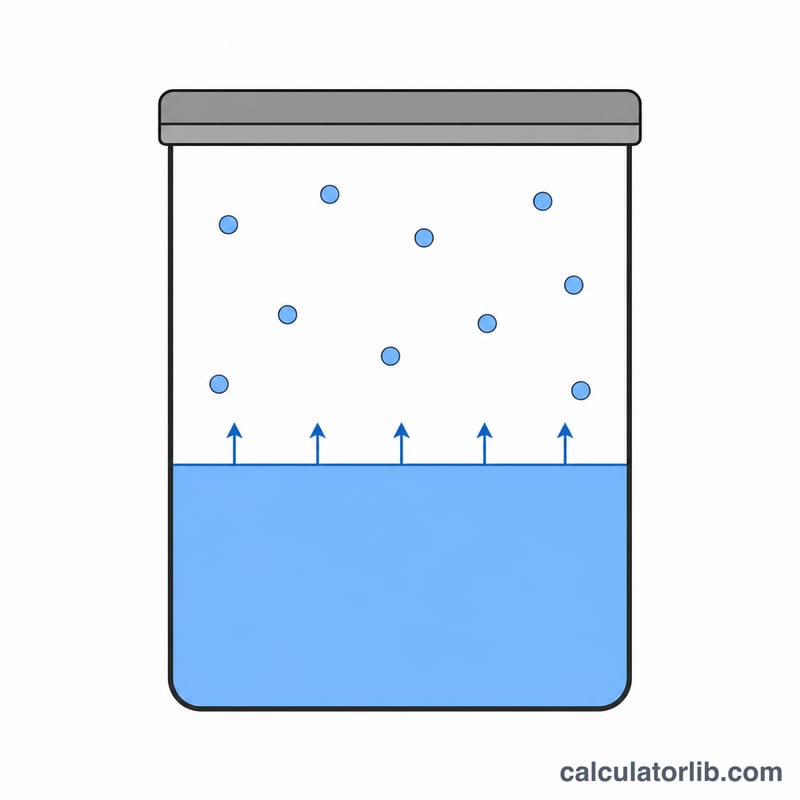
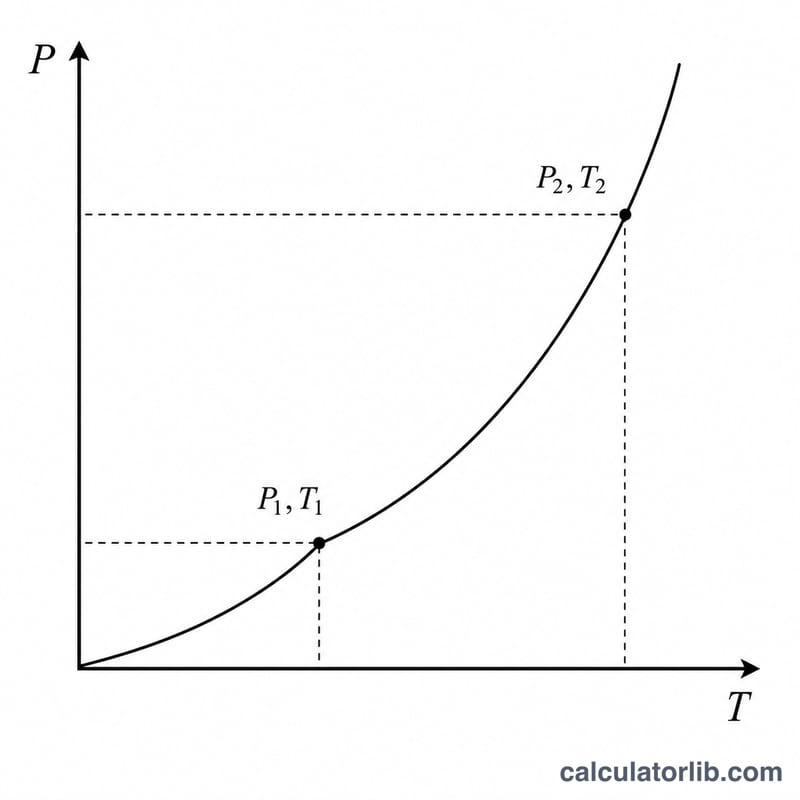
The Clausius–Clapeyron equation describes how the vapor pressure of a pure liquid changes with temperature. Given a known vapor pressure P1 at temperature T1, the enthalpy of vaporization ΔHvap, and a target temperature T2, this tool computes the vapor pressure P2 at that new temperature. It is a universal physical-chemistry relationship and applies to any pure substance, not a specific country or jurisdiction.
How to use it
Enter a reference point you already know — for water, 101.325 kPa at 373.15 K (boiling at 1 atm). Enter the target temperature \(T_2\) in kelvin (\(\text{K} = \degree\text{C} + 273.15\)) and the molar enthalpy of vaporization ΔHvap in kJ/mol. The calculator converts ΔHvap to J/mol, uses the gas constant \(R = 8.314\ \text{J/(mol}\cdot\text{K)}\), and returns \(P_2\) in the same pressure units you used for \(P_1\).
The formula explained
The two-point form is $$\ln\!\left(\frac{P_2}{P_1}\right) = -\frac{\Delta H_{vap}}{R}\left(\frac{1}{T_2} - \frac{1}{T_1}\right).$$ Solving for \(P_2\) gives $$P_2 = P_1 \cdot \exp\!\left[ -\frac{\Delta H_{vap}}{R}\left(\frac{1}{T_2} - \frac{1}{T_1}\right)\right].$$ The model assumes ΔHvap is constant over the temperature range and that the vapor behaves ideally, so it is most accurate over modest temperature spans.
Worked example
Water has \(\Delta H_{vap} \approx 40.66\ \text{kJ/mol}\) and boils at 373.15 K (101.325 kPa). At \(T_2 = 363.15\ \text{K}\): $$\frac{1}{363.15} - \frac{1}{373.15} = 0.0027537 - 0.0026799 = 7.379\times10^{-5}\ \text{K}^{-1}.$$ Then $$-\frac{40660}{8.3145}\times 7.379\times10^{-5} = -0.3609,$$ so $$P_2 = 101.325 \cdot e^{-0.3609} \approx 70.6\ \text{kPa}$$ — close to the measured value near 90 °C.
FAQ
Must temperatures be in kelvin? Yes. The equation uses absolute temperature; convert Celsius by adding 273.15.
What units does P2 come out in? Whatever units you enter for P1. The pressures only appear as a ratio, so units cancel.
Why is it only approximate? It assumes ΔHvap is temperature-independent and the vapor is ideal, which breaks down over wide temperature ranges and near the critical point.