
What Is the Antoine Equation?
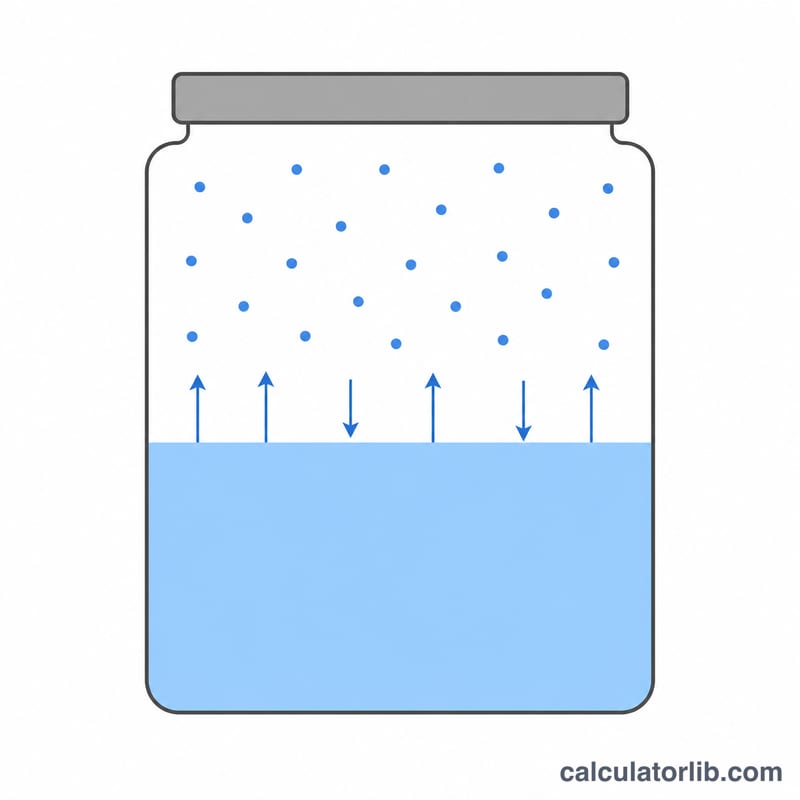
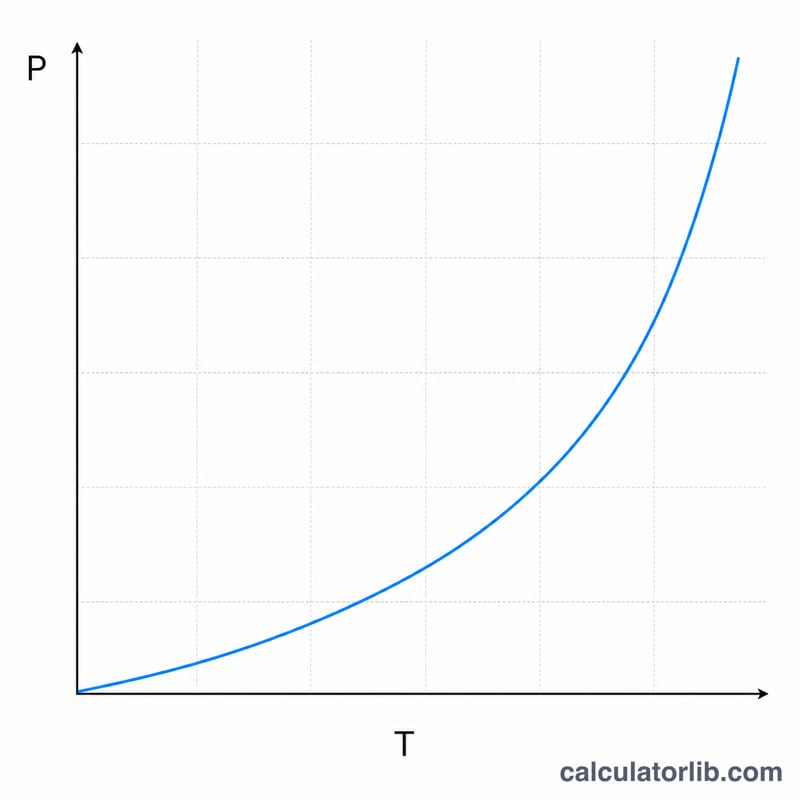
The Antoine equation is a simple, widely used semi-empirical relationship between the saturated vapor pressure of a pure substance and its temperature. It captures the strongly non-linear rise of vapor pressure with temperature using just three coefficients — A, B, and C — that are fitted to experimental data for each compound over a specific temperature range.
How to Use This Calculator
Enter the Antoine coefficients A, B, and C for your substance, then the temperature T in degrees Celsius. The calculator returns the vapor pressure P in mmHg and converts it to atmospheres, bar, and kilopascals. Make sure your coefficients match the unit convention you expect — the defaults shown use the NIST water set that returns pressure in mmHg with temperature in °C.
The Formula Explained
The equation is \(\log_{10}(P) = A - B / (C + T)\). Once the right-hand side is evaluated, the vapor pressure is recovered as $$P = 10^{\,A - \frac{B}{C + T}}$$ The constant \(A\) sets the overall scale, \(B\) controls how steeply pressure climbs, and \(C\) shifts the temperature reference to improve the fit. Always confirm whether a coefficient set uses \(\log_{10}\) or natural log and whether \(T\) is in °C or K.
Worked Example
For water with \(A = 8.07131\), \(B = 1730.63\), \(C = 233.426\) at \(T = 100\ °C\): \(C + T = 333.426\), so \(B/(C+T) = 5.19042\). Then $$\log_{10}(P) = 8.07131 - 5.19042 = 2.88089$$ giving \(P = 10^{2.88089} \approx 760.6\) mmHg — essentially 1 atm, exactly the boiling point of water at sea level, as expected.
FAQ
What units does it use? With the common NIST-style coefficients, T is in °C and P comes out in mmHg; the calculator also shows atm, bar and kPa.
Why are there different coefficient sets? Antoine constants are valid only over the temperature range they were fitted to, so substances often have multiple sets for low and high temperature regions.
Can I use Kelvin? Only if your coefficient set was derived for Kelvin; mixing conventions gives wrong results.