
What This Calculator Does
The GPA Improvement Calculator projects what your cumulative grade point average will be after you finish another term. It takes your existing GPA and the total credits you have already earned, then blends in the GPA you expect to achieve this term and the credits that term carries. The result is a credit-weighted average — the standard way schools compute a cumulative GPA — so you can see realistically how much one term can move the needle.
How to Use It
Enter four values: your current GPA, the credits you have already earned, the GPA you expect this term, and the credits this term is worth. The calculator returns your projected new cumulative GPA, the change versus today, and your total credits afterward. Try a few "expected GPA" scenarios to see what grades you need to hit a target.
The Formula Explained
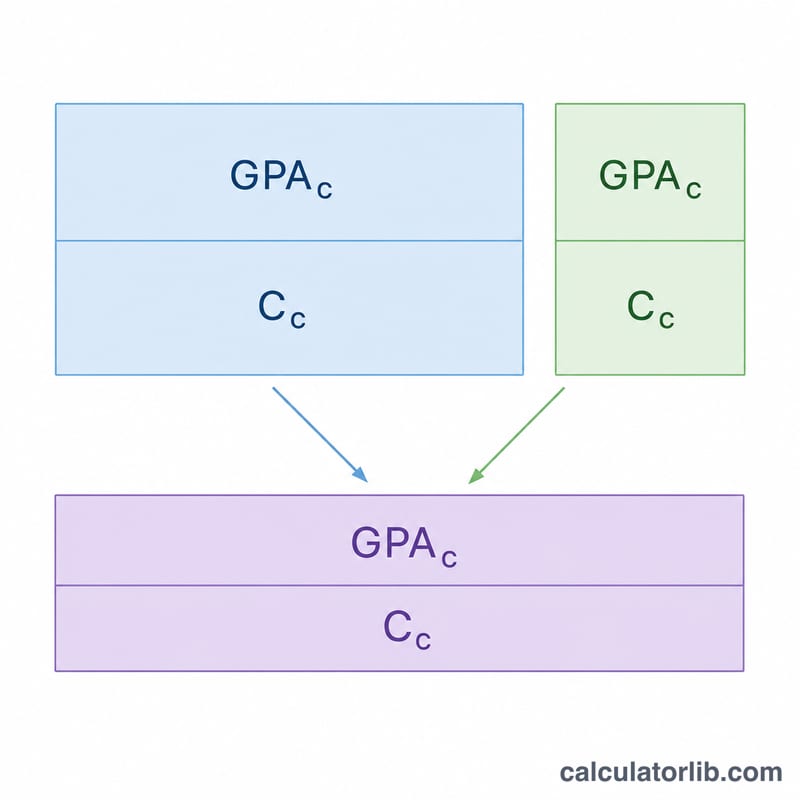
A cumulative GPA is the weighted average of every credit you take, weighted by how many credits each grade is worth. To add one more term we multiply each GPA by its credit count, add them together, and divide by total credits:
$$\text{New GPA} = \frac{\text{Current GPA} \times \text{Current Credits} + \text{Term GPA} \times \text{Term Credits}}{\text{Current Credits} + \text{Term Credits}}$$
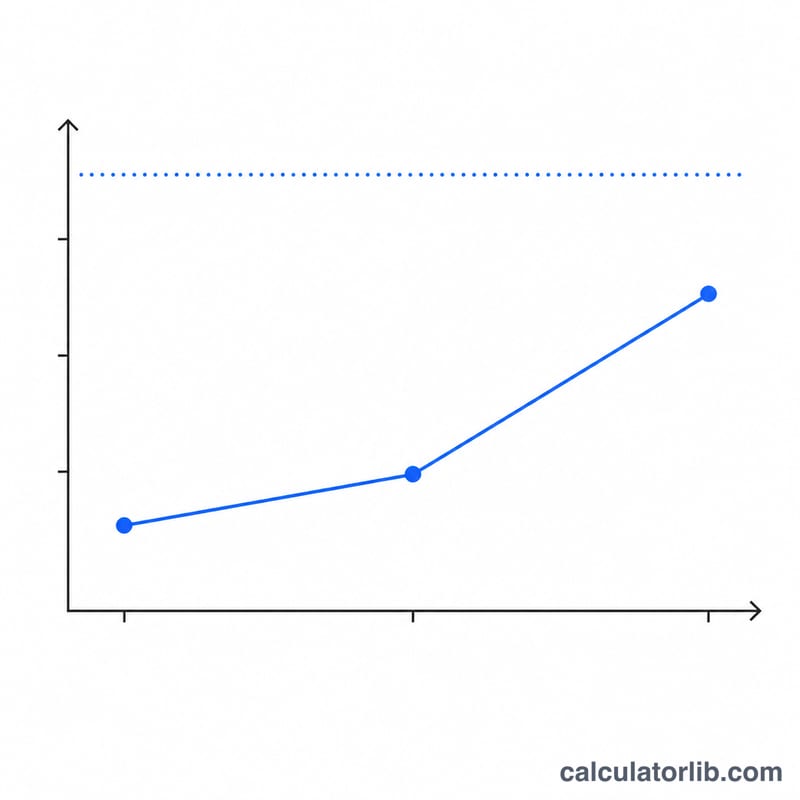
Because earlier credits keep their weight, a single strong (or weak) term shifts a large cumulative total only modestly — the more credits you already have, the harder the GPA is to move.
Worked Example
Suppose you have a 3.0 GPA over 60 credits and expect a 3.8 across 15 credits this term. $$\text{New GPA} = \frac{3.0 \times 60 + 3.8 \times 15}{60 + 15} = \frac{180 + 57}{75} = \frac{237}{75} = \mathbf{3.16}$$ Your GPA improves by about 0.16 points even with a strong term, illustrating the weight of those 60 prior credits.
FAQ
Does this work for any GPA scale? Yes. It's a pure weighted average, so it works for a 4.0, 4.3, or any consistent scale as long as both GPAs use the same one.
Why did my GPA barely change? Because your earned credits outweigh a single term. The more credits you already hold, the smaller the effect of one term.
Can I use it to set a target? Yes — adjust the expected term GPA until the projected new GPA reaches your goal to learn what you need this term.