
What is the ACFT Two-Mile Run Calculator?
This tool applies to the United States Army and its Army Combat Fitness Test (ACFT). The Two-Mile Run (2MR) is the final, cardiovascular endurance event of the ACFT. This calculator converts your finish time into an estimated 0–100 point score and tells you whether you cleared the 60-point passing threshold. It uses a representative single-curve approximation; the official Army scoring scales vary slightly by age and sex, so treat this as a close planning estimate rather than an official record.
How to use it
Pick your age group and gender, then enter your two-mile run time in minutes and seconds (for example 17 minutes and 45 seconds). The calculator returns your estimated points and a pass/fail flag. Aim for at least 60 points on every event to pass the ACFT.
The formula explained
The score is a piecewise-linear function of total run time t (in minutes). The maximum 100 points is awarded at 13:30 or faster. Between 13:30 and 21:00 the score drops linearly to 60 (the minimum passing mark). Between 21:00 and 23:00 it drops further to 0. Anything slower than 23:00 scores 0, and the result is always capped to the 0–100 range.
$$\text{Score} = 100 - \frac{t - 13.5}{21 - 13.5} \times 40$$$$\text{Score} = 60 - \frac{t - 21}{23 - 21} \times 60$$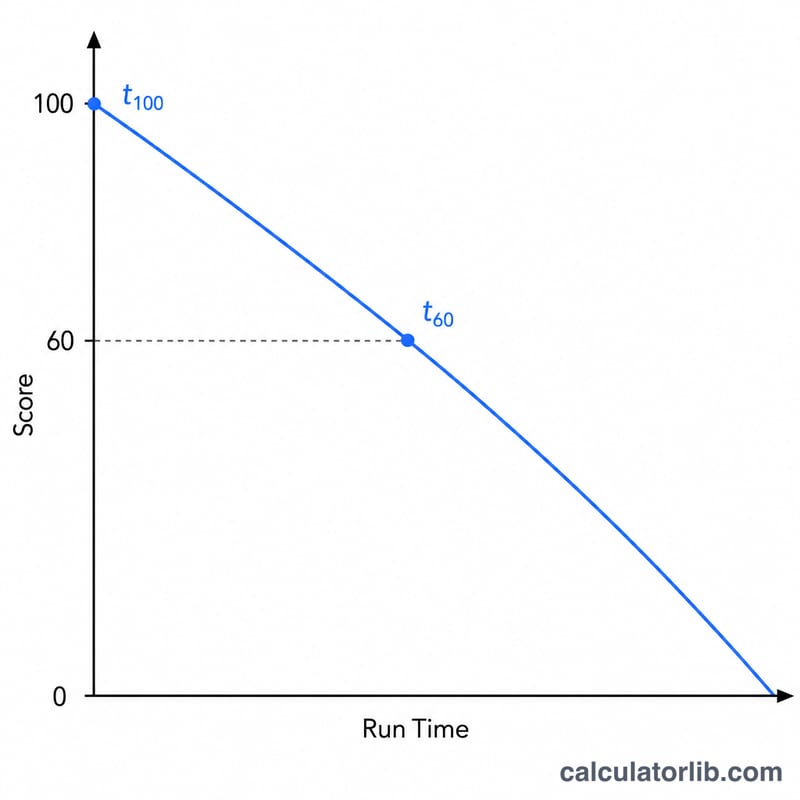
Worked example
Suppose you run the two miles in 17:00 (17.0 minutes). You are in the fast zone, so: $$100 - (17.0 - 13.5) / (21.0 - 13.5) \times 40 = 100 - (3.5 / 7.5) \times 40 = 100 - 18.67 = \textbf{81.3 points}$$ That comfortably passes the 60-point minimum.
2MR Time-to-Score Reference Table
The table below maps representative two-mile run (2MR) finish times to an estimated 0–100 point score using this calculator's single-curve model. Under this curve, a time of 13:30 (13.5 minutes) or faster earns the maximum 100 points, a time of 21:00 yields exactly the 60-point passing threshold, and any time slower than 23:00 scores 0.
| Finish Time (mm:ss) | Decimal Minutes (T) | Estimated Points | Status |
|---|---|---|---|
| 13:30 | 13.5 | 100 | Pass |
| 15:00 | 15.0 | 92 | Pass |
| 16:30 | 16.5 | 84 | Pass |
| 18:00 | 18.0 | 76 | Pass |
| 19:30 | 19.5 | 68 | Pass |
| 21:00 | 21.0 | 60 | Pass (minimum) |
| 22:00 | 22.0 | 30 | Fail |
| 23:00 | 23.0 | 0 | Fail |
Worked check for 18:00: \(100 - \dfrac{18.0 - 13.5}{7.5}\times 40 = 100 - \dfrac{4.5}{7.5}\times 40 = 100 - 24 = 76\) points.
Interpreting Your 2MR Score
On the Army Combat Fitness Test (ACFT), each of the six events is scored on a 0–100 scale, and a Soldier must earn at least 60 points in every event to pass that event. The two-mile run is the final event, and 100 points is the maximum any single event can contribute. A score of 60 represents the minimum acceptable performance — not a target — while a competitive Soldier aims well above it.
Important: the score produced here is a single-curve estimate. It uses one continuous scoring formula for all Soldiers, with 13:30 mapping to 100 points and 21:00 mapping to the 60-point pass line. The official ACFT scoring tables are graded by age group and sex, so your real point value for a given time may differ from this estimate. Use this tool for quick planning and pacing, and confirm against the current official Army scoring standards for an authoritative result.
Finally, passing one event does not mean you pass the test. To pass the full ACFT you must score at least 60 points in all six events — the maximum deadlift (MDL), standing power throw (SPT), hand-release push-up (HRP), sprint-drag-carry (SDC), plank (PLK), and the two-mile run. A strong run cannot compensate for failing another event; each event carries its own independent 60-point gate.
FAQ
What time do I need to max the 2MR? In this model, a time of 13:30 or faster scores the full 100 points.
What is the minimum passing time? 21:00 yields exactly 60 points, the standard ACFT passing mark for each event.
Is this the official Army score? No. Official ACFT scoring uses detailed tables that vary by age and gender. This calculator gives a fast, close estimate using a single representative curve.