
What Is Plus Sizing?
Plus sizing means fitting a larger-diameter wheel while keeping the overall tire diameter close to the original. This calculator compares any two tire sizes — entered in the standard width/aspect/rim format (e.g. 205/55R16) — and reports each tire's overall diameter, circumference (as revolutions per km), and the percentage difference between them. Keeping the diameter difference within ±3% preserves speedometer accuracy, clearance, and proper transmission and ABS behaviour.
How to Use It
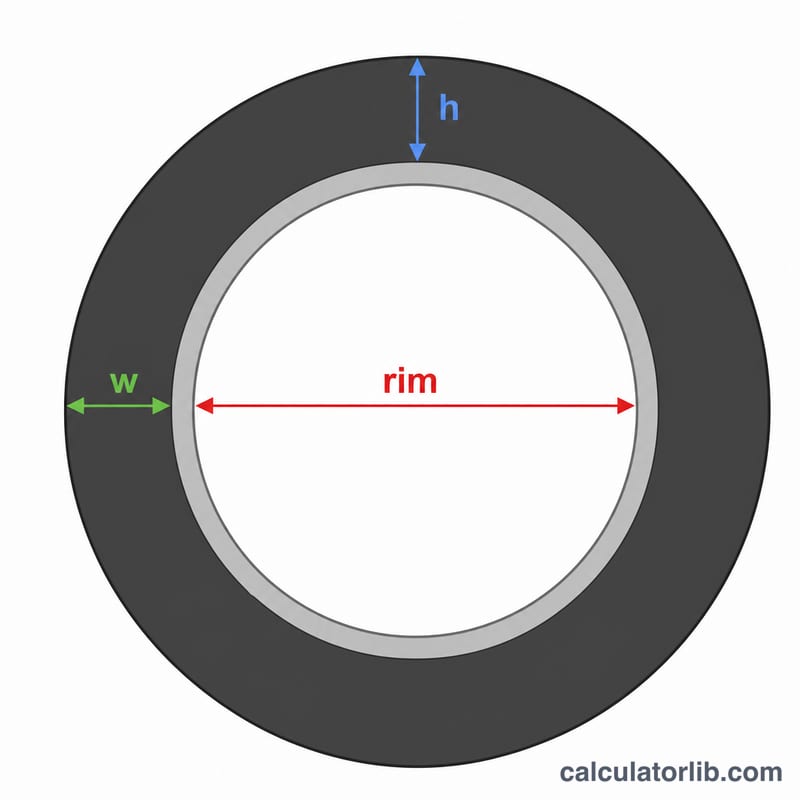
Enter the width (mm), aspect ratio (the two-digit profile number), and rim diameter (inches) for your original tire, then do the same for the new tire you are considering. The tool instantly shows both overall diameters and the percentage change. A positive percentage means the new tire is taller; a negative means it is shorter.
The Formula Explained
A tire's overall diameter is the rim diameter plus twice the sidewall height. The sidewall height equals the section width multiplied by the aspect ratio (as a fraction): \(\text{height} = \text{width} \times \text{aspect} / 100\). Converting the rim from inches to millimetres (\(\times 25.4\)) and adding two sidewalls gives:
$$D = \text{rim} \times 25.4 + 2 \times \text{width} \times \frac{\text{aspect}}{100}$$The difference is then:
$$\Delta\% = \frac{D_{new} - D_{old}}{D_{old}} \times 100$$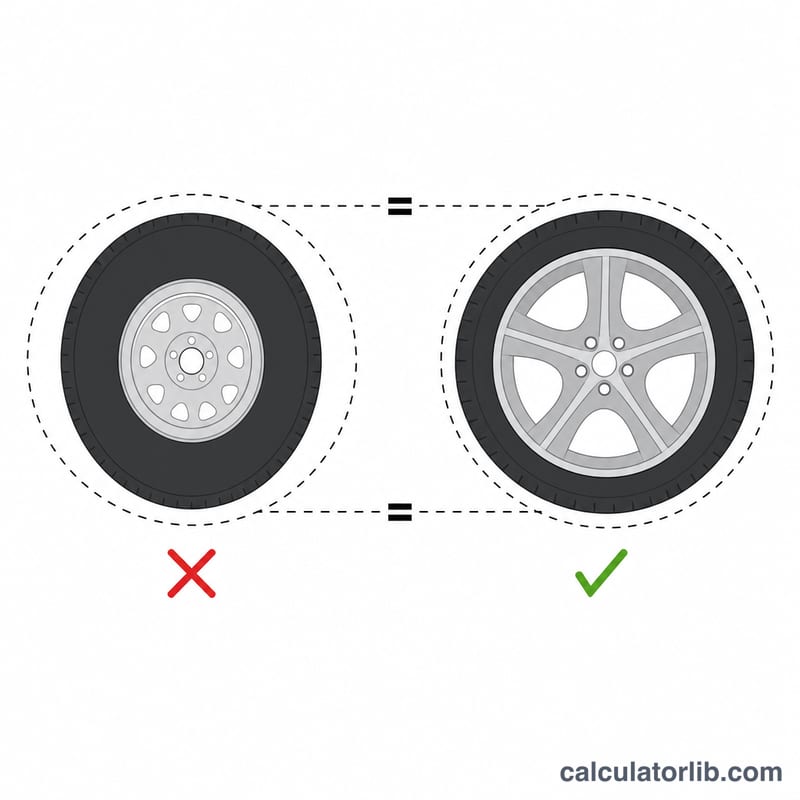
Worked Example
Original 205/55R16:
$$D = 16 \times 25.4 + 2 \times 205 \times 0.55 = 406.4 + 225.5 = 631.9 \text{ mm}$$New 225/45R17:
$$D = 17 \times 25.4 + 2 \times 225 \times 0.45 = 431.8 + 202.5 = 634.3 \text{ mm}$$Difference:
$$\Delta\% = \frac{634.3 - 631.9}{631.9} \times 100 \approx 0.38\%$$— well within the safe \(\pm 3\%\) range.
FAQ
What difference is acceptable? Aim for within \(\pm 3\%\) of the original diameter; larger changes throw off your speedometer and may rub.
Does a taller tire make the speedometer read low? Yes. A larger diameter means fewer revolutions per km, so your actual speed is higher than the display.
What is revolutions per km? It is \(1{,}000{,}000\) mm divided by the tire circumference (\(\pi \times \text{diameter}\)). It reflects how the speedometer and odometer are calibrated.