
What This Calculator Does
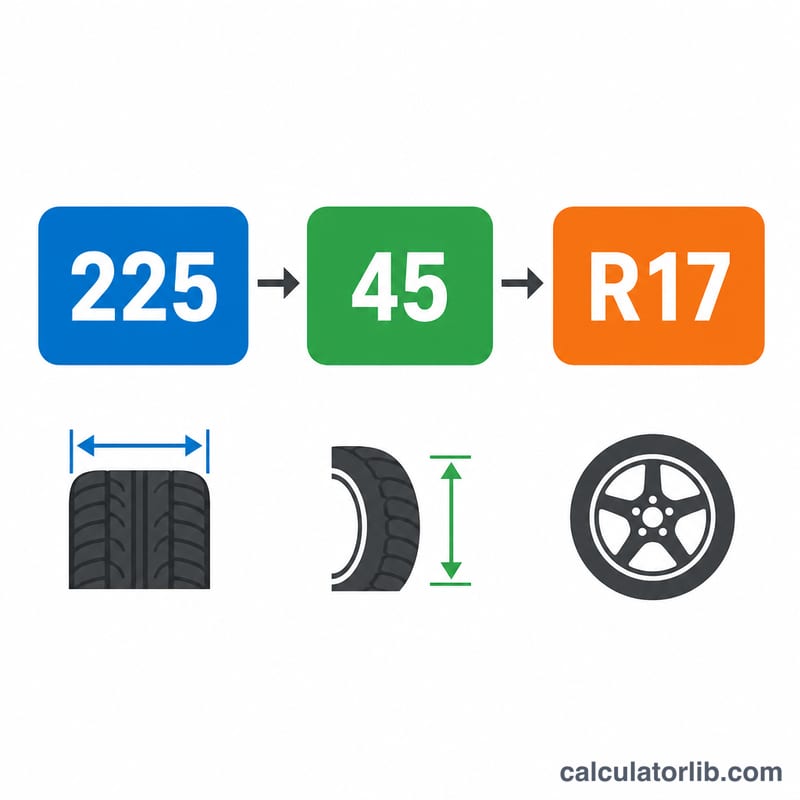
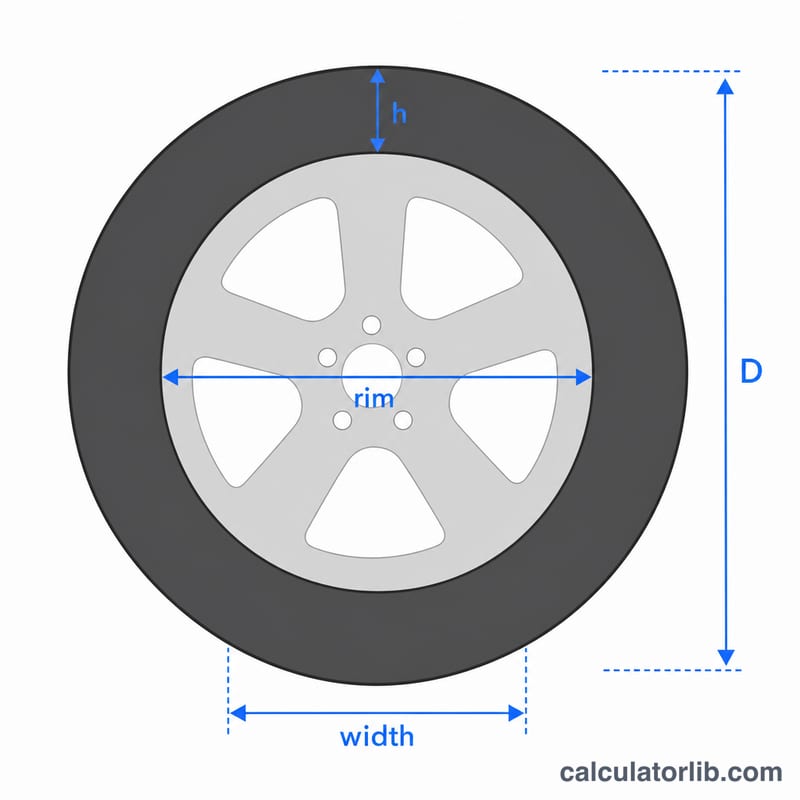
A tire's size markings encode its dimensions. A tire labeled 225/45R17 has a section width of 225 mm, an aspect ratio of 45% (sidewall height is 45% of the width), and fits a 17-inch rim. This calculator converts those three numbers into the tire's overall (outer) diameter, along with its sidewall height, circumference and the number of revolutions it makes per mile.
How to Use It
Read the three numbers off your tire's sidewall. Enter the section width in millimeters, the aspect ratio as a percentage, and the rim diameter in inches. Press calculate to see the overall diameter and related dimensions. This is useful when comparing replacement tires, checking for speedometer error, or verifying fitment and clearance.
The Formula Explained
The sidewall height in millimeters is the section width multiplied by the aspect ratio percentage: \(S = W \times A / 100\). A tire has a sidewall above and below the rim, so the total sidewall contribution to diameter is \(2 \times S\). Converting millimeters to inches (divide by 25.4) and adding the rim diameter gives the overall diameter:
$$D = \frac{2 \times W \times \dfrac{A}{100}}{25.4} + R$$
Worked Example
For a 225/45R17 tire: sidewall = \(225 \times 45 / 100 = 101.25\) mm. Both sidewalls = 202.5 mm = 7.97 in. Adding the 17-inch rim gives an overall diameter of about 24.97 inches (634.3 mm). Its circumference is \(\pi \times 24.97 \approx 78.45\) in, giving roughly 808 revolutions per mile.
FAQ
Why does aspect ratio matter? A lower aspect ratio means a shorter sidewall, so a 225/40R17 is smaller in diameter than a 225/55R17 even on the same rim.
What is the "R" in the size? R indicates radial construction; the number after it is the rim diameter in inches.
Why 25.4? There are exactly 25.4 millimeters in one inch, used to convert the metric sidewall to inches so it can be added to the inch-based rim size.