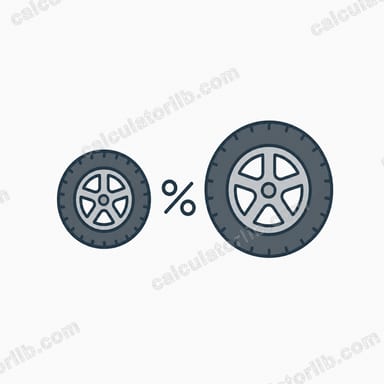

What is the Tire Size Comparison Calculator?
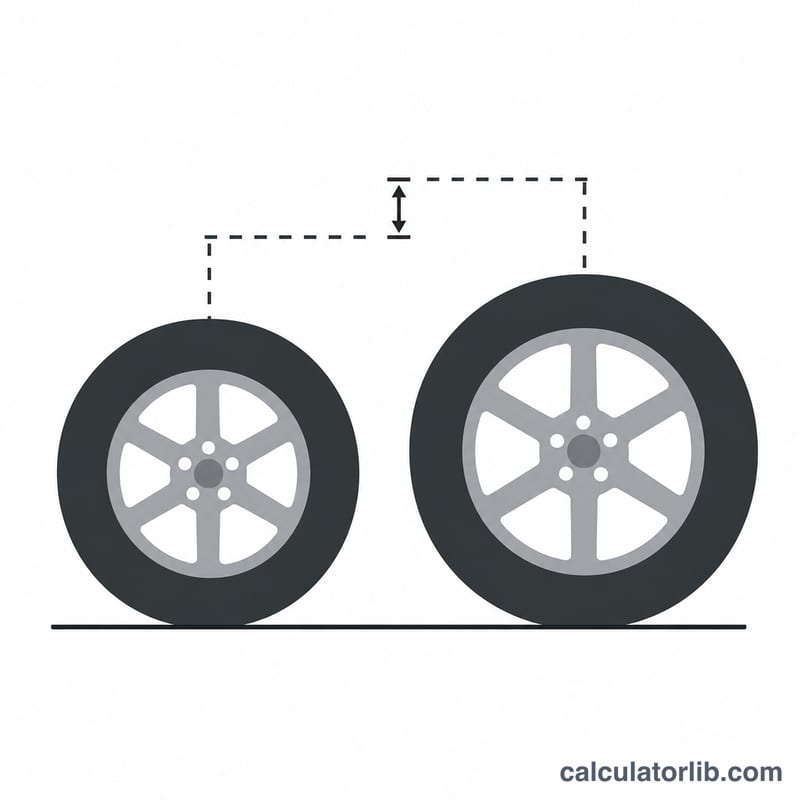
This tool compares two tire sizes written in the standard P-metric format (for example 205/55R16) and tells you how they differ in overall diameter, sidewall height, revolutions per mile, and how much your speedometer will read off after a change. It is a universal geometry tool and works with any vehicle.
How to use it
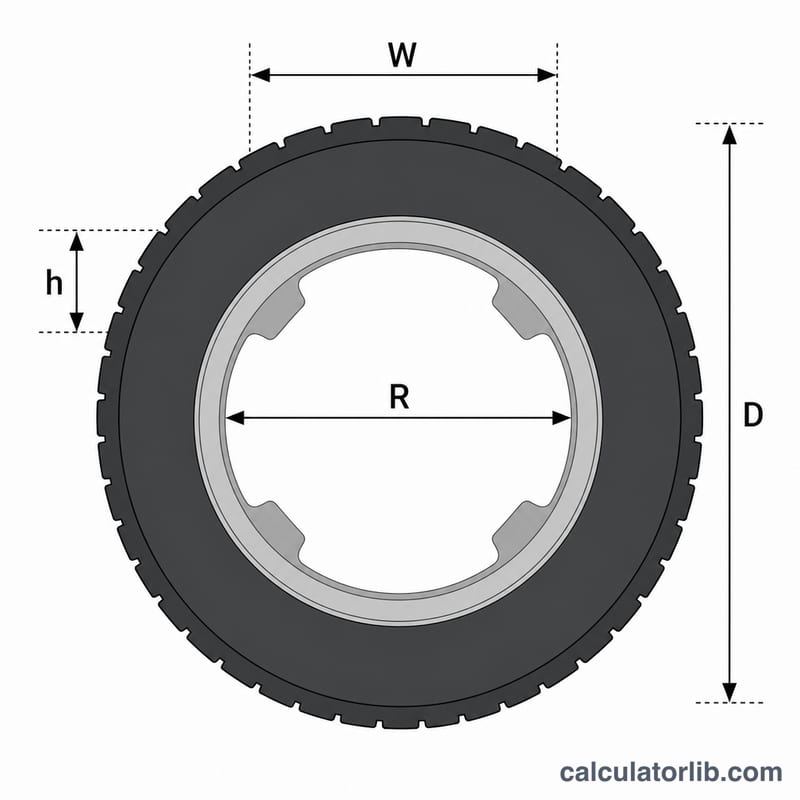
Enter the three numbers for your original tire — section width in millimetres, aspect ratio as a percent, and rim diameter in inches — then do the same for the new tire. The calculator instantly shows both diameters, the difference, and the speedometer effect.
The formula
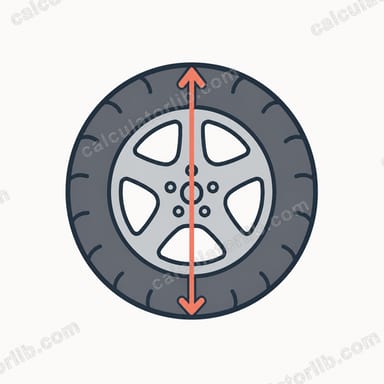
The overall diameter of a tire is the rim diameter (converted from inches to millimetres) plus two sidewall heights, since the sidewall sits above and below the rim:
$$D = R \times 25.4 + 2 \times W \times \frac{A}{100}$$Here \(W\) = section width in mm, \(A\) = aspect ratio percent, and \(R\) = rim diameter in inches. The speedometer reading at a true 60 mph is
$$S = 60 \times \frac{D_{2}}{D_{1}}$$where \(D_1\) is the original diameter and \(D_2\) the new diameter.
Worked example
Compare 205/55R16 against 225/45R17:
$$D_1 = 16 \times 25.4 + 2 \times 205 \times \tfrac{55}{100} = 631.9\,\text{mm}$$$$D_2 = 17 \times 25.4 + 2 \times 225 \times \tfrac{45}{100} = 634.3\,\text{mm}$$That is \(D_1 = 24.88\) in and \(D_2 = 24.97\) in. The diameter changes by about \(0.38\%\), and the speedometer reads \(S = 60 \times \tfrac{634.3}{631.9} \approx 60.23\) mph.
FAQ
Why does tire size affect my speedometer? The speedometer counts wheel revolutions and assumes a fixed rolling distance. A larger tire travels farther per turn, so the gauge reads slower than your true speed.
How much difference is safe? Most enthusiasts keep overall diameter within about 3% of stock to avoid speedometer error, gearing changes and clearance problems.
What is "revolutions per mile"? It is how many full turns the tire makes to cover one mile, found by dividing 1,609,344 mm by the tire circumference.