
What This Calculator Does
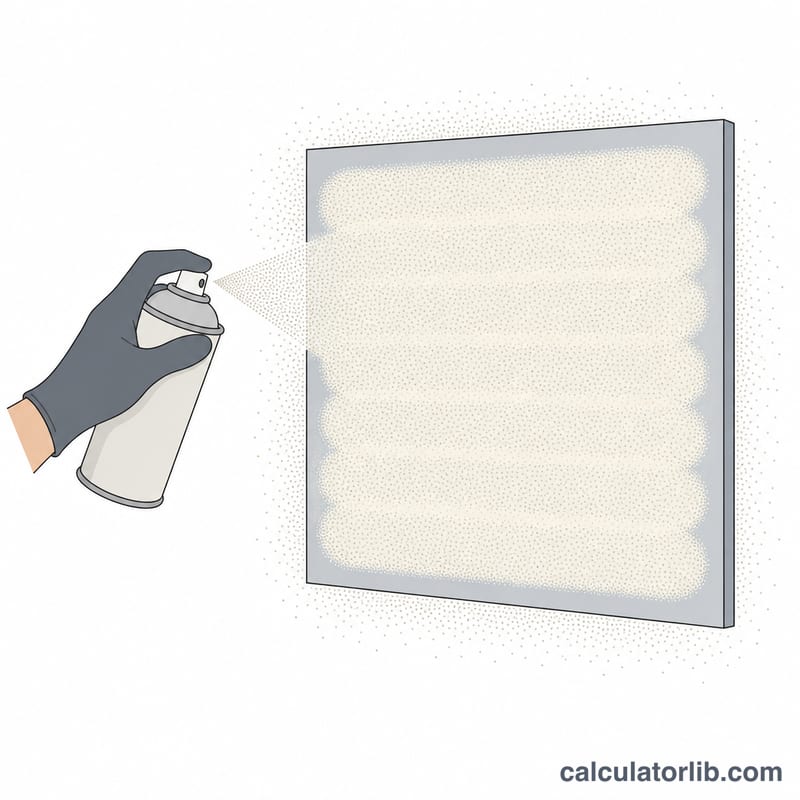
The Spray Paint Coverage Calculator tells you how many aerosol cans you need to finish a project. It accounts for the surface area, the number of coats, the rated coverage printed on each can, and a waste allowance for overspray. The result is rounded up to whole cans, since you cannot buy a fraction of a can.
How to Use It
Enter the total surface area in square feet, the coverage per can (typically 15–25 sq ft for full coverage), how many coats you plan to apply, and an optional waste percentage (10% is a sensible default for overspray and inefficiency). The calculator returns the exact unrounded number plus the whole cans to buy.
The Formula
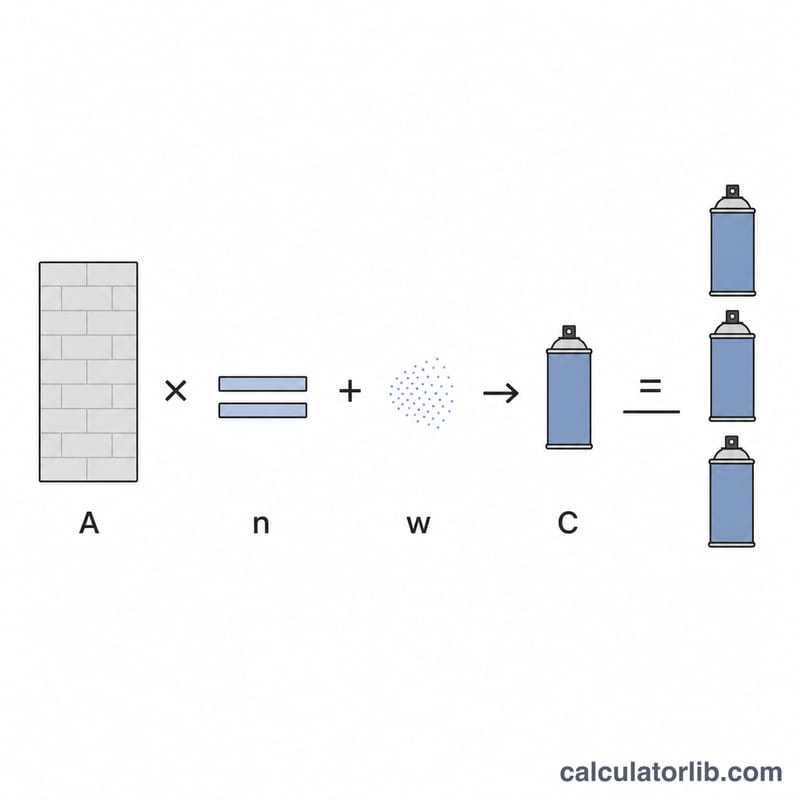
The core equation multiplies the area by the number of coats, scales for waste, then divides by the per-can coverage:
$$\text{Cans} = \left\lceil \frac{A \times n \times (1 + w/100)}{C} \right\rceil$$where \(A\) = surface area in sq ft, \(n\) = number of coats, \(w\) = waste percentage, and \(C\) = coverage per can in sq ft.
Worked Example
Suppose you have \(100\) sq ft, want \(2\) coats, allow \(10\%\) waste, and each can covers \(20\) sq ft:
$$A_{eff} = 100 \times 2 \times (1 + 0.10) = 220\ \text{sq ft}$$ $$\text{Cans} = \left\lceil \frac{220}{20} \right\rceil = \lceil 11 \rceil = 11$$You need 11 cans.
FAQ
How much area does one spray can cover? A standard 12 oz can covers roughly 15–25 sq ft for solid coverage, less for high-build colors. Check the label.
Why round up? You cannot buy part of a can, and running out mid-project risks visible color mismatches, so the result is always rounded up.
What waste percentage should I use? 10% is typical for overspray; use 15–20% for windy outdoor work or intricate shapes.