
What This Calculator Does
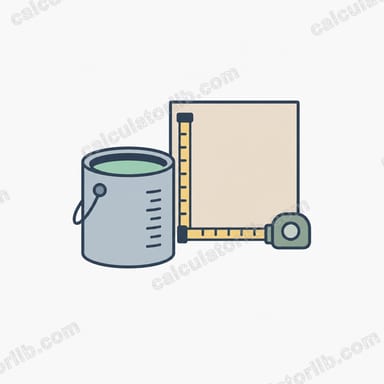
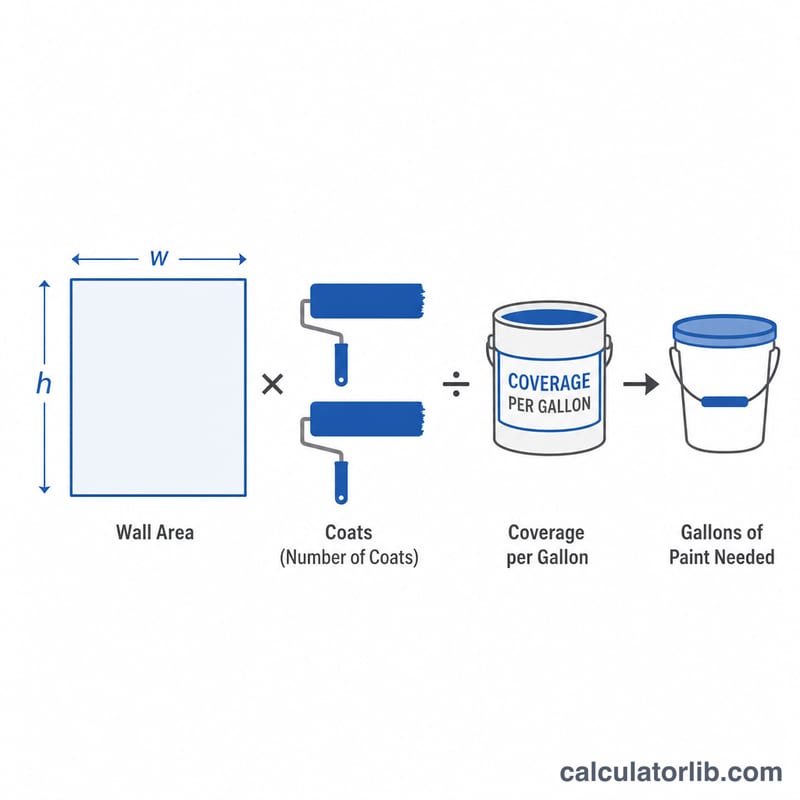
The Paint Volume & Coverage Calculator tells you how many gallons of paint to buy for a project. It multiplies your net wall area by the number of coats, then divides by the coverage a single gallon provides. Because you can't buy a fraction of a can, it also rounds up to a whole number of gallons so you don't run short mid-job.
How to Use It
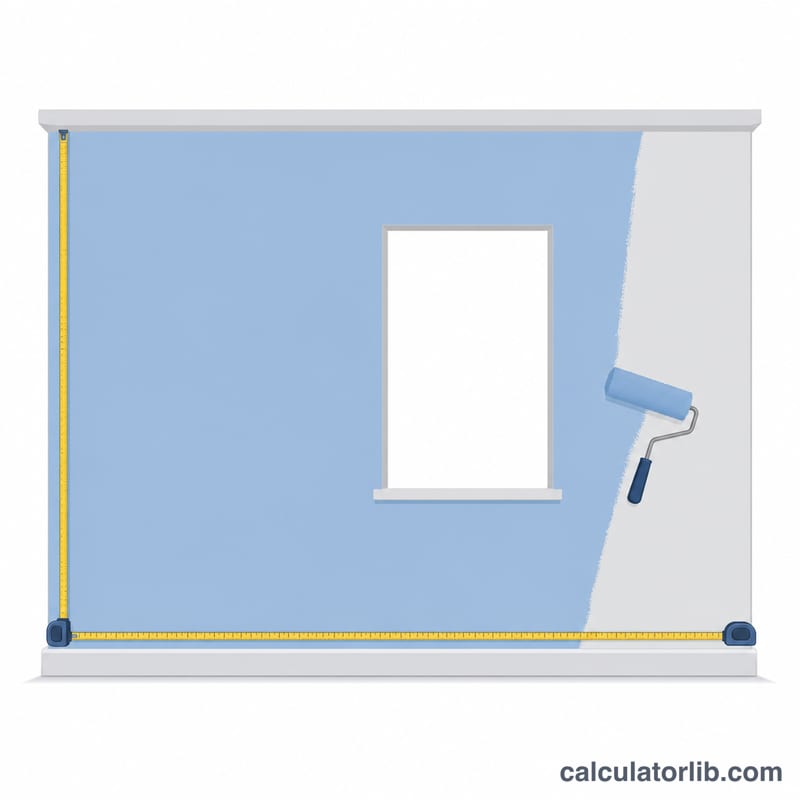
Enter the total length of the walls you're painting and their height in feet. Subtract the combined area of any doors and windows you won't paint (a standard interior door is roughly 21 sq ft and an average window about 12 sq ft). Choose how many coats you plan to apply — two is typical for good coverage — and enter the coverage per gallon listed on your paint can (most interior paints cover 300–400 sq ft per gallon).
The Formula Explained
The math is simple: $$\text{Gallons} = \left\lceil \frac{\left(\text{Length} \times \text{Height} - \text{Openings}\right) \times \text{Coats}}{\text{Coverage}} \right\rceil$$. Wall area is length times height minus openings. Multiplying by coats accounts for repainting the same surface. Dividing by coverage converts square feet into cans. Smooth surfaces use less paint; porous or textured walls use more, so lean toward the lower coverage number if unsure.
Worked Example
Suppose a room has 40 ft of wall length and 8 ft ceilings, with 30 sq ft of doors and windows. Net area = $$(40 \times 8) - 30 = 290 \text{ sq ft}.$$ For 2 coats at 350 sq ft/gal: $$(290 \times 2) \div 350 = 580 \div 350 \approx 1.66 \text{ gallons},$$ so you'd buy 2 gallons.
FAQ
How much does a gallon of paint cover? Typically 300–400 sq ft per coat on smooth, primed surfaces. Check your specific product label.
Do I need a primer coat? Yes if you're covering bare drywall, stains, or a big color change. Add it as an extra coat.
Should I round up? Always. Buying one extra gallon avoids a second store trip and gives you touch-up paint later.