
What is engine displacement?
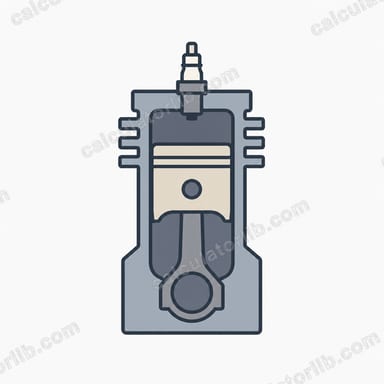
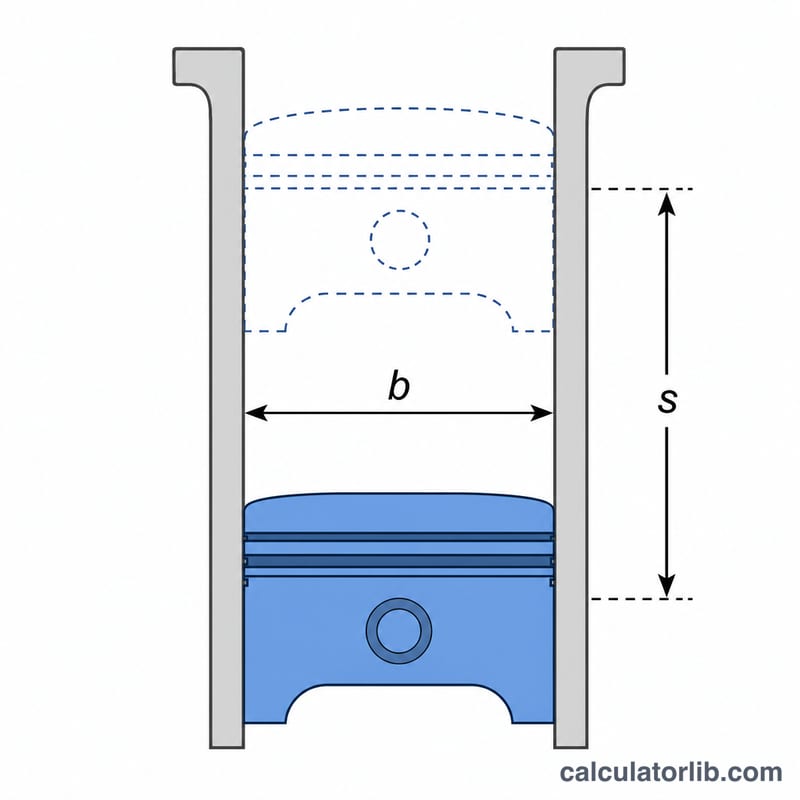
Engine displacement is the total volume swept by all the pistons inside the cylinders of an engine as they move from top dead center to bottom dead center. It is one of the most important measures of an engine's size and is commonly expressed in cubic centimeters (cc), liters (L), or cubic inches (ci). A larger displacement generally allows an engine to take in more air and fuel per cycle, which often translates to more potential power.
How to use this calculator
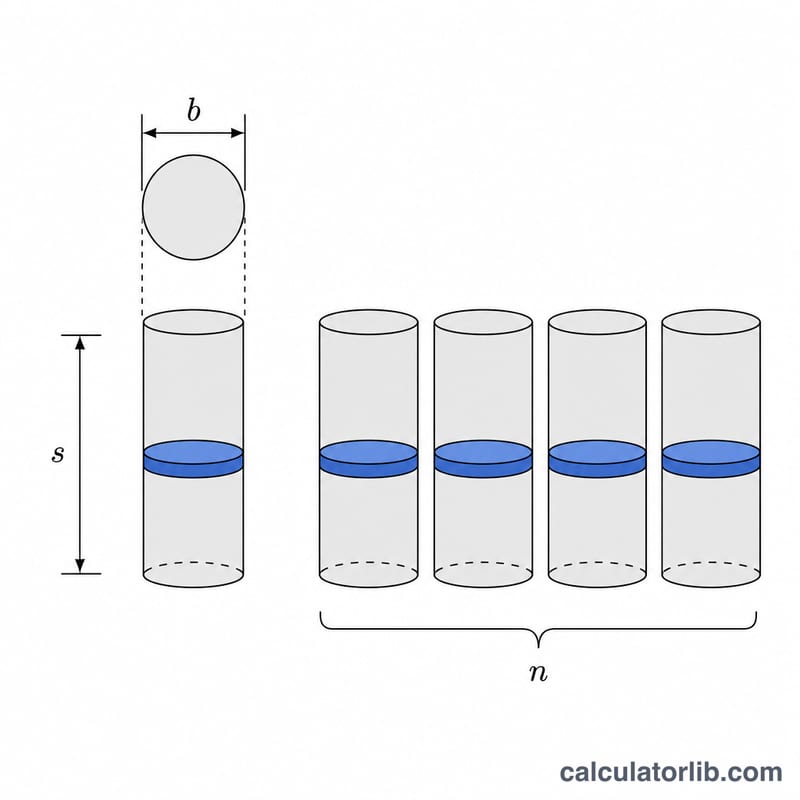
Enter three values: the bore (the diameter of each cylinder, in millimeters), the stroke (the distance the piston travels, in millimeters), and the number of cylinders. The calculator returns the total displacement in cc, then converts it to liters and cubic inches, and also shows the swept volume of a single cylinder.
The formula explained
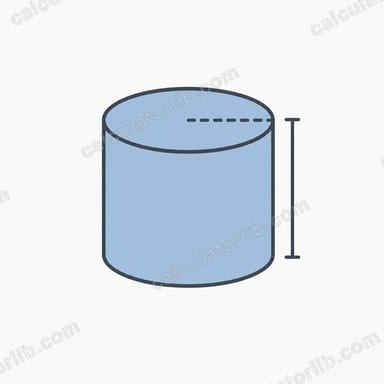
Each cylinder is treated as a circular cylinder. Its volume equals the circular cross-sectional area times the stroke length. The area of a circle is \(\pi r^{2}\), and since bore is a diameter, \(r = \text{bore}/2\), giving area \(= \frac{\pi}{4}\cdot\text{bore}^{2}\). Multiplying by stroke gives one cylinder's volume, and multiplying by the number of cylinders gives total displacement:
$$V = \frac{\pi}{4} \cdot \text{bore}^{2} \cdot \text{stroke} \cdot \text{cylinders}$$
Because bore and stroke are entered in millimeters, the raw result is in cubic millimeters, which we divide by 1000 to get cc.
Worked example
Consider a four-cylinder engine with an 86 mm bore and 86 mm stroke (a classic "square" engine). One cylinder $$= \frac{\pi}{4} \times 86^{2} \times 86 = 0.7854 \times 7396 \times 86 \approx 499{,}565 \text{ mm}^{3} \approx 499.6 \text{ cc}.$$ Four cylinders \(\approx 1998\) cc, or roughly 2.0 liters — exactly what a typical 2.0L engine measures.
FAQ
Why is bore squared but stroke not? Bore is a diameter and defines a circular area (which scales with the square of the diameter), while stroke is a single linear distance.
How do I convert cc to liters? Divide cc by 1000. So \(1998 \text{ cc} = 1.998 \text{ L}\).
What is a "square" engine? One where bore equals stroke. If stroke is longer it is "undersquare" (good low-end torque); if bore is wider it is "oversquare" (favors higher revs).