
What is the Volume to Weight Calculator?
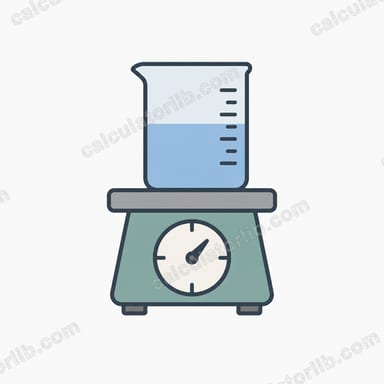
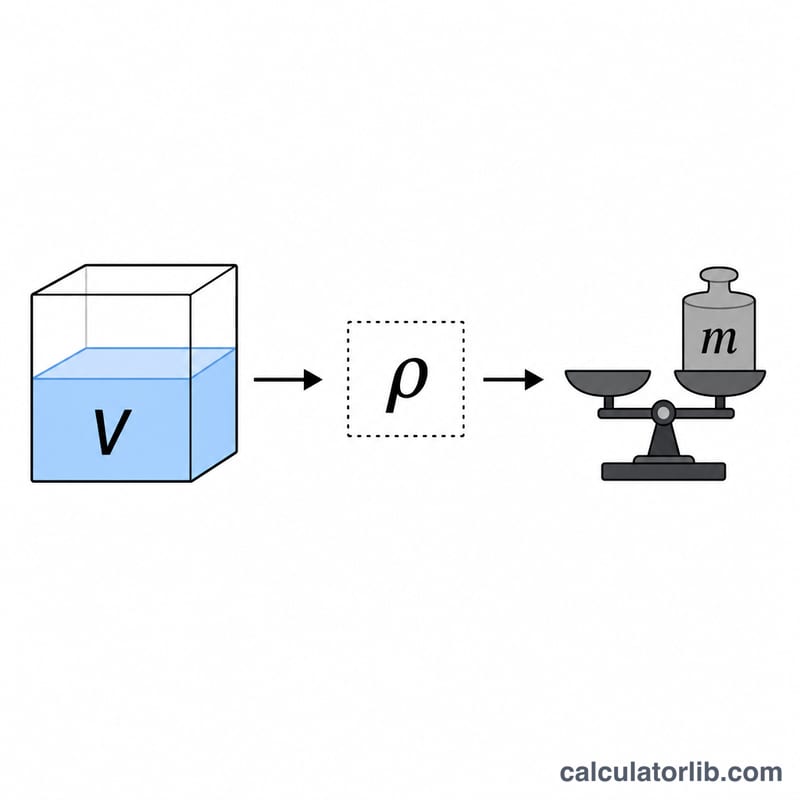
This tool converts a measured volume of any substance into its weight (mass) using the substance's density. It applies the universal relationship between mass, density and volume, so it works for water, oils, fuels, metals, chemicals and more — anywhere on Earth, with no country-specific rules.
How to use it
Enter the volume, choose the volume unit (milliliters, liters, cubic meters or US gallons), and type the density of your substance. Density can be given in g/cm³ or kg/L — they are numerically identical. The calculator returns the weight in kilograms, grams and pounds.
The formula explained
The core equation is $$m = \rho \cdot V$$ where \(m\) is mass, \(\rho\) (rho) is density and \(V\) is volume. To keep units consistent, the entered volume is first converted to liters, then multiplied by the density in kg/L to yield kilograms. Grams are kilograms \(\times 1000\) and pounds are kilograms \(\times 2.20462\).
Worked example
Take 5 liters of water, which has a density of 1.0 kg/L. $$\text{Mass} = 1.0 \times 5 = 5 \text{ kg}$$ which is 5,000 g or about 11.02 lb. Olive oil at 0.92 kg/L gives \(0.92 \times 5 = 4.6\) kg for the same 5 L.
FAQ
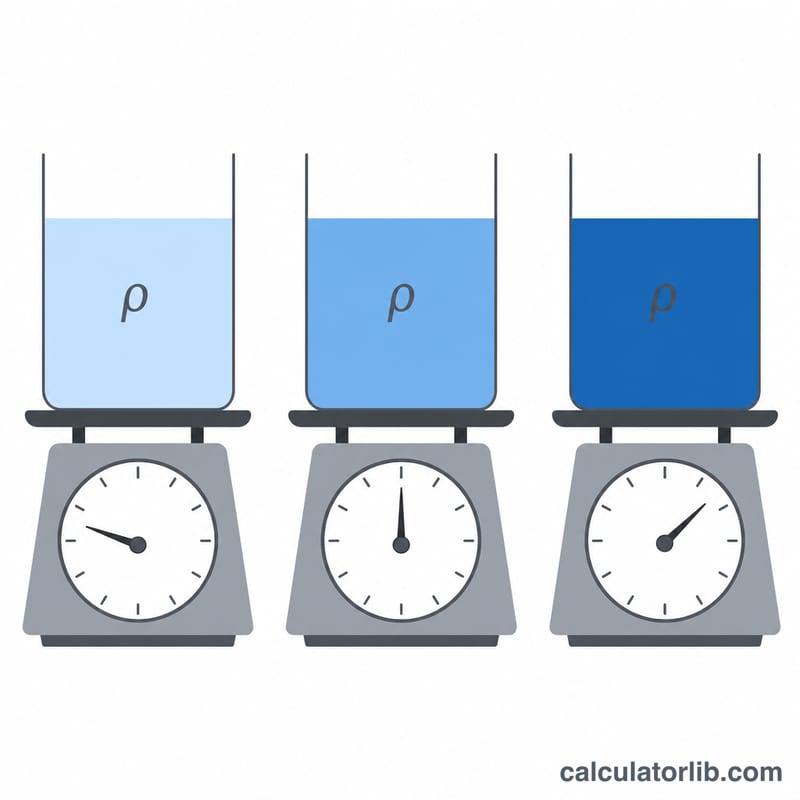
Where do I find the density? Common densities: water 1.0, milk 1.03, olive oil 0.92, gasoline 0.74, honey 1.42, mercury 13.6 (all in g/cm³ = kg/L).
Why are g/cm³ and kg/L the same number? Because 1 cm³ = 1 mL and there are 1000 mL in a liter and 1000 g in a kg, the conversion factors cancel exactly.
Does temperature matter? Yes — density varies slightly with temperature, especially for gases and liquids. Use a density value measured at your working temperature for best accuracy.