
What is the Volume to Mass Calculator?
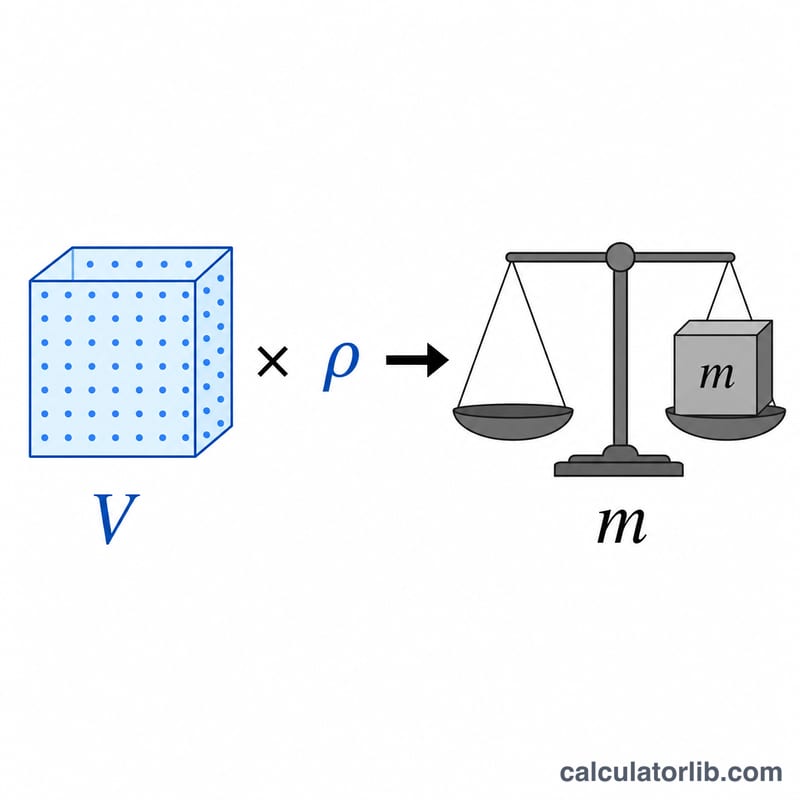
This calculator converts a known volume of a substance into its mass using the substance's density. It applies the fundamental physics relationship \(m = \rho \times V\), where m is mass, \(\rho\) (rho) is density, and V is volume. It works for any material — water, oil, metals, gases, or liquids — as long as you know the density.
How to use it
Enter the volume and choose its unit (milliliters/cm³, liters, or cubic meters). Then enter the density in kilograms per cubic meter (kg/m³). For reference, water is about 1000 kg/m³, milk ≈ 1030 kg/m³, ethanol ≈ 789 kg/m³, and steel ≈ 7850 kg/m³. The calculator returns the mass in kilograms and grams.
The formula explained
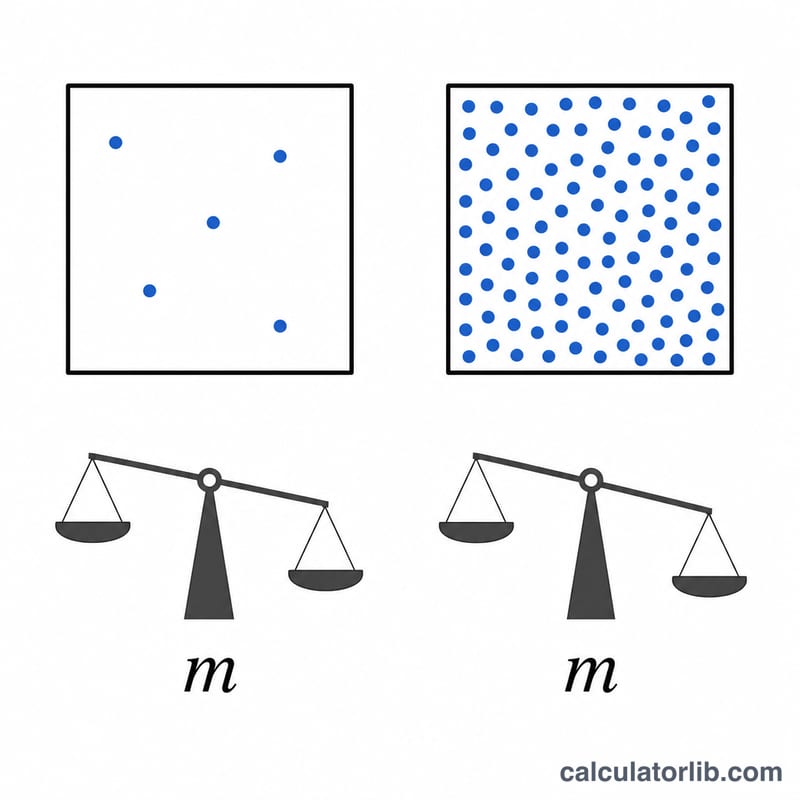
Density is mass per unit volume: \(\rho = m / V\). Rearranging gives mass: \(m = \rho \times V\). To keep units consistent, the calculator converts your volume to cubic meters (1 L = 0.001 m³, 1 mL = 0.000001 m³) and multiplies by the density in kg/m³, producing mass in kilograms.
Worked example
Suppose you have 2 liters of water (density 1000 kg/m³). Convert volume: 2 L = 0.002 m³. Then $$m = 1000 \times 0.002 = 2 \text{ kg}$$ (2000 g). For 500 mL of ethanol (789 kg/m³): 0.5 L = 0.0005 m³, so $$m = 789 \times 0.0005 = 0.3945 \text{ kg}.$$
FAQ
What units should density be in? Use kg/m³. To convert g/cm³ to kg/m³, multiply by 1000 (e.g. 0.79 g/cm³ = 790 kg/m³).
Does temperature matter? Yes — density changes with temperature, so use the density value at your working temperature for accurate results.
Can I use this for gases? Yes, as long as you supply the correct gas density at the relevant temperature and pressure.