
What Is the Mass Calculator?
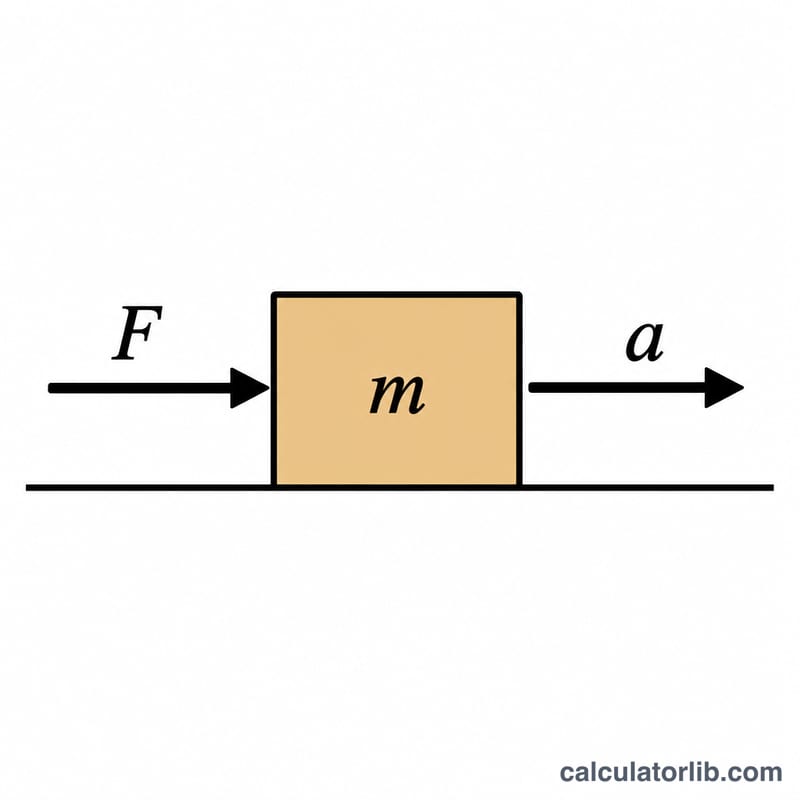
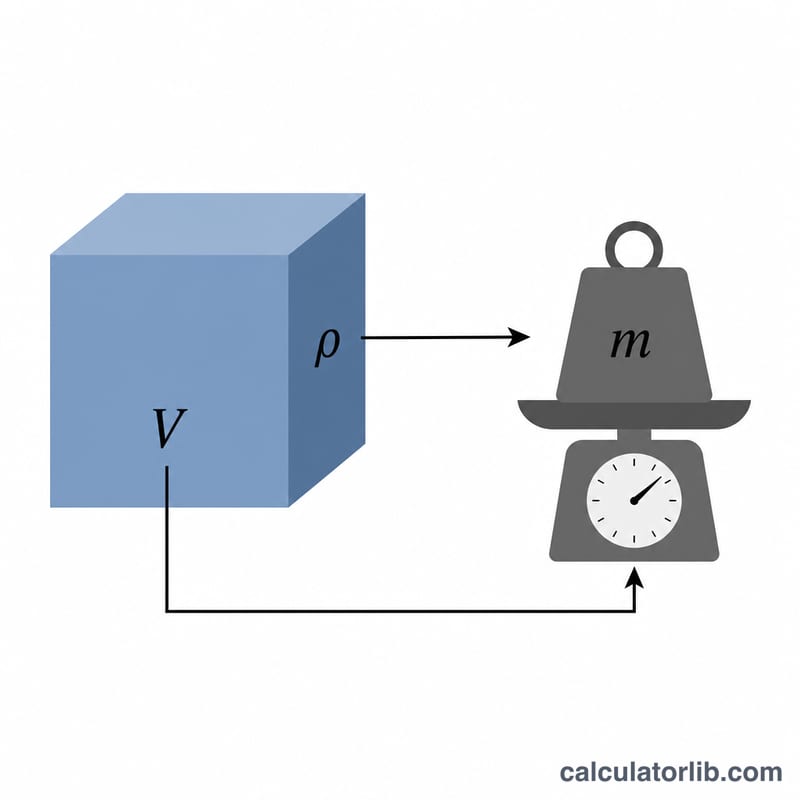
This calculator finds the mass of an object using one of two fundamental physics relationships. You can compute mass from an object's density and volume (\(m = \rho \times V\)), or from a measured force and the acceleration it produces (\(m = F / a\), derived from Newton's second law, \(F = m \cdot a\)). Both methods return the result in kilograms and grams.
How to Use It
Pick a calculation method. For the density method, enter the material's density in kilograms per cubic metre and the volume in cubic metres. For the force method, enter the applied force in newtons and the resulting acceleration in metres per second squared. The tool instantly displays the mass.
The Formula Explained
Density (\(\rho\)) describes how much mass is packed into a given volume, so multiplying it by volume (\(V\)) returns the total mass: $$m = \rho \times V$$ Newton's second law states that force equals mass times acceleration (\(F = m \cdot a\)). Rearranging for mass gives $$m = \dfrac{F}{a}$$ Consistent SI units (kg, m³, N, m/s²) keep the result in kilograms.
Worked Example
Water has a density of about 1000 kg/m³. A tank holding 2 m³ of water therefore has a mass of $$m = 1000 \times 2 = \mathbf{2000 \text{ kg}}$$ (2,000,000 g). Using the force method, if a 100 N net force accelerates a cart at 10 m/s², its mass is $$m = \dfrac{100}{10} = \mathbf{10 \text{ kg}}$$
FAQ
Is mass the same as weight? No. Mass is the amount of matter in an object (kg), while weight is the gravitational force on that mass (N). \(\text{Weight} = \text{mass} \times g\).
What density should I use? Use the material's density: water ≈ 1000 kg/m³, aluminium ≈ 2700 kg/m³, steel ≈ 7850 kg/m³.
Can I use grams and cm³? Yes, but keep units consistent — density in g/cm³ times volume in cm³ gives mass in grams. This tool assumes SI units (kg, m³).