
What Is Gravitational Potential Energy?
Gravitational potential energy (GPE or PE) is the energy an object possesses because of its position in a gravitational field. The higher you lift an object, the more potential energy it gains — energy that can be released as kinetic energy if the object falls. This calculator computes that stored energy from three simple inputs: mass, gravitational acceleration, and height.
How to Use This Calculator
Enter the object's mass in kilograms, the gravitational acceleration (use 9.81 m/s² for Earth's surface, 1.62 for the Moon, or 3.71 for Mars), and the height in meters above your chosen reference point. The calculator multiplies the three values and returns the potential energy in joules (J).
The Formula Explained
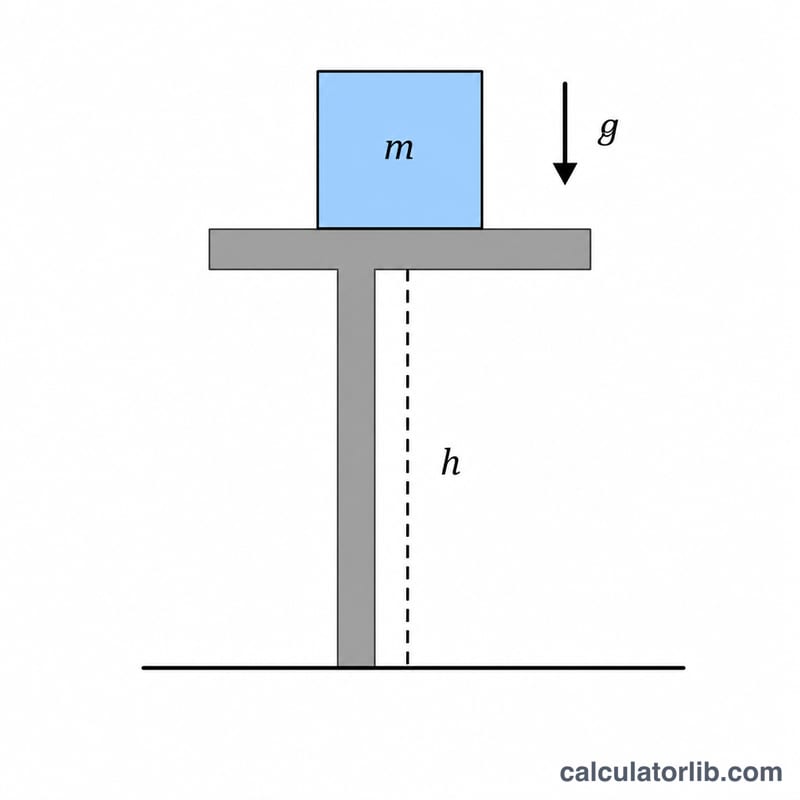
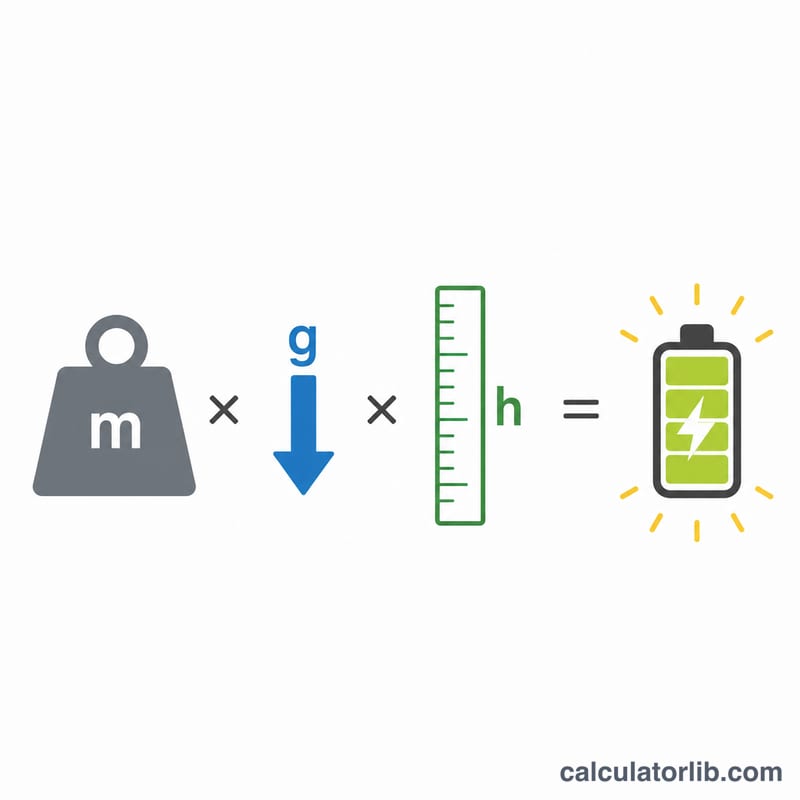
The equation is $$PE = m \times g \times h$$, where:
\(m\) = mass of the object in kilograms (kg)
\(g\) = gravitational acceleration in meters per second squared (m/s²)
\(h\) = height above the reference level in meters (m)
The result is in joules, where 1 joule = 1 kg·m²/s². Potential energy is always measured relative to a reference height, so "h" is the vertical distance above whatever point you call zero.
Worked Example
Suppose a 10 kg box is lifted 5 meters above the ground on Earth (g = 9.81 m/s²). Then $$PE = 10 \times 9.81 \times 5 = 490.5 \text{ joules}.$$ If that box were dropped, it would convert this 490.5 J into kinetic energy just before hitting the ground.
FAQ
Does the path taken affect potential energy? No. GPE depends only on the vertical height change, not the route taken to get there.
What gravity value should I use? Use 9.81 m/s² for everyday Earth calculations. Use other planetary values for off-world scenarios.
Can potential energy be negative? Yes, if the height is measured below your chosen reference point — the value simply indicates position relative to zero.