
What Is Electric Potential Energy?
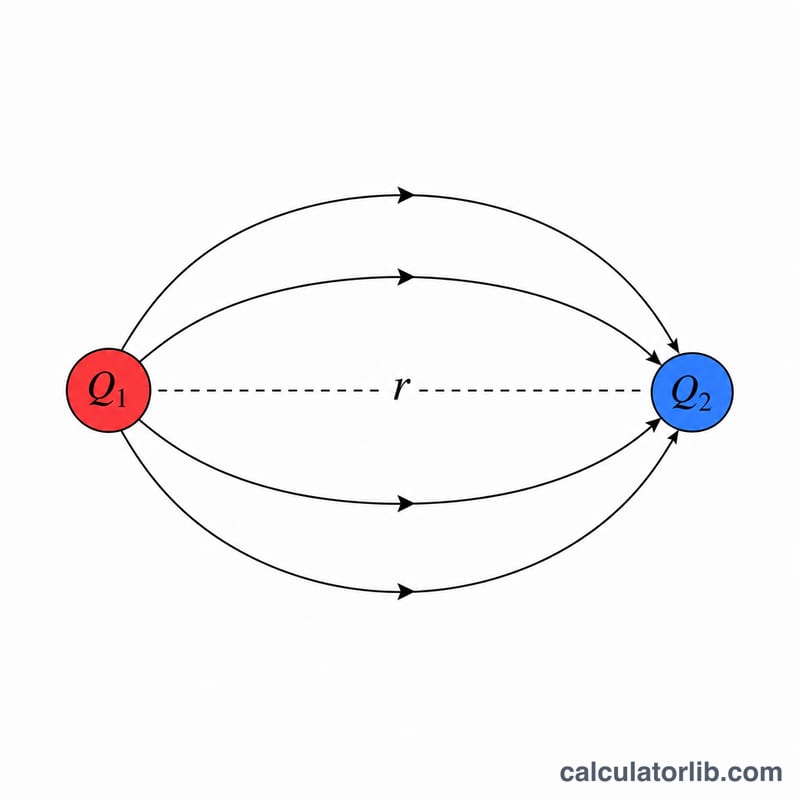
Electric potential energy is the energy stored in a system of two charged particles due to their electrostatic interaction. For two point charges Q1 and Q2 separated by a distance r, the potential energy is given by \(U = kQ_1Q_2/r\), where k is the Coulomb constant (about \(8.988 \times 10^{9}\ \text{N}\cdot\text{m}^2/\text{C}^2\)). This relationship applies universally and uses SI units: charges in coulombs (C), distance in meters (m), and energy in joules (J).
How to Use This Calculator
Enter the two charges Q1 and Q2 in coulombs and the separation distance r in meters. The calculator multiplies the charges by the Coulomb constant and divides by the distance. Use scientific notation if needed (for example, a microcoulomb is 0.000001 C). A positive result means the charges repel (like signs); a negative result means they attract (opposite signs).
The Formula Explained
$$U = k \cdot \frac{\text{Q}_1\,\text{(C)} \cdot \text{Q}_2\,\text{(C)}}{\text{r (m)}}$$
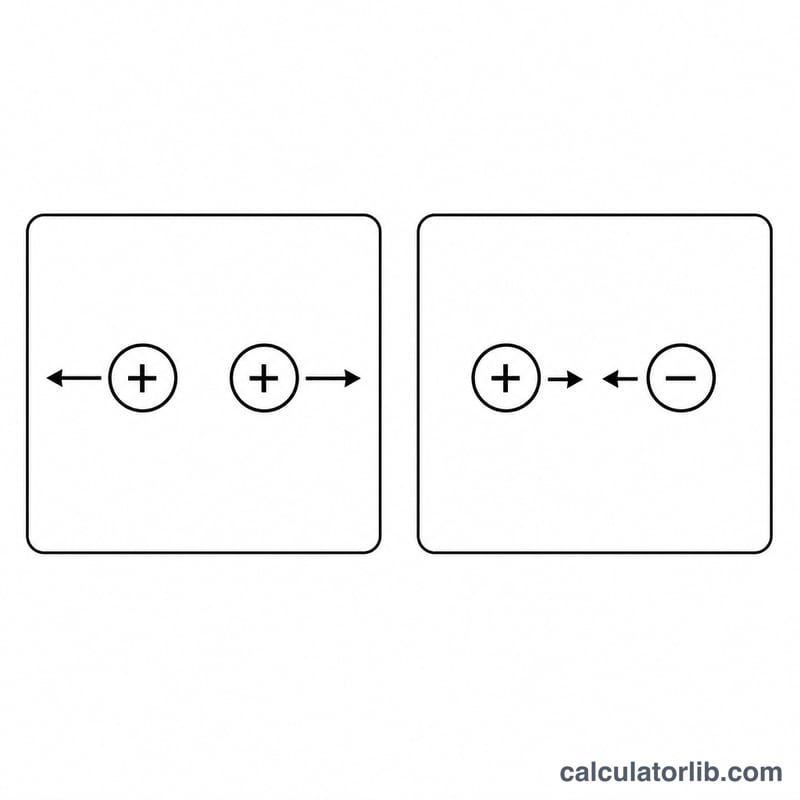
The sign of each charge matters. If both charges are positive or both negative, \(Q_1\cdot Q_2\) is positive, giving positive energy that must be supplied to push them together. If the charges have opposite signs, the product is negative and the system has lower (negative) energy, reflecting attraction. The energy approaches zero as the charges move infinitely far apart, which is the chosen reference point.
Worked Example
Suppose \(Q_1 = 1\ \mu\text{C} = 1\times 10^{-6}\ \text{C}\), \(Q_2 = 2\ \mu\text{C} = 2\times 10^{-6}\ \text{C}\), and \(r = 0.5\ \text{m}\). Then $$U = \frac{8.988\times 10^{9} \times 1\times 10^{-6} \times 2\times 10^{-6}}{0.5} = \frac{8.988\times 10^{9} \times 2\times 10^{-12}}{0.5} = \frac{0.017975}{0.5} = 0.03595\ \text{J}.$$ Both charges are positive, so the energy is positive — the configuration is repulsive.
FAQ
What does a negative result mean? Negative potential energy indicates the charges attract each other; energy would be released as they come together.
Is this the same as electric potential (voltage)? No. Electric potential \(V = kQ/r\) is energy per unit charge (volts), while this calculator returns total energy (joules) for the pair.
What if I enter r = 0? Distance must be greater than zero — the formula diverges at zero separation, so the calculator returns 0 to avoid division by zero.